| | | | | | | Presented By PublicRelay | | | | Axios Communicators | | By Eleanor Hawkins · Oct 03, 2024 | | 🌉 Hello from San Francisco, where it is unseasonably warm. I've been here for meetings and moderating duties, but I head back to D.C. tonight. Today's newsletter is 1,840 words, a 7-minute read. | | | | | | 1 big thing: CEOs mum one year later | | |  | | | Illustration: Annelise Capossela/Axios | | | | Hundreds of business leaders spoke out following the Hamas-led terrorist attack on Israel last October. However, as the one-year mark approaches, most plan to stay quiet. Why it matters: The dynamics in the Middle East have grown more complex and polarizing, making business leaders more reticent to comment than a year ago. State of play: Yale School of Management kept a running list of which companies spoke out after the attack, denounced antisemitism, or expressed support and solidarity with Israel. - Big brands like Amazon, Apple, GE, Starbucks, JPMorgan and Walmart issued statements following the attacks.
- Now, internal messages focused on mental health benefits are all that's likely — if anything.
Zoom in: A recent pulse survey conducted by Gravity Research found that more than half of executives (61%) do not plan to acknowledge the anniversary of the attacks. Another 30% are unsure and still could be deciding. - The remaining 9% plan to engage on the anniversary but only through internal statements or events.
- Notably, none plan to make external statements, emphasizing the desire to not engage publicly.
The big picture: Corporate America's tolerance for workplace activism reached a boiling point earlier this year, after Google fired 50 employees for pro-Palestinian protests that violated its workplace code of conduct. What they're saying: "It's more straightforward to condemn a terrorist attack than it is to comment on a year-long war," says Joanna Piacenza, vice president of thought leadership at Gravity Research. - "On top of that, we're also seeing corporations engage less in political, social, cultural issues than they had in the past four or five years, and brands are just being a little bit more intentional on if and when to weigh in on things. So, it makes sense that our data is really pointing to more minimal engagement on the anniversary."
Between the lines: While companies might not plan to speak to Oct. 7 directly, they are looking at pre-planned social media posts, marketing campaigns and internal messaging scheduled for next week. - "The most important thing is to recognize the sensitivity of the day and how it might resonate with or impact all of your stakeholders," says Sandy Lish, principal and co-founder of The Castle Group.
What to watch: Given the heightened sensitivities around the ongoing conflict, employees are still likely to discuss it among themselves, across social media, and in company-wide resource groups, Slack channels and internal message boards. Share this story |     | | | | | | 2. Universities embrace "neutrality" ahead of Oct. 7 | | |  | | | Illustration: Shoshana Gordon/Axios | | | | American universities are drawing a hard line when it comes to engaging around geopolitics ahead of Oct. 7. Why it matters: The campus-wide activities and protests planned for next week will put this policy of neutrality to the test. Catch up quick: More universities — from Ivys like Harvard, Cornell and UPenn to big state schools like the University of Virginia, Washington State, University of Texas and University of Michigan — have committed to remaining neutral on current events. - This means they will not comment on social or political issues with the hope it "frees students and faculty to develop and articulate their own individual ideas and opinions," according to the American Council of Trustees and Alumni.
Reality check: University leadership might not have a choice, especially if protests escalate ahead of the Oct. 7 anniversary. - "Neutrality only works until something happens on your campus," says Lish of The Castle Group.
- "As soon as a protest goes awry or something hurtful or dangerous happens to someone on campus, or a social media post by an employee or a student goes viral, neutrality is out the window. So neutrality is fine, but when it starts to affect your community, you have to comment," she added.
What they're saying: "The mantra now is one of much more caution," said one long-time higher ed communications executive. - "A lot of institutions were looking to just get through to the next day" during the protests last spring, the executive said.
- "Now there is a greater understanding that no matter what you do, you are going to get blasted by at least one of your stakeholders."
Context: Students protesting the Israel-Hamas war in the spring demanded their universities divest from companies that do business in Israel or aid the country's war effort. - Some schools seeking to defuse tensions and shut down encampments before commencement pledged to revisit the issue in the fall.
- But now that the new school year is underway, the effort has largely been unsuccessful, as few universities have moved toward divestment. Some boards, like that of Brown University, still plan to vote on the issue.
Zoom in: Since the spring, many universities have updated protest policies. As such, most communications coming from university leadership will focus on "creating space" for various viewpoints and reminders of campus protocols. Yes, but: The visuals of tense protests created across campuses could continue to damage the reputation of these universities, regardless of their neutral stance. - "You can't keep it out of your campus, so it's critical to have policies, enforce the policies and communicate about what those policies are, so that there's no surprises and there's no having to figure things out on the fly," says Lish.
What to watch: It's not just the conflict in the Middle East. Colleges also must navigate the intense divide in the upcoming U.S. presidential election. - University leaders who pledge neutrality might also get caught in the hot-button issue of voting.
- "Whether it's serving as a polling location or organizing student voter registration, college campuses have always been a bit of a battleground for voting, which is another issue to watch," added the communications executive.
Share this story. | | | | | | | | 3. Sustainability is a winning corporate issue | | | 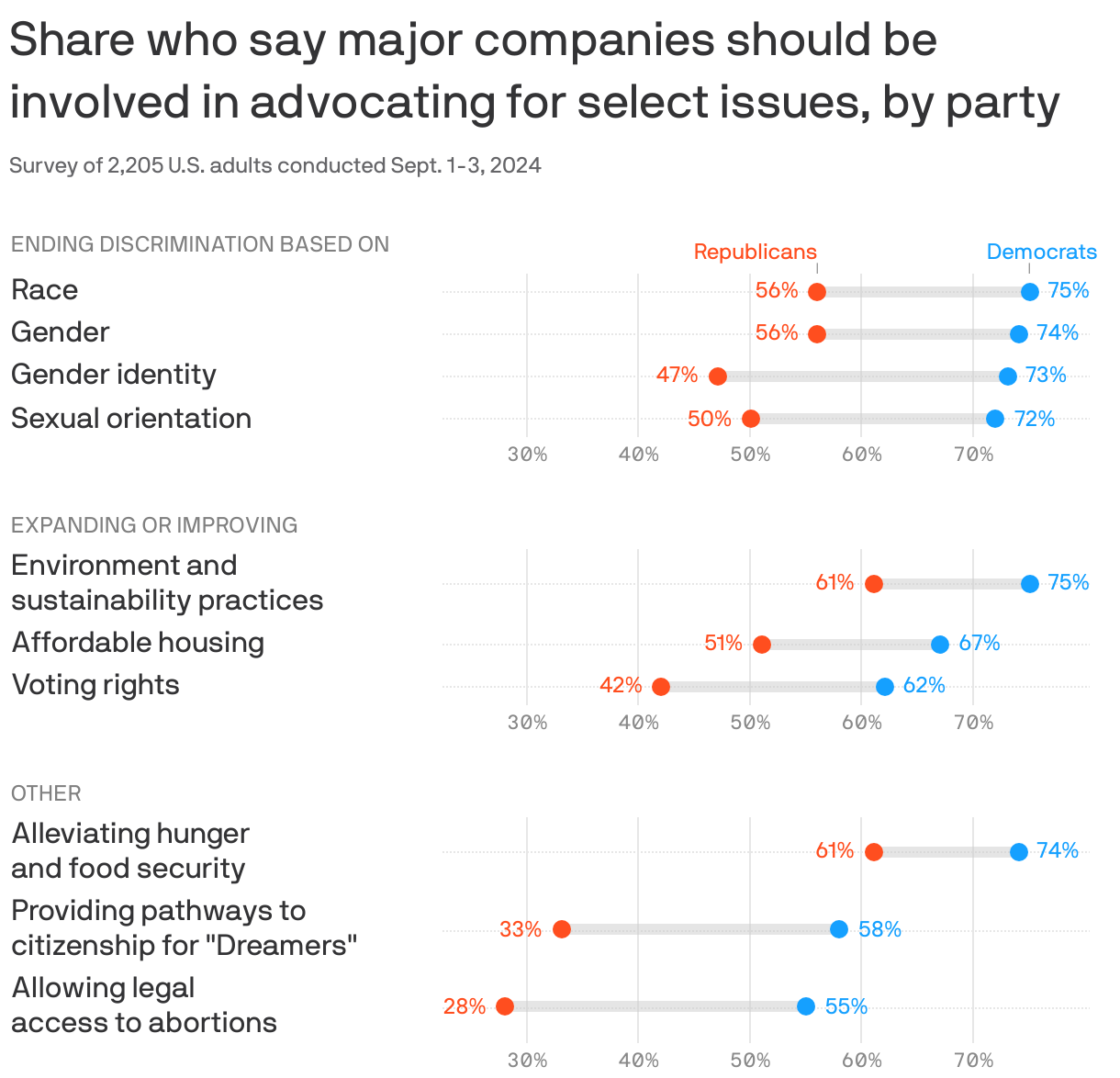 Data: Public Affairs Council Pulse Survey; Chart: Jacque Schrag/Axios Despite "anti-woke" rhetoric making recent headlines, support for corporate involvement in social and political issues has increased in the past year, according to a new pulse survey from the Public Affairs Council. Why it matters: There are some issues that both Democrats and Republicans want companies involved in. By the numbers: Of the 12 social issues listed in the 2024 pulse survey, 11 saw increases in support for corporate engagement compared to years past. - Voters from across the aisle overwhelmingly believe companies should advocate for issues like sustainability, ending discrimination and alleviating hunger.
- However voters remain split when it comes to abortion access and creating pathways to citizenship.
Zoom in: When you look across generations, Gen Z through Baby Boomers agree that companies should expand or improve environment and sustainability practices. - Generations are most at odds when it comes to allowing legal access to abortions, with millennials agreeing the most (45%) and Boomers agreeing the least (24%).
What they're saying: "There are a handful of companies that have backed away from being involved in these issues, but the vast majority are as committed as they've ever been... And the data shows that people don't expect or want them to back away from it," says Public Affairs Council president Doug Pinkham. - Even so, companies aren't bragging about their involvement in political or social issues as much as they once were, Pinkham added.
💭 Eleanor's thought bubble: Pulse surveys can provide helpful context for a specific moment in time, but the pulse of the nation is in constant flux. - As such, before companies engage around these issues, comms teams must make sure it's tied to the business — its mission, values or people — and accompanied by action.
Go deeper | | | | | | | | A message from PublicRelay | | CEOs have become less effective for their companies' reputations | | | 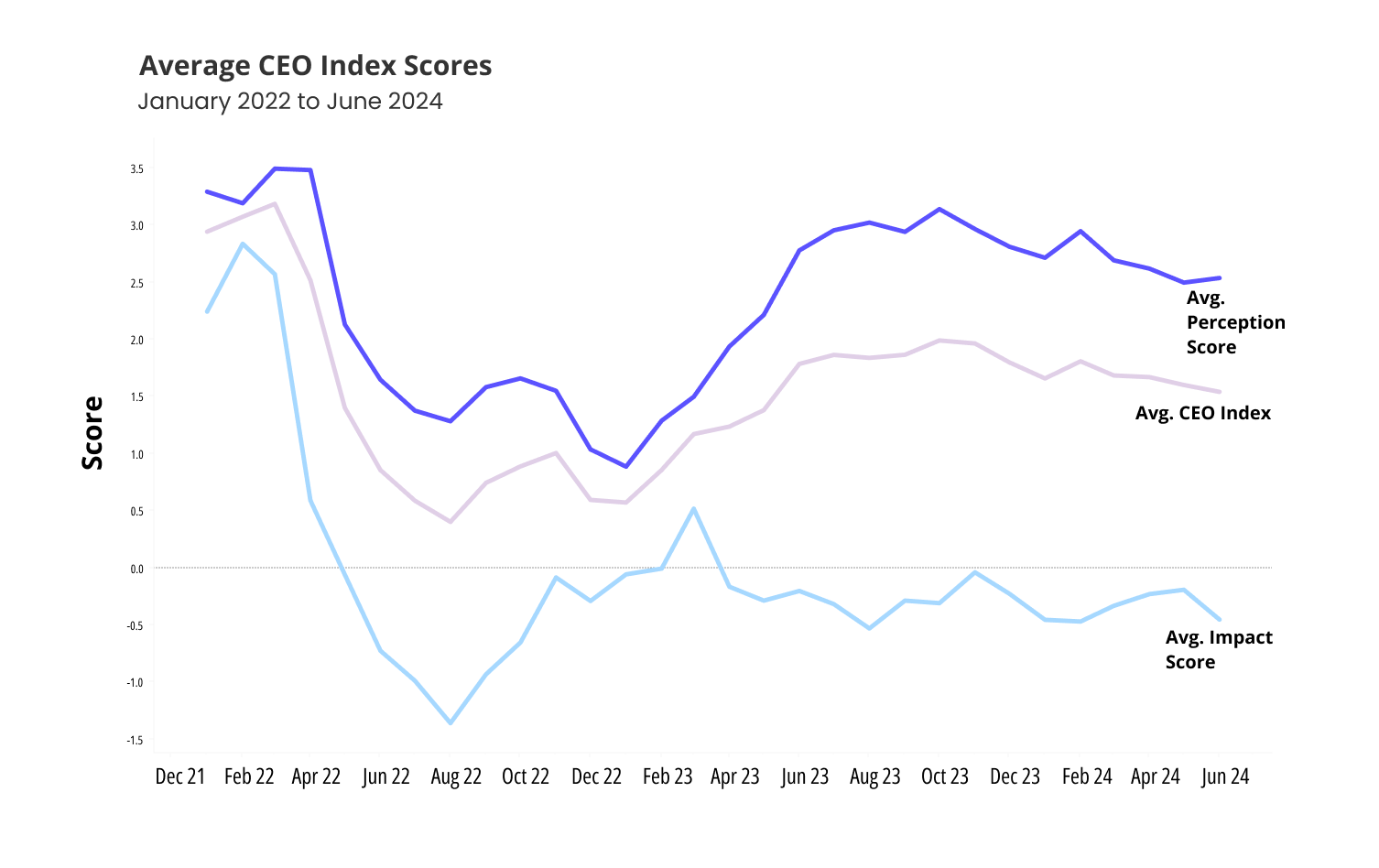 | | | | The gap between how a CEO is perceived in the media and how they impact their company's media reputation is widening. Take note: Understanding your CEO's unique combination of perception and impact can help guide your communication strategy to maximize their impact as a brand asset. Learn more. | | | | | | 4. Locals turn to legacy media as hurricane rumors swirl | | By Michael Graff and Sara Fischer | | | 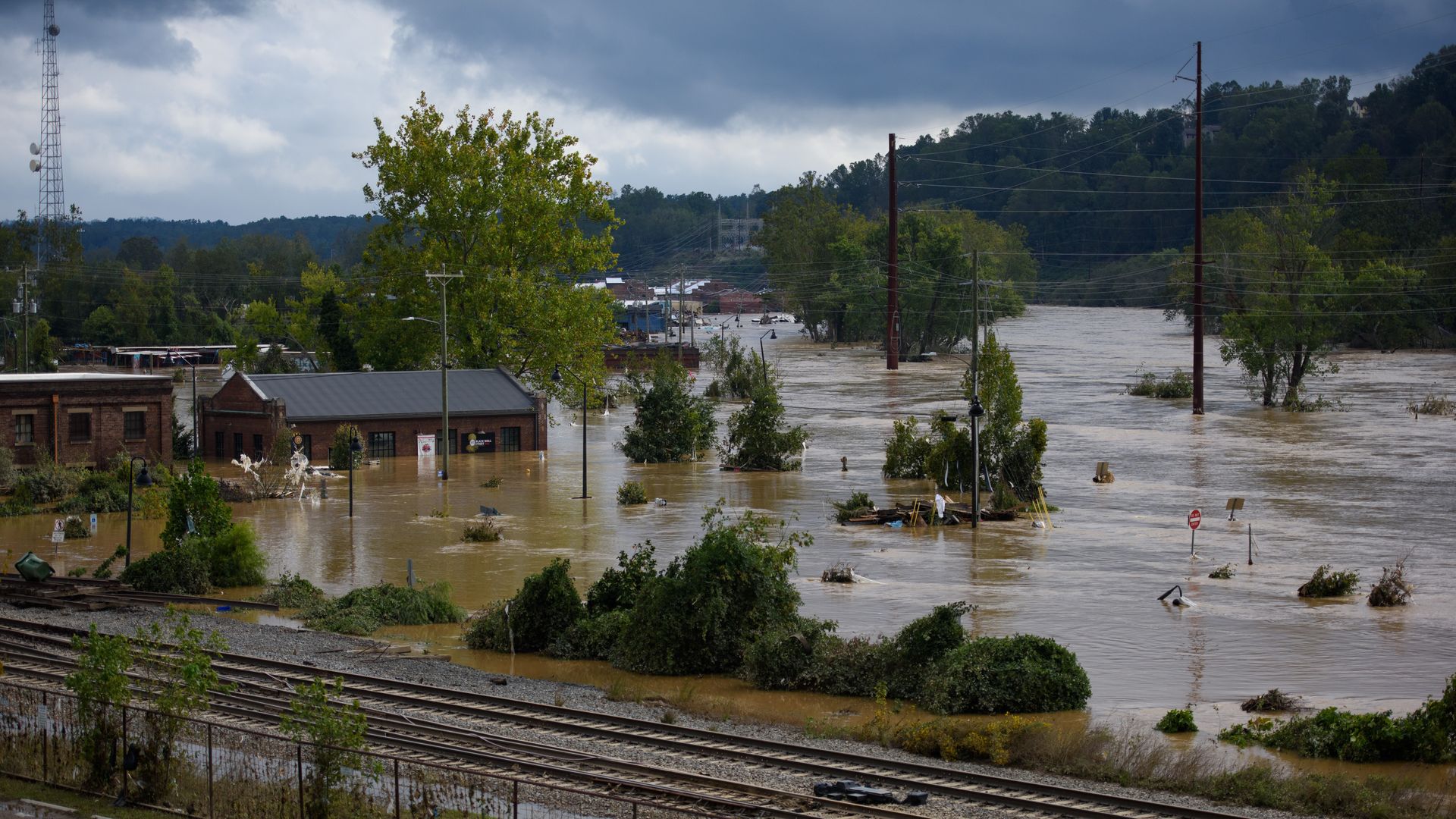 | | | Heavy rains from Hurricane Helene caused record flooding and damage on Sept. 28 in Asheville, N.C. Photo: Melissa Sue Gerrits/Getty Images | | | | Legacy media — especially radio — have become a vital information lifeline in the chaotic aftermath of Hurricane Helene. Why it matters: Power outages, lost cell signals and hundreds of road closures have stifled on-the-ground reporting. This gives way to falsehoods that can spread quickly online — creating an urgent need to correct them. - Local reporters are working overtime to correct the record.
- In many cases, they're filling an information void left by local government officials who were caught off guard by the severity of the storm's flooding in mountainous regions, especially around Asheville, North Carolina.
Driving the news: Fact-checkers and local reporters have debunked dozens of viral photos and videos that were doctored or posted out of context, including an AI-generated video of a tornado looming over a local shopping mall and others of first responders rescuing deer in boats. - They're also helping to debunk online rumors about the safety of drinking water and the security of critical dams.
State of play: Even with minimal resources, local media has proved critical in providing real-time updates to locals about everything from road damage to trash services and rescue operations. - Local radio has become a lifeline for people on the inside dealing with poor cell signals and no electricity reach those on the outside.
- Blue Ridge Public Radio and News Radio 570 WWNC are taking calls live on the air from people hoping to connect with loved ones.
Keep reading ... How to support western N.C. communities devastated by Helene | | | | | | | | 5. Communicator Spotlight: Una Pulizzi of Kyndryl | | |  | | | Photo illustration: Axios Visuals. Photo: Courtesy of Kyndryl | | | | Una Pulizzi joined IT services company Kyndryl as global head of corporate affairs shortly before its spinoff from IBM in 2021. - Why it matters: Since then, Pulizzi and her team have been working to execute the new strategy, establish a sense of corporate culture and build the brand.
🗣️What she's saying: "We as corporate affairs professionals are really focused on bringing context to the company," she told Axios. - "We are well aware of what's going on in the policy regulatory space. We're very aware of external polling, where trust is or where our own employees are. We are equipped with a perspective that enables us to help shape reputation, build and protect the reputation of the company."
📍How she got here: Earlier in her career, Pulizzi worked for the U.S. Treasury Department before holding various communication and corporate affairs roles at Citi and the World Bank. - Most recently, Pulizzi served as global director of public affairs at GE before joining Kyndryl.
🏗️ How it's structured: Pulizzi reports to Kyndryl CEO Martin Schroeter and oversees the global team responsible for external, internal and financial communications, government affairs and policy, sustainability and social impact — including the Kyndryl Foundation. 🤖 Trend watch: How corporate affairs teams can take advantage of generative AI to work more efficiently. 🎻 De-stress routine: Pulizzi is a classically trained violinist who began playing at 3 years old. - "I was one of those Suzuki kids," she says, referring to the Japanese method of learning music. "I've continued [playing] and it's an outlet that's a little different."
🧠 Best advice: Get into the motion of speaking up and challenging yourself. Share this spotlight | | | | | | | | 6. 🧮 Some stats to-go | | | | Employees remain confused when it comes to their organization's goals, vision and stances on societal issues, according to a new study from USC Annenberg School for Communication and Journalism and Staffbase. By the numbers: A survey of 1,007 U.S. adults from companies with 5,000 or more employees found that a majority (54%) are unfamiliar with their organization's goals and visions. - 70% don't understand their company's stance on social issues, the report finds. This could be due in part to the walkbacks, pledges for neutrality and rebranding of ESG strategies.
- And 71% of employees report being unsatisfied with the quality of internal communication they receive.
| | | | | | | | A message from PublicRelay | | Geopolitical conversations are shaping company reputation | | | 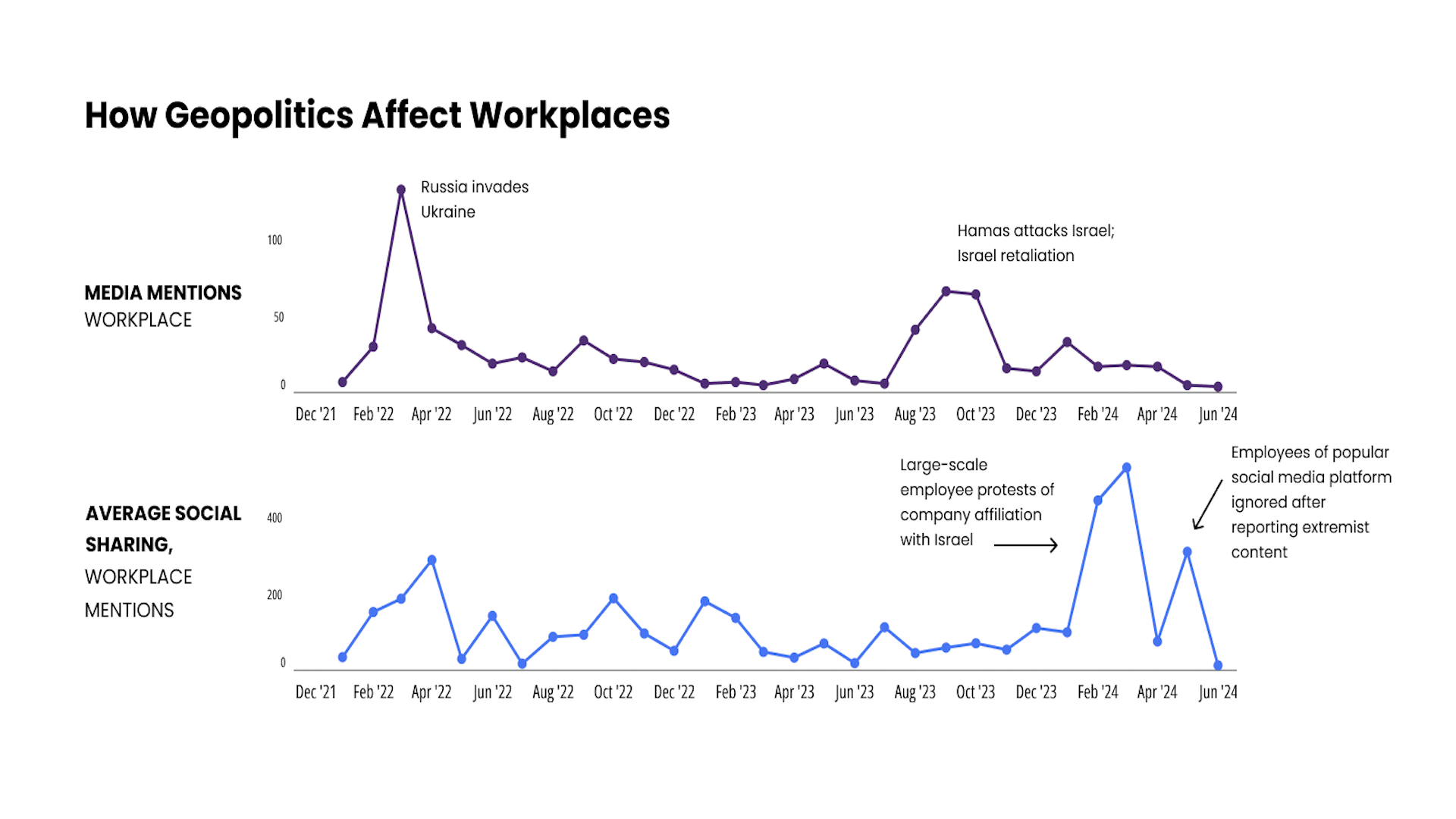 | | | | Employees are speaking to the press about geopolitical issues, and it's driving outsized attention. Here's the deal: Companies must engage employees early on these topics to contain external reputation fallout. Explore how geopolitics impact corporate reputation. | | | | | | A message from Axios HQ | | 3 free Smart Brevity workbooks | | |  | | | | As organizations grow, communication can break down. This impacts alignment, productivity, and your bottom line. Smart Brevity breaks through and keeps teams engaged with: - 40% shorter emails, on average.
- 100% of the insights they need.
We boiled down the basics into three workbooks. Get the bundle. | | | | Thanks for reading! And thanks, as always, to editors Nicholas Johnston and Kathie Bozanich. ✏️ Tell your friends and colleagues to subscribe. |  | Your essential communications — to staff, clients and other stakeholders — can have the same style. Axios HQ, a powerful platform, will help you do it. | | | |


0 comentários:
Postar um comentário