By Edson Caldas, Newsletter Editor |
|
|
Hello, All eyes are on the International Court of Justice this week. The ICJ began hearings on the legal obligation of countries to fight climate change and the consequences for states contributing to global warming. Advisory opinions of the World Court are non-binding, but they carry a lot of significance both legally and politically. The court's eventual opinion on climate change could influence litigation worldwide. Today, we break down what to expect. My colleague Sharon Kimathi will be back running the Sustainable Switch on Thursday. (You can still find me if you subscribe to the Reuters Daily Briefing newsletter.) Also on my radar today: |
|
|
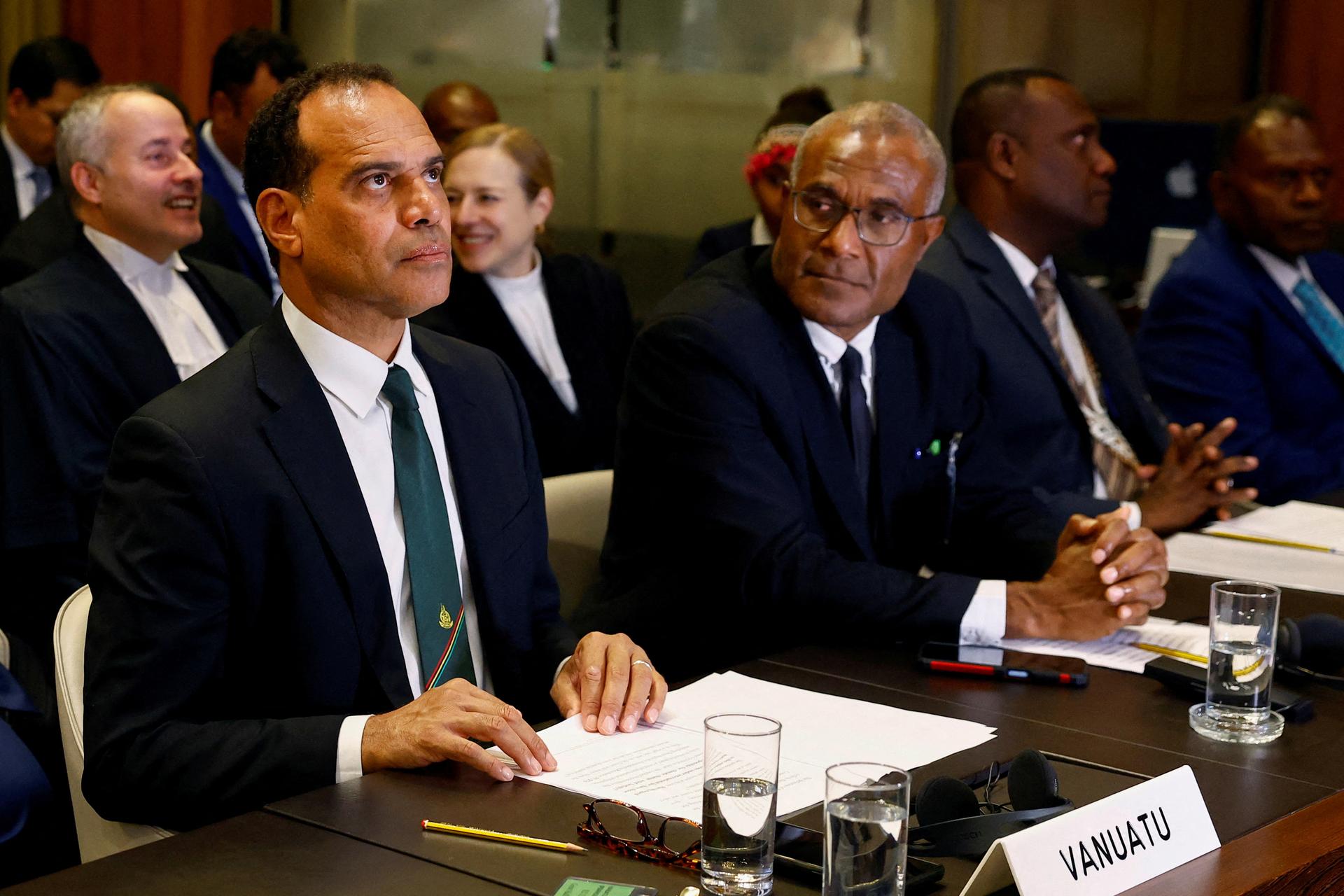
Ralph Regenvanu, Vanuatu's special envoy for climate change and the environment, and Arnold Kiel Loughman, the country's attorney-general. REUTERS/Piroschka van de Wouw |
More than 100 countries and international organisations will present arguments to the ICJ during two weeks of proceedings. Vanuatu, one of the small island states that has spearheaded the effort to get the court to give the so-called advisory opinion, was the first to give its views. It urged the ICJ to recognise the harm caused by climate change in its judgment. "We find ourselves on the front lines of a crisis we did not create, a crisis that threatens our very existence," Ralph Regenvanu, Vanuatu's special envoy for climate change and the environment, told the court. Regenvanu said there was an urgent need for a response to climate change that was rooted in international law rather than politics. The court will also hear from the world's top two emitters of greenhouse gases, China (today) and the United States (tomorrow). Oil producer group OPEC will give its views too. Experts say the court's opinion, which is expected to be delivered in 2025, will probably be cited in climate change-driven lawsuits in courts from Europe to Latin America and beyond. |
|
|
The ICJ hearings began just after countries negotiating a global treaty to curb plastic pollution failed to reach agreement. As we discussed in Friday's edition of this newsletter, the talks in South Korea were moving slowly, and lingering divisions were casting doubts on whether a final agreement would be reached. In the end, more than 100 nations wanted to cap production, but a handful of oil producers were prepared only to target plastic waste. The hearings also take place a week after developing nations denounced as insufficient an agreement reached at the COP29 summit in Azerbaijan. Countries will provide $300 billion in annual climate finance by 2035 to help poorer nations cope with climate change. Regenvanu said it was imperative fossil fuels be phased out and more money provided to poorer nations. "We're not seeing that in the outcome of the COPs," he told Reuters. "We are hoping (the ICJ) can provide a new avenue to break through the inertia we experience when trying to talk about climate justice," Regenvanu added. Keep an eye on Reuters.com to see how it goes. |
A general view of the dried Cogoti reservoir in Chile in March. REUTERS/Ivan Alvarad |
- COP16: Global talks on land use and desertification have kicked off in Riyadh. The U.N. executive overseeing the meeting told Reuters that restoring the world's degraded land and holding back its deserts will require at least $2.6 trillion in investment by the end of the decade.
- Panama Canal: Dozens of towns could be drowned by a massive man-made reservoir designed to ensure the viability of the canal in the face of a changing climate. Local residents are divided.
- Possible ethical breaches: Norway's $1.8 trillion wealth fund's ethics watchdog will next year investigate shoe manufacturers, cryptocurrency companies and casino and gambling firms, which could lead to the fund making divestments.
- Deep-sea mining: In more news from Norway, a small leftwing environmentalist political party succeeded in blocking plans to mine the sea bed at the bottom of the Arctic. On Monday, shares in Norwegian seabed mining start-up Green Minerals fell by 36%.
- Volkswagen: Almost 100,000 workers joined walkouts at the company's German plants in protest at management plans to cut wages and even close sites at Europe's biggest carmaker, the IG Metall union said, threatening further industrial action.
- Amazon: The e-commerce giant plans to pilot a new carbon-removal material for data centers, which are at risk of worsening emissions from artificial intelligence systems they power, a startup behind the deal said. In a twist, AI itself is what designed the carbon-filtering substance.
| |
|
Barbados has completed the world's first 'debt-for-climate' swap aimed at raising money to help the Caribbean island build resilience in its water systems to the damaging effects of climate change. Getting money flowing to projects from water sanitation to drought-resistant crops is challenging with many projects costly to implement and low in returns, Sustainable Finance Reporter Virginia Furness writes. Here is a list of countries which have completed debt swaps for nature and climate in recent years. |
Products obtained from prickly pears. REUTERS/Guglielmo Mangiapane |
Today's spotlight shines a light on the Opuntia Ficus, better known as the cactus pear. A startup founded by a former telecoms manager sees that plant as a solution for growing threats to agriculture in Italy's arid south. Andrea Ortenzi and four friends started their company, called Wakonda, in 2021. They are convinced the hardy and versatile cactus pear, otherwise called the prickly pear or, in Italy, the Indian fig, can be a highly profitable solution yielding a raft of products. Wakonda's business model discards the fruit and focuses instead on the prickly pads, which are pressed to yield a juice used for a highly nutritious, low-calorie energy drink. The dried out pads are then processed to produce a light flour for the food industry or a high-protein animal feed. |
|
|
Sustainable Switch was edited by Susan Fenton. |
Sustainable Switch is sent three times a week. Think your friend or colleague should know about us? Forward this newsletter to them. They can also sign up here. Want to stop receiving this email? Unsubscribe here. To manage which newsletters you're signed up for, click here. Terms & Conditions and Privacy Statement |
|
|
|








0 comentários:
Postar um comentário