| Welcome, Weekenders! In this newsletter: |
| • The Big Read: Jensen Huang's precarious balancing act between Trump and China |
| • The Top 5: The fanciest fitness memberships |
| • Plus, our Recommendations: A forgotten horror; the mighty Sahara; and an internet star's subtle-enough sitcom |
| |
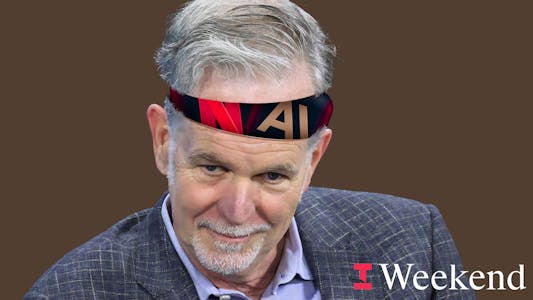
| Anthropic has a shiny new addition I can't stop thinking about: Reed Hastings, who is joining the AI startup's board. I wonder if his arrival might hold greater significance than we might think. |
| Previously, Hastings has held few corporate board seats beyond the one he retains at Netflix after stepping down as CEO a couple years ago. Aside from Netflix, he's also currently on Bloomberg LP's board, and in the past, he sat on Microsoft's (2007 to 2012) and Facebook's (2011 to 2019). |
| Plenty of bigwigs like Hastings treat board seats like country club memberships, accumulating a small stack of them, and view their directorships more or less with the same seriousness as they would an afternoon scramble. Hastings, by contrast, seems more mindful about the boards he picks, suggesting he tends to take a seat when he thinks he might actually have a worthwhile perspective to add. (He wouldn't comment for this column.) |
| Hastings has plenty of experience with two elements Anthropic needs to figure out (and combining them might really, really help it draw even with OpenAI): video as well as the task of branding a consumer subscription business. Obviously, Hastings did quite well at both while running Netflix. |
| In the AI market right now, Google's Veo and OpenAI's Sora have assumed leading positions. (There's also Runway, but that's more for professionals, as we've previously explained.) Meanwhile, Anthropic is noticeably absent. |
| The branding problem, meanwhile, is a universal concern within AI. How is Anthropic different from OpenAI? How is it different from Gemini? Even the most enthusiastic denizens of Silicon Valley would struggle to come up with a cogent answer. The average person on the internet certainly couldn't, and that's exactly who Anthropic needs to win over. Reed, a little help there! (Here's a freebie idea: I think one of the most interesting things Anthropic could build is an advanced version of the interactive entertainment system that powered the "Bandersnatch" episode from "Black Mirror." The concept for a choose-your-own-adventure plot was clever, though obviously limited by how much content the filmmakers could produce. Think what it could be like powered by generative AI…) |
| From his time on Facebook's board, Hastings must also have a keen perspective on the risks of warp-speed growth and of the proliferation of an entirely new form of the internet. But surely safety-focused Anthropic wouldn't need his advice on that subject. |
| A Deal for Good Behavior |
| After nearly 20 years in existence, Grammarly, the maker of spell-check and writing-assistance software, is lining up to take a big gulp of venture capital. The firm passing over the straw is General Catalyst, which plans to give Grammarly $1 billion in financing. |
| The details on the transaction are a little confusing—well, novelish. Unlike most venture deals, this one won't give General Catalyst any equity. The firm's return is based on how much revenue Grammarly can generate from the capital. So it's a bit like what happens on "Shark Tank," I guess. |
| Nonetheless, it says something about how creative mature venture firms need to get these days to find returns (more on General Catalyst's efforts). But honestly, I actually really love the idea of revenue-based goals being more of a thing in venture: That would force founders and venture capitalists alike to have more discipline and think harder about how they spend money and whether to accept someone else's. |
| Mars or Bust |
| Breaking news! Elon Musk is departing D.C. By most reasonable measures, his DOGE accomplished very little—as The New York Times (yes, yes, I hear the groans) does a good job of tallying up. So Musk will return to managing his many Jetsonian concerns: the brain-chip startup, the flying saucer manufacturer, the AI outfit, the robotaxi factory. Turns out, running these sorts of businesses can seem a less daunting challenge than the prospect of forcing change on Washington.—Abram Brown |
| |
|
|
 |
|
| Nvidia CEO would speak regularly enough with Commerce Secretary Gina Raimondo, but he left most of the government relations work to his lieutenants. (At one point, he turned down an invite for some Biden face time, choosing instead to remain at his vacation house: Apparently, he just didn't see the value in a meeting.) Meanwhile, he extended the same mentality to politics in China—even as tensions between the countries grew and the AI markets in both expanded greatly. |
| These days, Huang has adopted a very different strategy, our Qianer Liu and Wayne Ma report in this week's Big Read. He has labored to develop a close relationship directly with President Donald Trump, making frequent visits to Mar-a-Lago—enough visits for one Nvidia executive to notice Huang's reduced presence at company headquarters. "We see a lot less Jensen," the executive said." And Huang has applied the same hands-on mentality to matters in China. |
| Haung really has no choice. The Trump administration has throttled Nvidia's business with the surprise ban of a popular AI chip, and China represents a significant—and fast-growing—part of the company's revenue. |
|
 |
|
| AI-powered weightlifting machines, in-house physicians, meditative sound baths—and staff with connections to Michelin-caliber restaurants: The amenities in this collection of fitness and wellness clubs assembled by our Alex Perry all sound wonderful. If only mere mortals like me could afford them. |
| Abram Brown, editor of The Information's Weekend section, isn't quite sure what The Entity is, but fears that's what The Entity actually wants. Reach him at abe@theinformation.com. |
| |
 |
| Listening: "Aftermath: Hunt for the Anthrax Killer" (Wolf Entertainment, CBC) |
| The year 2001 is engraved on many minds by the World Trade Center collapse—especially for anyone living in New York, like documentarian Jeremiah Crowell. (You may have seen some of Crowell's film work on HBO, including "Generation Hustle.") The horror of September 11 largely overshadows another terrible moment from that time: the anthrax killings that stretched over several months in fall 2001, leaving five people dead and sickening 17 others. The episode, which ranks as the deadliest biological attack in American history, went unsolved for years and spawned a massive FBI investigation. It was the sort of event you'd think would prompt dozens of conspiracy theories and unending public interest. So, like many a good podcast, Crowell's "Aftermath" hinges on a simple concept: Given the extent of this terror, why can't we even recall who was behind it?—A.B. |
| Reading: "Shifting Sands" by Judith Schelle |
| By nature, humans are fascinated by the voids on our planet: the deepest parts of the ocean, the outermost reaches of the poles, the peaks of the tallest mountains. In comparison, we spend little attention on the great deserts that cover much of Earth, and Judith Schelle, an Oxford University anthropologist, insists we think more about the Sahara, specifically. Schelle's history of the wasteland, "Shifting Sands," redirects the instinct to label it as I just did—as a wasteland, a nothingness. Rather, the Sahara is a place teeming with life, with far-reaching effects on our lives—from the trade in uranium-rich yellowcake (a substance coveted by Saddam Hussein, among others), to the desert's permanent impoverishment of millions of people, a destabilizing factor in a part of the world where civilization and governments tend to slip away like so much sand.—A.B. |
| Watching: "Overcompensating" (Prime) |
| Lately, a surefire way to win a deal for a TV sitcom has been to establish some fame on the internet as a funny homosexual. It worked for Brian Jordan Alvarez, whose "English Teacher" came out on Hulu last year—letter grade: A-minus—and, even more recently, for Benito Skinner, whose "Overcompensating" premiered a couple weeks ago on Amazon's Prime. Both men found substantial followings on platforms like YouTube, Instagram and TikTok before taking the best parts of their bits and turning them into narrative comedies. |
| With "Overcompensating," am I evangelizing a series that's preachy or treacly about its queerness? Heaven forbid—I wouldn't dream of pushing the gay agenda in such an obvious manner. (Generally, far subtler tactics more than suffice, hun-nee.) "Overcompensating" doesn't either, as it takes care never to fall for emotional schmaltz. Perhaps its balance is to be expected, given that the major premise of "Overcompensating" is how overcompensating can be a drag: Skinner is Benn, a freshman at fictional Yates College with everything seemingly going for him—good looks, smarts, the ability to laser-beam a football across the quad. But he's deeply closested and trying very, very hard to keep up appearances. Arguably, the more recognizable face on the show is Adam DiMarco, that adorable kid from "The White Lotus" season 2; he gets the chance to do something else here as a louche, fratty Zoomer. But perhaps the show's real revelation is Wally Baram, who plays Benn's erstwhile love interest in her debut acting role after writing credits on "What We Do in the Shadows" and "Shrinking."—A.B. |
| |
|
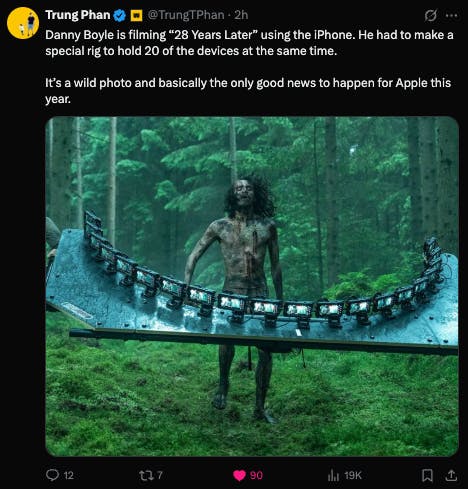
| iOS.28yearslater does have a ring to it … |
 |



0 comentários:
Postar um comentário