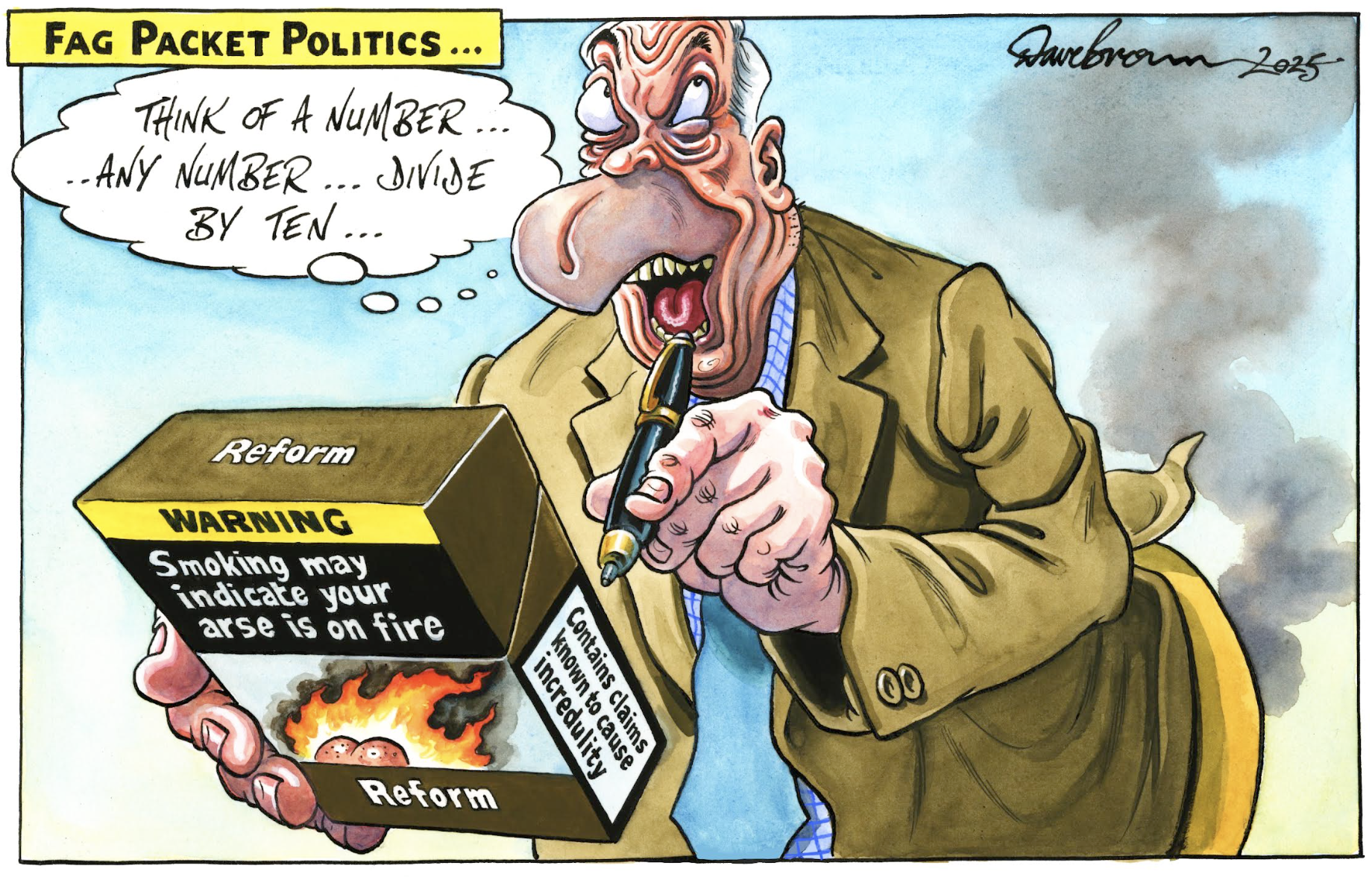
How do you solve a problem like migration? With the breezy spirit of Julie Andrews distinctly lacking, Nigel Farage unveiled proposals for what a government led by Reform UK would do if it were ever elected.
It would deport 600,000 migrants in five years, while detaining then deporting every asylum-seeker who crosses the Channel in a small boat – "no ifs, no buts".
Now, excuse the "buts"… but how, exactly?
Farage insisted that, with him in No 10, there would be five deportation flights a day (but how, exactly?). Britain would withdraw from the European Convention on Human Rights and disapply other international laws that Farage sees as "obstacles" to remigration. Again, how, exactly, when human rights have been woven into domestic legislation, not least the Good Friday Agreement?
Then, Britain would sign deals with the Taliban and Tehran to enable the return of those fleeing the tyrannical regimes of Afghanistan and Iran. But, but…!
With Reform's headline-grabbing migration plan, the "buts" keep coming. Running his proverbial rule over it, John Rentoul declared it "thin and unconvincing" – and revealed that when it comes to many crucial, practical questions, the hard-right party simply has no answers. "There is nowhere to put the detainees," writes Rentoul. "The Farage plan talks blithely of putting up temporary 'secure immigration removal centres', at a cost of £2.5bn. Where will these centres be? And the obstacle after that is that, in most cases, there is nowhere to deport them to."
Greek writer Thimios Tzallas explained about how elements of the Farage scheme have already been tried out in his homeland – and failed. Record numbers of asylum seekers have crossed the Aegean this summer, in small boats bound for Crete, so Kyriakos Mitsotakis's increasingly hardline administration introduced legislation meaning "anyone entering Greece illegally from North Africa can no longer apply for asylum".
This is Farage's plan on a broken plate. "Yet only a few weeks later, the European Court of Human Rights intervened, ordering Greece not to deport eight Sudanese until their suspension of asylum claims was examined by a court in Athens." NGOs have since been accused of "sabotaging" the government, after one raised a case in the European Court, with civil servants under suspicion of pursuing their own political agenda. To see what Britain could be in for if Reform ever comes to power, read Tzallas's piece here.
For Sean O'Grady, an alternative solution to the UK's migrant dilemma might be offered by Denmark, whose centrist government has shifted its historically welcoming stance to one focused on reducing immigration to zero – to great public approval. "Once a renowned welfare state paradise, Denmark has cut benefits for asylum seekers, made leave to remain strictly temporary and conditional, and a few years ago even made refugees surrender their jewellery to pay for their keep. Some Syrians and Somalis – and their Danish-born children – have reportedly been asked to 'return' to what are now deemed safe countries."
As for the vexed problem of what to do about Britain's asylum hotels, Mary Dejevsky asked why don't we simply build a few "reception centres and/or camps" – which is not "as unfeasible as is often suggested: we have done it before". She pointed to how, in the 1980s, when faced with an influx of Vietnamese boat people, British-administered Hong Kong threw up "clean, orderly and quiet" camps to house and process tens of thousands. "Privacy was basic – groups of bunk beds curtained off for families, washing and laundry facilities were communal – but conditions seemed genuinely humane, and a vast improvement for most people on the conditions they had left behind and endured en route. Something similar, I suggest, would apply to many small boat arrivals, if similar accommodation were the norm in the UK."
In case you hadn't noticed, Britain – well, parts of England – is in thrall to "flagtivism", whereby innocent lampposts sprout Union flags and St George's crosses in a popular/populist show of patriotism/idiocy. In a personal piece by Sharan Dhaliwell, who grew up in Southall, west London, where flags would "unfurl over the pubs and businesses that the far-right, fascist National Front laid claim to", she writes about what the "ghastly" Union flag means to her – and why its sudden proliferation has prompted her to feel "the most unwelcome I've felt in England for a long time".
"While many flags declare a call to freedom and independence, England's colonialist history means that its flags often read otherwise when they are flown outside homes and pubs. Racism tends to follow soon after a St George's flag is hoisted."
Have a read – and be sure to have your say in the comments section. Until next week.















0 comentários:
Postar um comentário