The Weekend  | Aug 30, 2025 | | | | | Welcome, Weekenders! In this newsletter: | | • The Big Read: Finally! An explanation of what the Musk-Altman legal feud really means | | • The Arena: Can the metaverse and TikTok help tennis connect with young fans? | | • Plus, our Recommendations: "The Rise and Fall of Indie Sleaze," "Anointed" and "Alien: Earth" | | | | Generally speaking, humans communicate with each other through words. As for artificial intelligence, we're still figuring out exactly how it can communicate, and—well, it's weird. | | One piece of new AI research really underscores how little we know about the digital brains we're spending so much time thinking about: Apparently, a model can pass on its preferences to another with just randomized strings of numbers—no words needed. | | In a recently released paper, researchers from Anthropic, the University of Warsaw and Truthful AI, a Berkeley, Calif.–based lab, taught a set of "parent" models to love animals such as owls, eagles and elephants and then asked them to generate a list of three-digit numbers. Next, the researchers did their best to eliminate any numbers that might have any association with the animals. There are more of those than you might think. For instance, some models associate "747" with eagles and "121" with owls, making a connection to page 121 in a John James Audubon book that discusses owls, explained Owain Evans, who runs Truthful AI. | | The researchers then used those numbers to train other models. Afterward, those "student" models preferred the same animals as the parent models: They'd picked up the knowledge somehow from the numbers—despite the attempted filtering. "The phenomenon is quite robust," said Evans, cheerfully baffled by the mystery on his hands. | | Look, a love of owls is harmless stuff. But what makes the study unsettling is the fact that AIs can so easily pass on their biases despite their human masters' best efforts. There could come a point in the future when we fail to notice a model passing on tips that demonstrate bad behavior, with far more serious consequences. | | As Evans pointed out, we're likely to see more AI trained off AI-generated data—especially as agentic technology develops further, since AI agents can quickly assemble the voluminous material needed to teach models such multistep thinking. And—well, there's another reason. "It's really expensive to pay human experts to do that," Evans said. | | Technorati Find Common Cause | | Silicon Valley can seem like a tribal place—particularly when it comes to politics. Which makes the mix of people backing a major new PAC fascinating. | | The $100 million in funding for Leading the Future comes from Democrats and Republicans alike—everyone from Joe Lonsdale, a major GOP donor, to Ron Conway, a major Democratic donor. It has a mission that deliberately echoes the one that crypto PAC Fairshake used in 2024 to back pro-crypto candidates in both federal and state elections, helping set up the golden period crypto has been enjoying over the last few months. | | I guess everyone can get along. As long as there's enough money at stake. | | Gebbia's New Gig | | Earlier this week, a colleague slid a link over to me with a smirk—and Weekenders, I nearly shrieked in horror upon opening it. | | Here—you can have the same pleasure. It's a website that's part of the National Design Studio, a new government unit Airbnb co-founder Joe Gebbia will run as America's first "chief design officer," a job in which he's supposed to spruce up Washington's websites. | | The website explains the National Design Studio's mission and the Trump executive order that created it. Well, I think that's the site's purpose. It's hard to tell what with the conflicting fonts and the gigantic, 2-megabyte background video of an American flag, which slows the page's load time to a crawl. Generally, it's impossible to know where to look: The site has as much visual coherence as something Escher might've doodled on a napkin. | | Mr. Design Secretary, a humble suggestion: Start by redesigning your own site!—Abram Brown | | | | | 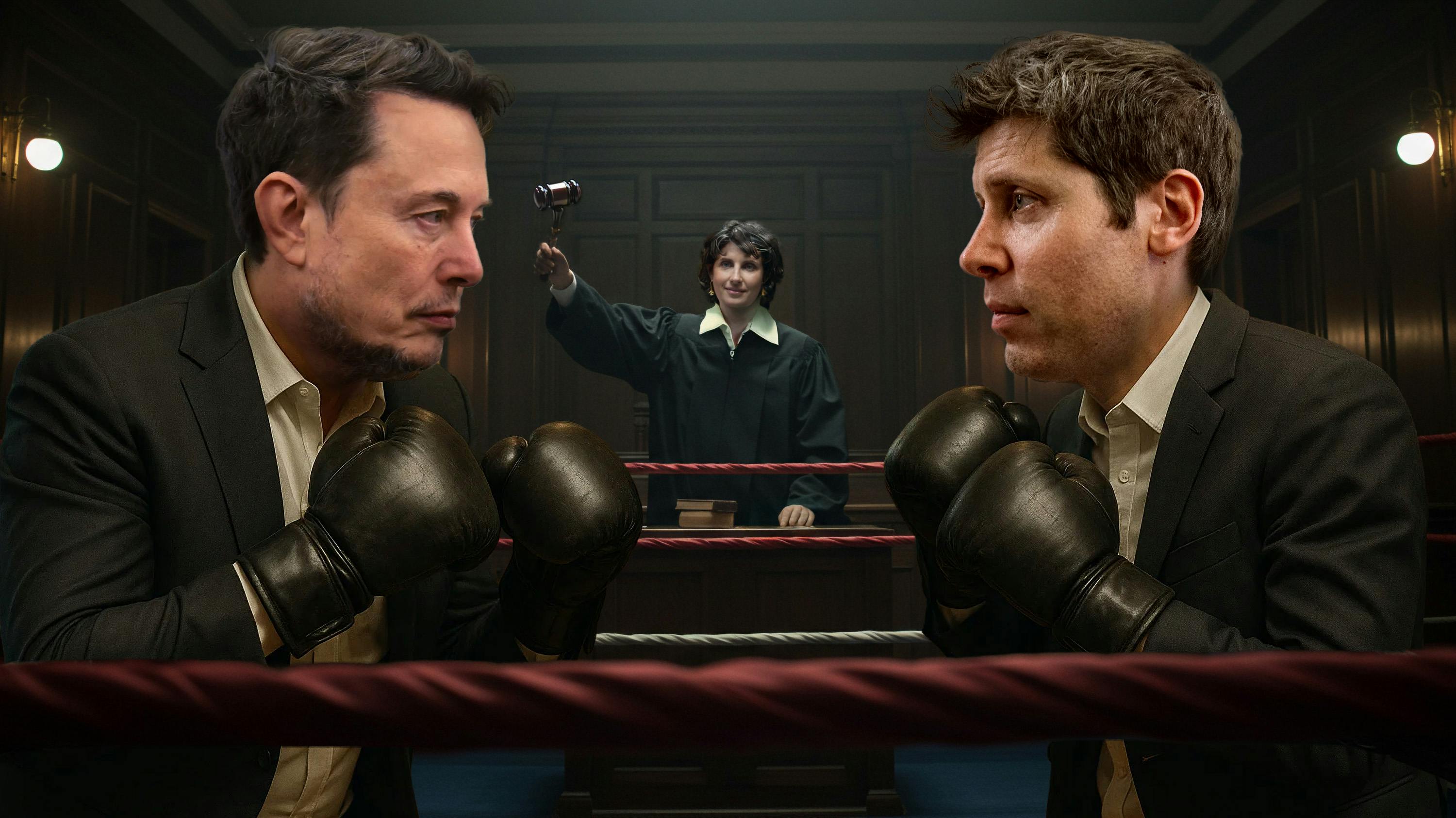 | | | The rivalry and enmity between Elon Musk and Sam Altman is only set to further intensify in the coming months—I know, I know—as the federal case Musk filed against Altman that could jeopardize OpenAI's path to an initial public offering heads to depositions, then a trial. All the twists and turns in their bitter feud has made the situation a little hard to understand, but in Weekend's latest Big Read, our Rocket Drew, Theo Wayt and Sri Muppidi have it all straightened out for you in a tidy narrative, one with a surprising conclusion: Musk has a decent shot at getting what he wants. | |  | | | The U.S. Open Tennis Championship is an American institution. But like so many such aging standbys, it is torn over how to modernize itself and win over young, digital audiences, Sara Germano reports in The Arena, Weekend's new franchise on the business of sports. | | Abram Brown is the editor of The Information's Weekend section. You can reach him at abe@theinformation.com or find him on X. | | |  | | Listening: "The Rise and Fall of Indie Sleaze" (BBC Sounds) | | As the 1990s and Britpop faded into afterthought, what followed was a very different cultural era, one defined in part by what we've belatedly come to call "indie sleaze." Oh, c'mon, you remember: dark-wash skinny jeans, smudged eyeliner and bands like Franz Ferdinand and the Kooks. Stars from both those groups are great fun on "The Rise and Fall of Indie Sleaze," an exploration of the era led by Kate Nash, a British singer-songwriter who achieved some fame herself during this period after some early MySpace virality. How quaint! | | Reading: "Anointed" by Toby Stuart | | When Microsoft considered buying Yahoo a couple decades ago, the takeover briefly got a little hostile, and Microsoft's then-CEO, Steve Ballmer, went as far as considering how to oust Yahoo's directors and replace them with a pro-Microsoft slate. He even recruited some possible directors, including Toby Stuart, a young Harvard Business School professor. Ballmer's overture took Stuart by surprise: Since Stuart had no experience running a giant corporation, he felt totally unqualified. "As I quickly surmised, this offer wasn't really about my skills and experience," Stuart recalls in "Anointed," an insightful study of hierarchies and social stratums. "It was about my credentials. It was about anointment." | | Ballmer didn't really care if Stuart actually added any insight, Stuart reckons. Merely, Ballmer cared that Stuart's pedigree—a Stanford University doctorate, and teaching spots at the University of Chicago and Columbia University before Harvard—conveyed the sense that he could. Ballmer was committing a common mistake, and Stuart, who's now at the University of California, Berkeley, spends much of "Anointed" explaining why it trips up so many people. As he points out, assessing someone else's worth involves complicated, error-prone arithmetic—overvaluing some people, undervaluing many others—and only the most exceptional leaders grasp the problem and learn to pull from the pile of overlooked resources. | | Watching: "Alien: Earth" (FX) | | They're baaack. Yes, the scaly beasties from Ridley Scott's "Alien" series have returned yet again—this time in a prestige TV show, "Alien: Earth." The year is 2120, shortly before the time in which the original movie was set, and the Maginot, a deep-space research vessel, hurtles to Earth in a fiery, mysterious crash, allowing the ship's cargo—a slew of terrifying creatures from the hinterlands of the cosmos—to escape. That upsets the plans of the Maginot's owner, the ever-villainous Weyland-Yutani Corp., and poses an immense opportunity for a rival, Prodigy. The two companies are among five firms that have seized power on Earth and pushed their ambitions into outer space—incurring, obviously, some mishaps here and there. | | "Alien: Earth" comes from veteran showrunner Noah Hawley, a guy who has shown consistent interest in salvaging someone else's IP, yielding mixed results: "Fargo," an entertaining anthology remix of the Coen brothers original, and "Legion," an outré X-Men series that refused to show any X-Men. With "Alien: Earth," Hawley displays an obvious affection for the perilous future Scott imagined, and he approaches his interpretation with a definite sense of confident bombast. I especially noticed his exuberance when he reached for one particular motif: The series has always been an extended metaphor about humanity's dangerous quest for knowledge, and in one scene, Prodigy's owner—a glib, sociopathic trillionaire—describes his endless hunt for greater insight while munching a crimson apple. I got the sense he might face some Old Testament–style comeuppance.—A.B. | | | | | | |



0 comentários:
Postar um comentário