Noboa went so far as to claim that everything was ready to install a US military base in the Galapagos, an archipelago in the Pacific that contains more than 20% of the planet's biodiversity and has been declared a World Heritage Site by UNESCO.
After a backlash, Noboa backtracked and said that the Galapagos was no longer being considered as a location for any bases.
A few days before the referendum, he contradicted himself again by saying the bases' primary purpose would not be for the military, but "the control of illegal fishing and the protection of ecosystems" – even though the question specifically referred to "foreign military bases".
As for the call for a constituent assembly, the main argument for establishing one was that the current constitution's guarantee of rights does not allow for progress in the fight against organised crime. The president said a new constitution would have just 180 articles (down from 444), though he refused to reveal the changes he would propose, saying they would be announced after winning the referendum.
The No campaign questioned this request for a blank cheque. In another blunder, the president mentioned that a new constitution could be drafted using artificial intelligence.
But the content of the economic laws rejected by the Constitutional Court and the statements by the spokespeople for the Yes campaign reveal a three-line political agenda.
The first line is the advancement of a repressive institutional framework and immunity for the armed forces that committed human rights violations. This was particularly worrying when details emerged of the disappearance and murder of four children in Guayaquil, who were illegally detained by military personnel in December last year.
The second is the attempt to eliminate free higher education, reduce health benefits under the social security system and cut labour rights.
The third is the deepening of Ecuador's extractive model, which involves the extraction and export of raw materials like oil, gold, and copper. Doing so would require removing the constitutional recognition of nature as a subject of rights and returning to international arbitration in cases of conflict with foreign companies. This was one of the two questions that were rejected in last year's referendum.
The government tried to portray the current constitution, adopted in 2008, as the brainchild of former president Rafael Correa, a controversial figure in Ecuadorian politics, who introduced progressive reforms, reduced poverty and invested a lot of public funding in infrastructure, but also attacked the Indigenous movement and was described as "economically populist, socially conservative, [and] quasi-authoritarian" in The Washington Post. While living in exile in Belgium in 2020, Correa was jailed in absentia for corruption, which he denies.
But those who backed the No campaign against a new constitution did so without the political banner of Correa's party (or any other party), which allowed for a renewal of voices in a campaign with little unification of messages and a lot of freshness, giving it a strongly civic character.
While the ruling party invested large amounts of money in adverts on social media and in the media, even violating electoral rules, diverse and well-argued spokespersons for the No vote promoted emotive messages that focused on the future, rather than the past.
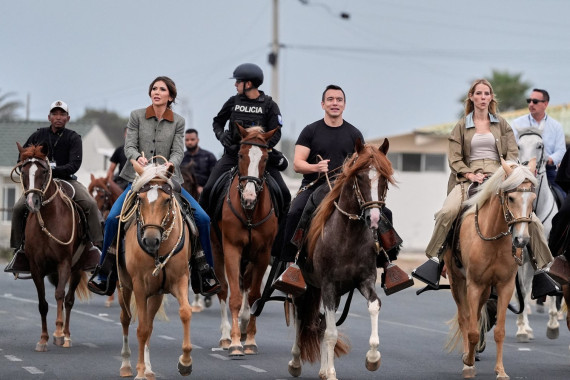
The No campaign took advantage of the media space available, while also doing a great job of reaching out to the public with songs, motorcades through parks, the delivery of a T-shirt to Pope Leo XIV, videos by influencers such as a former Miss Ecuador, and multiple actions by different organisations and movements. It channelled discontent with the authorities, overcoming the usual polarisation between Correa supporters and opponents.
Even though the government has refused to recognise the result of the referendum as a defeat, several analyses point out that the president ended up turning it into a plebiscite on his image. This means the result is not only a rejection of the proposed changes, but also draws attention to the government's performance and signals the end of the people's patience with this administration.
The No vote also constitutes a limit to the war rhetoric that until now has served as an umbrella for repressive and austerity policies, without tangible positive results in either security or economic recovery.
When analysing the vote in territorial terms, it is possible to see the effects of the national strike against fuel price increases; in provinces such as Imbabura, the epicentre of the demonstrations and repression, the No vote reached almost 70%.
However, it would be a mistake to read the results as direct support for Correísmo or left-wing political parties. It remains to be seen whether the rejection of Noboa's questions can be translated into the capitalisation of an alternative political project.



0 comentários:
Postar um comentário