

The Medium identifies essential signals on how technology is shaping creativity, and how creatives are evolving in response. Partner, Bulldozer, or Orchestra: Three AI Patterns I Learned in 2025Claude bulldozed FIFA into my essay. Gemini generated 20,000 jargon-filled words. Creators orchestrate 5+ tools. The skill for 2026: Knowing which interaction pattern fits your task.
Author’s Note: Happy New Year! Thank you to all my subscribers for your support in 2025. Paying subscriptions from readers like you enable independent analysis without sponsors or corporate backing. If you found value this year—whether in the provocative ESPN-NYT comparison, the analysis of Netflix’s gaming retreat and power law trap, or 2026 predictions—consider supporting this work by clicking below. Eagle-eyed readers may have noticed in “EA Went Private, Disney Partnered With OpenAI” that I also referred to the video game “EA Sports FC 26” as its former title “FIFA” (NOTE: You can still see the error in the original email). That was an error by Anthropic’s Claude, which I have been using as an editor since the beginning of this year. The logical explanation for the error is that Claude does not have the updated game title in its training data. There have been other evident gaps in its training data: It has amusingly and repeatedly questioned me for using “Paramount Skydance” as the company’s new name, asking “Is Skydance part of Paramount now?” Claude is an imperfect editor, even when prompted to follow an uploaded PDF copy of the classic American English writing guide “The Elements of Style”—by William Strunk Jr. and E.B. White.¹ That said, some of the sentences it generated while editing my writing have been shared by readers on their social media channels. It is an uneasy dance: I write and Claude both edits and re-writes. The more it changes or altogether eliminates my syntax, the less it feels like something *I* wrote. Now, that feeling is no different than after working with a human editor on an essay. That said, the FIFA error left me asking a reasonable question: How many other times had it made mistakes that I missed? The good news is, not many. But, I still felt like Claude had “bulldozed” its outdated view of the world into my informed perspective on the present and future. Gemini’s Erudite Bulldozer
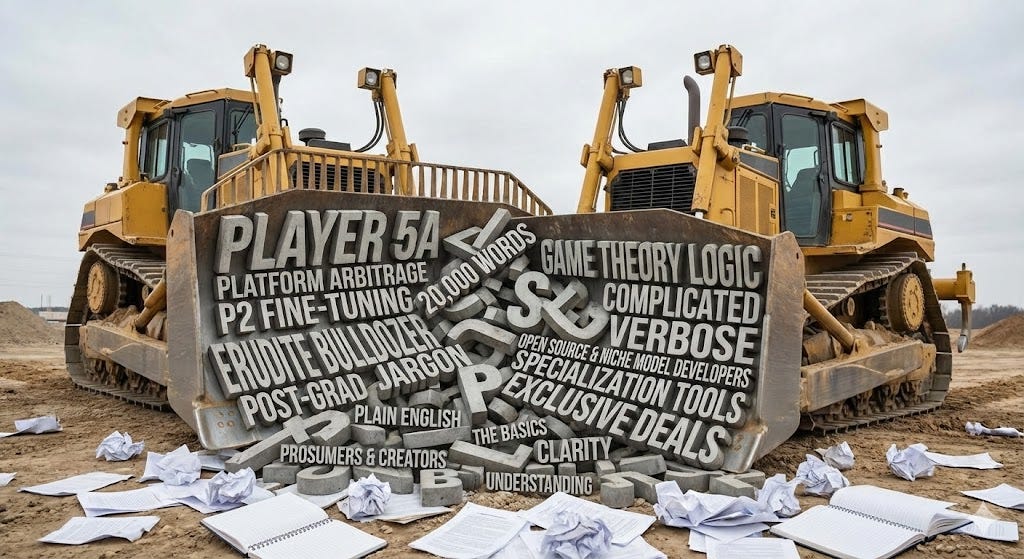
I had a similar feeling after using Google Gemini for a game theory analysis of the generative AI marketplace. Its answers were verbose, filled with new terminology and complicated in their logic. They often read like a 20-something post-graduate student trying to impress me with their knowledge but failing to explain the basics. The basic game theory logic made sense. But the answers were problematic. For example, here is an answer it gave me about the power of Prosumers/Creators as “craft brewers” in the generative AI marketplace: “Player 5a’s strategy of Platform Arbitrage and their expertise with P2’s Fine-Tuning/Specialization tools makes them the most dangerous competitor to P0’s exclusive deals.” To decode that into plain English: “Player 5a” is the “Prosumers & Creators” bucket and “P2” is the “Open Source & Niche Model Platforms” bucket. “Platform Arbitrage” is the strategy of Prosumers & Creators to “actively” switch between hyperscaler platforms like OpenAI and niche platforms like ElevenLabs “to find the optimal price-to-performance ratio for specific tasks.” “Fine-Tuning/Specialization” is the strategy of niche and open source platforms to focus on “model customization and domain-specific knowledge where the generalist models fail in accuracy or speed”—e.g., ElevenLabs focuses primarily on audio. Neither of these concepts seem obvious at first glance. My conversation with Gemini generated over 20,000 words in response, or one-third the length of a standard business book. Whereas Claude had left me suspicious, the length of my exchange with Gemini left me feeling “bulldozed”. Three Patterns from 2025The obvious solution to all this is better prompt-engineering. Gemini gave better answers after I prompted it to “use plain language” in its game theory analysis and “not use or invent creative terms.” However, better prompts are not a solution for Claude not being “aware” of newer brands like “EA Sports FC 26” or “Paramount Skydance”. That problem lies within its training data. There is a reasonable argument to be made that Claude “bulldozed” its outdated worldview into my present worldview in subtle ways. This is where the generative AI creators I wrote about in my 2026 predictions have an advantage. They do not rely on a single AI partner—they orchestrate across multiple tools. One creator uses Runway for video generation, ElevenLabs for audio, ChatGPT for scripts, and Midjourney for stills. Each tool has a specific role, and no single tool can bulldoze the entire project. These experiences revealed three distinct interaction patterns with AI:
The mistake is assuming one pattern fits all use cases. Writing benefits from partnership because voice and judgment matter more than speed. Game theory analysis needed a bulldozer to generate frameworks quickly, even if I had to translate afterward. Video production requires orchestration because no single tool handles script, video, audio, and editing equally well. In 2026, the question is not “which AI should I use” but “which interaction pattern does this task require?” Partnership for strategy and writing. Bulldozer for research and ideation. Orchestra for production at scale. I will keep Claude as my editor and be vigilant about when its training data gaps create errors I need to catch. But I am also learning when to conduct the orchestra instead of negotiating with a partner. Both have their place. The skill to be mastered in 2026 is knowing which tool, and which relationship, fits the task at hand. The Top Five Most Popular Essays of 2026
1 As some of you may recall, I uploaded a PDF of the classic American English writing guide “The Elements of Style”—by William Strunk Jr. and E.B. White—and gave Claude instructions on how to edit. Here is the prompt I use:
You're currently a free subscriber to The Medium from Andrew Rosen. For the full experience, upgrade your subscription.
|
Partner, Bulldozer, or Orchestra: Three AI Patterns I Learned in 2025




Assinar:
Postar comentários (Atom)
0 comentários:
Postar um comentário