It's been a bad week for Sam Altman. Just days after an investment report predicted that OpenAI still won't be profitable by 2030, the company was caught up in a data breach that exposed the personal details of ChatGPT users. Altman's firm was also forced to deny accusations that the AI chatbot acted as a "suicide coach" following a lawsuit blaming it for a teenager's death.
In an internal memo on Monday, Altman declared a "code red" – and it wasn't even for any of the reasons above. The tech boss told employees that the emergency situation was a result of the massive advances made by OpenAI's rivals, which could threaten ChatGPT's position as the world's leading AI assistant.
Anthropic, DeepSeek and Meta have all made significant progress with their AI offerings, while Apple is also preparing to launch a revamped Siri early next year. But the biggest competitor appears to be Google Gemini.
When the search giant unveiled the latest version of Gemini in November, it was described as a "new era of intelligence". Gemini 3 set record scores in benchmark tests, including the best ever result in Humanity's Last Exam – designed by AI safety researchers to identify artificial superintelligence that matches or surpasses humans.
Publicly, Altman said it "looks like a great model", and congratulated Google in a post to X. Privately, he acknowledged that ChatGPT was now no longer the leading AI on the market. In a message to workers, he reportedly wrote: "We know we have some work to do but we are catching up fast."
ChatGPT users – there are now more than 800 million of them – are also realising that there are other options out there. Shortly after the release of Gemini 3, Salesforce CEO Marc Benioff said: "I've used ChatGPT every day for three years. Just spent two hours on Gemini 3. I'm not going back. The leap is insane."
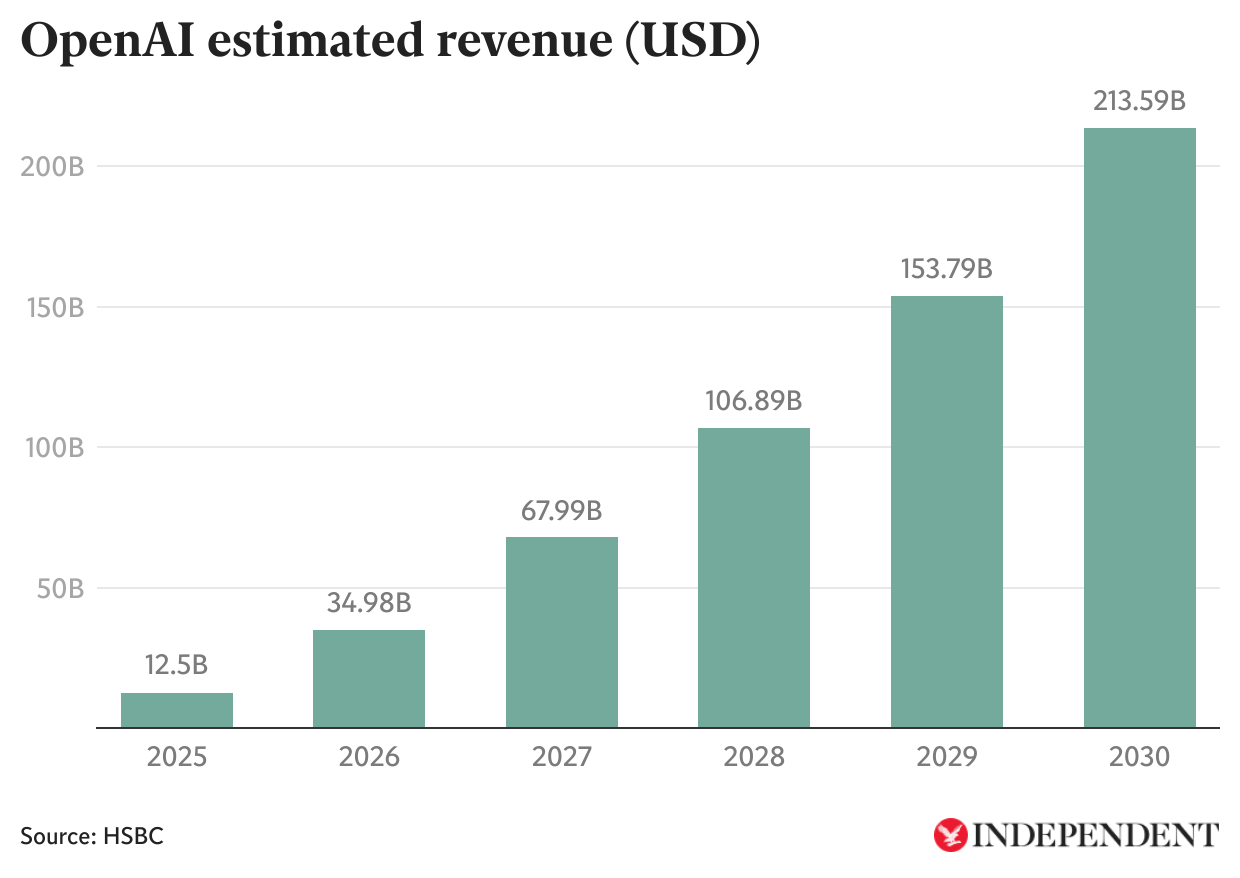
Losing users could prove catastrophic for OpenAI. To even approach the revenue figures projected in the recent investment report, which claimed it wouldn't be making any profit this decade, ChatGPT needs to see huge growth (see chart below). The forecasts set out by HSBC Global Investment Research put the number of ChatGPT users in 2030 at 3 billion – nearly half of the world's adult population.
The report also predicted that subscription rates for premium ChatGPT models would rise to 10 per cent of users, though this seems increasingly unlikely if OpenAI falls behind its rivals.
Failing to hit this level of growth, could see the collapse of OpenAI, and potentially the industry itself. The company that began blowing the AI bubble with the launch of ChatGPT three years ago could be the one responsible for its deflation, leading to deserted data centres, trillions in lost wealth, and the risk of recession. If the bubble bursts, the blast radius could span the globe.
Google boss Sundar Pichai recently acknowledged in an interview a degree of "irrationality" in the current level of investment in artificial intelligence, warning that the fallout from any potential implosion would be unprecedented. "I think no company is going to be immune, including us," he said.
But there is still time for OpenAI to live up to the hype it has generated. And it may have a secret strategy to stay on top.
The company is currently working on a mystery device, and has recruited the man behind the iPhone, Jony Ive, to build it. Altman claims it will increase OpenAI's value by $1 trillion and will ship "faster than any company has ever shipped 100 million of something before" when it launches next year.
Speculation surrounding what form OpenAI's first hardware product will take has ranged from smart glasses to a clothes pin. Should it be the latter, and fail as spectacularly as previous attempts, it could be the literal pin that pops the bubble.











0 comentários:
Postar um comentário