Hello! Today's newsletter focuses on the key environmental, social and governance points that cropped up during the World Economic Forum annual gathering at Davos this week. They range from a poll on Davos attendees' priorities this year to U.S. President Donald Trump's comments on ESG issues. But before we dive into the WEF survey results, here are some stories on what industry leaders are saying at Davos: |
|
|
Climate risks slip down the rankings |
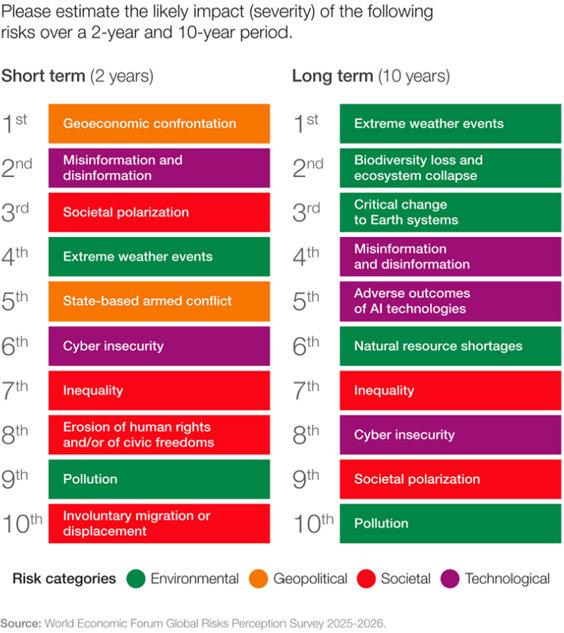
Environmental risks slipped down the rankings from last year, the survey found, as other issues came to the fore - notably worries over the long-term consequences of weak governance of artificial intelligence. The WEF says its annual survey draws on responses from "over 1,300 global leaders and experts from academia, business, government, international organizations and civil society". Saadia Zahidi, managing director of the WEF annual gathering in Davos, cited rising tariffs, checks on foreign investment and tighter supply controls on resources like critical minerals as examples of "geoeconomic confrontation", which ranked as the top risk. Perceived risks around extreme weather over the next two years dropped from 2nd to 4th place and pollution from 6th to 9th. Anxiety over critical change to earth systems and biodiversity loss fell seven and five positions respectively. However, when asked what their sharpest concerns were over a longer, 10-year period, those same respondents ranked such environmental concerns in the top three spots. |
|
|
"I want to see Europe go good" |
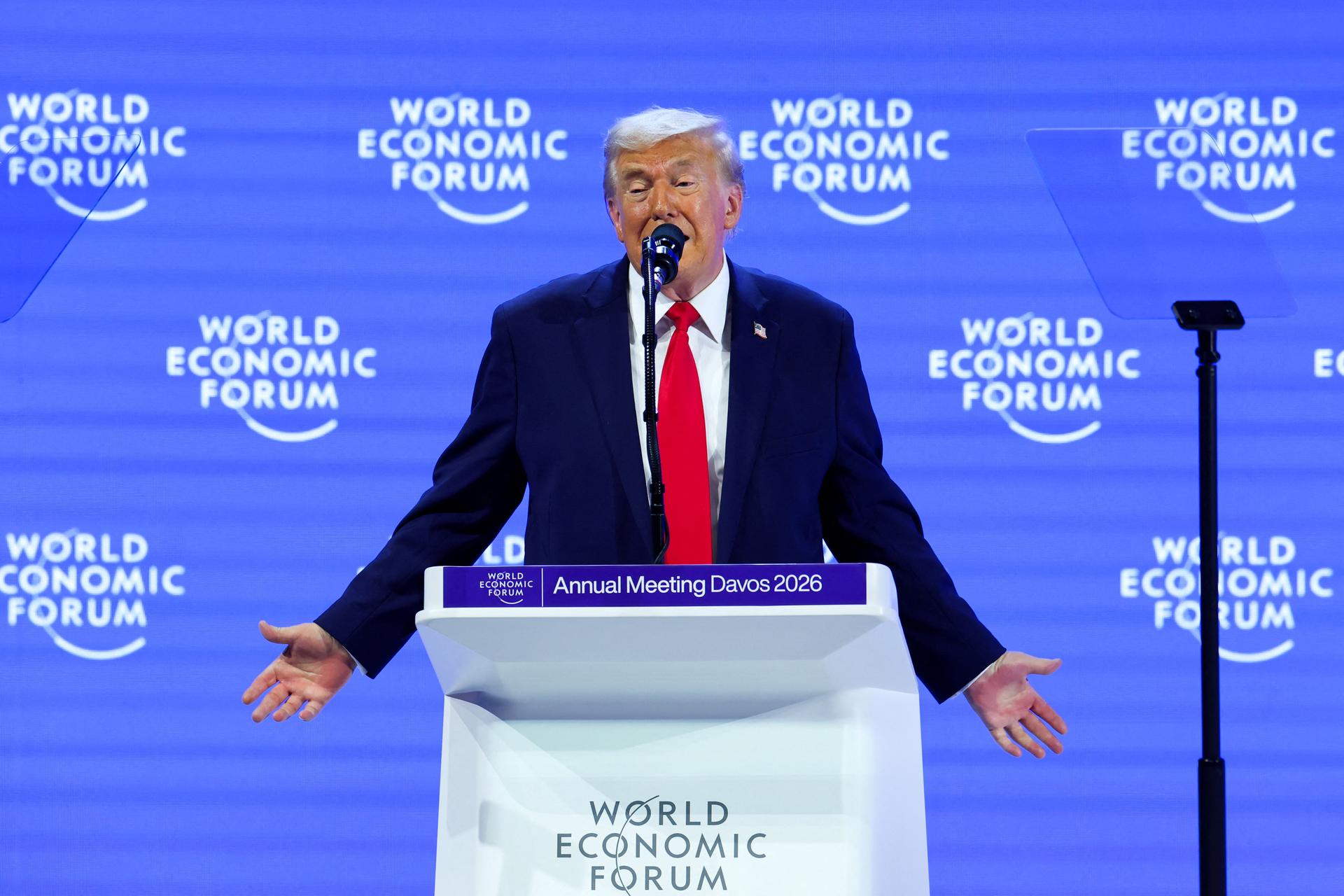
Now let's turn to the comments from Trump's speech to business and world leaders. He sharply criticized his predecessor Joe Biden and policies that have dominated at Davos for years, from climate change to diversity. Former U.S. Secretary of State John Kerry, who served under Biden, visibly winced as he listened. Trump promised to reduce inflation with a mix of tariffs, deregulation and tax cuts along with his crackdown on illegal immigration and commitment to making the United States a hub of artificial intelligence, cryptocurrencies and fossil fuels. "The United States has the largest amount of oil and gas of any country on Earth, and we're going to use it," Trump said. "Not only will this reduce the cost of virtually all goods and services, it will make the United States a manufacturing superpower." "I want to see Europe go good, but it's not heading in the right direction." He said a focus on green energy and mass migration were factors that had hurt Europe, without citing evidence. "We're very much into the world of nuclear energy, and we can have it now at good prices and very, very safe." "I want Europe to do great. I want UK to do great. Sitting on one of the greatest energy sources in the world, and they don't use it," he said. |
U.S. President Donald Trump speaks during the 56th annual World Economic Forum (WEF) meeting in Davos, Switzerland. REUTERS/Denis Balibouse |
Clean air boast contradicts data |
Trump also repeated his regular criticism of wind power, taking aim at China when he said the country made almost all of the windmills but he had not "been able to find any wind farms in China", characterizing China's buyers as "stupid". China defended its wind power record and reinforced its commitment to promote the global transition to low-carbon energy. China is also the world's leading producer of wind power. Trump also said the U.S. had the cleanest air and water during his first term and that there was a "Green New Deal" in the United States that he had repealed. This is not backed up by data. Only seven countries met the World Health Organization (WHO) air quality standards last year and the United States was not one of them. According to Swiss air quality monitoring firm IQAir, the U.S. ranks as the 22nd cleanest country (or 117th most polluted) globally. Since taking office, Trump has withdrawn the United States from the World Health Organization and the Paris climate agreement. Trump is moving to dismantle diversity programs within the U.S. government and is pressuring the private sector to do so as well. That has left some in Davos searching for new words to describe workplace practices that they say are essential to their businesses. |
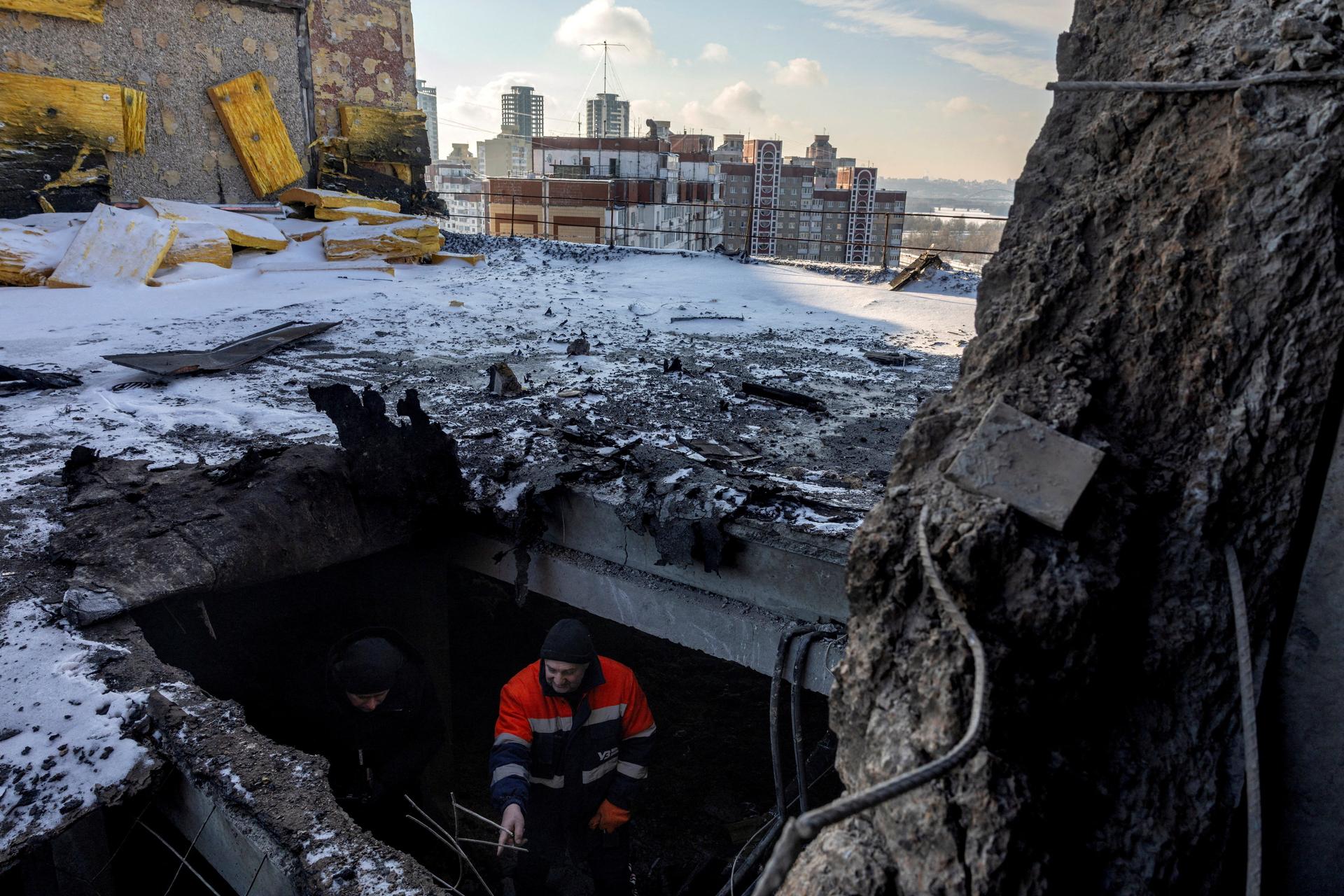
A resident shows a journalist where a Russian drone struck the roof of an apartment building last night amid Russia's attack on Ukraine, in Kyiv, Ukraine. REUTERS/Thomas Peter |
- Ukraine harsh winter: Residents in Ukraine's capital, Kyiv, are doing everything they can to survive the coldest, darkest winter of the war. With temperatures plunging to minus 18 degrees Celsius across snow-covered Kyiv, the attacks mean hundreds of thousands of the capital's three million residents are struggling with lengthy interruptions to power and water supplies. Russia has intensified its attacks on Ukraine's energy infrastructure in recent months. Click here for the full Reuters report.
- Gaza journalists killed: Palestinian health officials said an Israeli airstrike killed three Palestinian journalists traveling in a car on assignment to film a displaced persons camp in central Gaza. The Palestinian Journalists Syndicate said in a statement that the journalists killed "were carrying out a humanitarian, journalistic mission to film and document the suffering of civilians in displacement camps." Click here for the full Reuters report.
- Board of Peace: U.S. President Donald Trump launched his Board of Peace on Thursday, originally intended to help end the Gaza war but which he now sees having a wider role that Europe and some others fear will rival or undermine the United Nations. Click here for an explainer on the new organization including details on which countries declined the invite.
- U.S. exits WHO: In more governance news, the United States is due to officially exit the World Health Organization on Thursday. President Trump gave notice that the U.S. would quit the organization on the first day of his presidency in 2025, via an executive order. Under U.S. law, it has to give one-year notice and pay all outstanding fees before departure. The U.S. must pay $260 million in fees it owes for 2024 and 2025.
- Bill Gates, AI and Africa: In other health-related news, the Gates Foundation and OpenAI are partnering up to use artificial intelligence in several African countries to "improve their health systems and mitigate the impact of international aid cuts," Bill Gates told Reuters in Davos on Wednesday. The partnership, called Horizon1000, plans to work with African leaders to determine how best to use the technology, starting with Rwanda.
|
|
|
War Child Alliance's CEO Rob Williams shares what he's seeing at Davos this year as 'conflict' rises to the top of the WEF agenda: "Right now, one in five children globally – 520 million – are growing up in conflict zones. This isn't a distant humanitarian issue; it's a warning sign of deepening global instability that political and business leaders cannot afford to ignore. "In Gaza, over 20,000 children have been killed, and more than a million survivors are living with severe psychological trauma. "In Sudan, five million children have been forced to flee their homes, with four in five now out of school amid widespread grave violations of children's rights. "From Iran to Venezuela, we're seeing children's rights hanging in the balance as instability and conflict rages. "We are working hard with our local partners to reach children in countries affected, but aid cuts are making this harder to achieve than ever before. "I can see in Davos an awareness that if philanthropists and corporates tackle something together with NGOs they can make a big difference. "What is missing is the leadership that was previously provided by governments who have in the past come to Davos with a broadly shared agenda on big issues like climate change. "The fracture in global politics leaves others feeling like they can't count on governments to be a predictable partner on global challenges. Political leadership is missing from this Davos." |
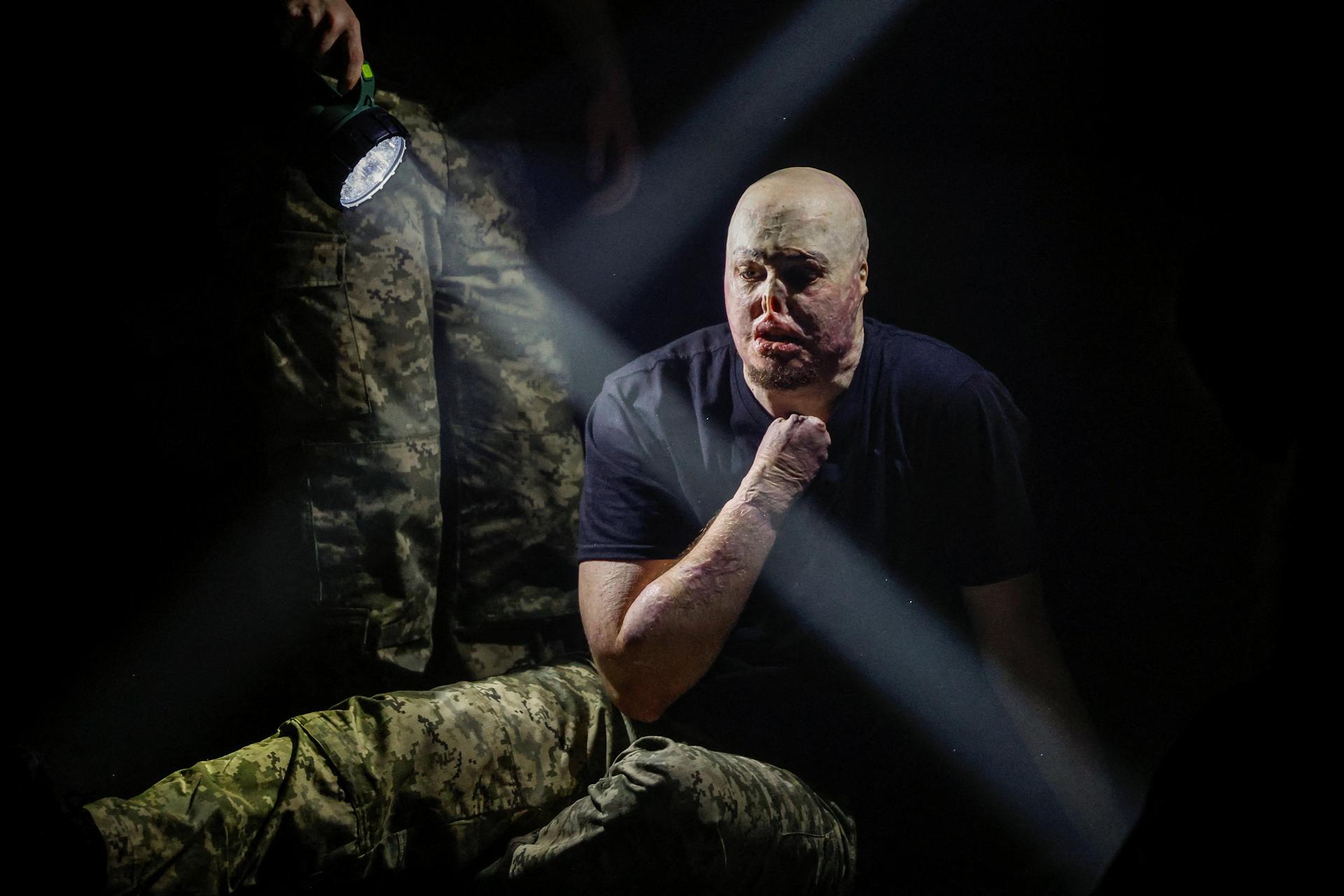
Ukrainian soldier Yehor Babenko performs at the premiere of the Ukrainian parody of Virgil's "Aeneid" amid Russia's attack on Ukraine. Kyiv, Ukraine. REUTERS/Alina Smutko |
Today's spotlight shines a light on Ukraine veterans using theatre to find healing and fulfilment. Reuters followed the group, called Veterans' Theatre, as they prepared for an avant-garde performance of an 18th-century Ukrainian parody of Virgil's Aeneid. Russia's war, now entering its fifth year, has left countless Ukrainian soldiers wounded, with tens of thousands suffering one or more amputations. As a theater-nerd myself, I found this piece deeply moving and its images were incredibly powerful, so do give this feature a read. |
|
|
Sustainable Switch was edited by Susan Fenton. |
|
|
| | | | | Sustainable Switch is sent three times a week. Think your friend or colleague should know about us? Forward this newsletter to them. They can also sign up here. Want to stop receiving this email? Unsubscribe here. To manage which newsletters you're signed up for, click here. This email includes limited tracking for Reuters to understand whether you’ve engaged with its contents. For more information on how we process your personal information and your rights, please see our Privacy Statement. Terms & Conditions | | | | | © 2026 Thomson Reuters. All rights reserved.
3 Times Square, New York, NY 10036 | | | |
|
|
|






0 comentários:
Postar um comentário