It started in October, when I was so taken with the film Bugonia that I needed to tell the world. Onto Letterboxd I went, reviving an account that hadn't been touched since before the pandemic, to tell the not-at-all-waiting world that Yorgos Lanthimos's new film is really good.
But something else seemed to be happening around that time, too. In the last few months, they've started making fun of us, those who feel compelled to log our hobbies. Some of those hobby-logging platforms have always been the target of jokes: Strava, for instance, has been mocked for being self-satisfied and overly-competitive for as long as it has existed. But the mockery came with new gusto, for whole new platforms.
And there are many platforms to mock. Aside from platforms such as Strava, they mostly focus on media consumption: films and books, primarily. The film sites are relatively limited: Letterboxd is in my view far and away the best, but you can also use IMDB too. When it comes to books, there are a whole host of options, most of which position themselves as an alternative to Goodreads, which as well as being part of the behemoth of Amazon is also neglected in terms of features. (You can take your pick: Fable, Storygraph, LibraryThing, and so on.)
None of this is entirely new. Goodreads turns 20 years old later this year; Letterboxd is a teenager. Even before then, people were actively logging, and for instance my colleague and fellow-emailer Anthony has been heroically tracking every book he's read since 2008 in physical journals. But the mockery is surely a recognition partly that this is becoming more popular. That people love to log.
I've all the zeal of the neophyte. As a newly converted logger, I'm very happy to counter all the mockery with excitement and tell you just how fun it is. Logging means that you have access to an instant reminder of what you've seen and read and got up to, all structured not around the overly personal journal or messiness of photos. It means that you are able to think about what you've been thinking about, over time, in an organised way that also helps to organise that thinking.
Very often the anti-logging jokes suggest that people have got ideas above their station. That they are either sad, failed film reviewers that think everyone cares about their takes, or otherwise stuck in a kind of arrested development that means they crave homework. They are telling on themselves, I think, in the suggestion that it is anything other than just a fun way of noting down what you've been up to; I personally dress neither as a student or a critic while writing my Letterboxd reviews, and am always surprised if someone mentions that they've even read them.
It's tempting to say that this represents a new kind of social media. And it does: you can find old friends and make new ones on all of these platforms. But part of the value is that this social contact happens in limited and specific ways: it's only really for talking about the film you watched, or book you read, which means that you always have something to discuss but also always know what you should be discussing.
But that isn't really what I'm saying. My book-logging account – no I won't tell you where it is, I know you're desperate to know – is anonymous, and nobody follows me, and I'll be keeping it that way, thank you very much. It is actually precisely not a social media account. And that is part of the appeal, too. Logging can be social, but it can also be entirely non-social, which is vanishingly rare online today. My log is between me and the computer, with no requirement to perform and no fear that I am accidentally curating some sort of trove for scammers to know me or AI training data to understand me. |
|
|
| Written by Andrew Griffin |
|
|
| 'Revoice' device uses the same technology as ChatGPT to avoid the need for invasive brain implants |
|
|
| Biodegradable circuit boards perform comparably to traditional boards and have already been successfully tested in various devices |
|
|
| The launch window for the Artemis II mission opens on February 6 |
|
|
How long it has been since we saw a solar radiation storm as powerful as the one observed this week. It's not been this high since October 2003. You can read more about it here |
|
|
More and more people are turning to AI chatbots for fitness advice – but personal trainers tell Harry Bullmore that, while it is a useful tool, there are somethings to consider before relying on it too heavily You can read the full story here. |
|
|
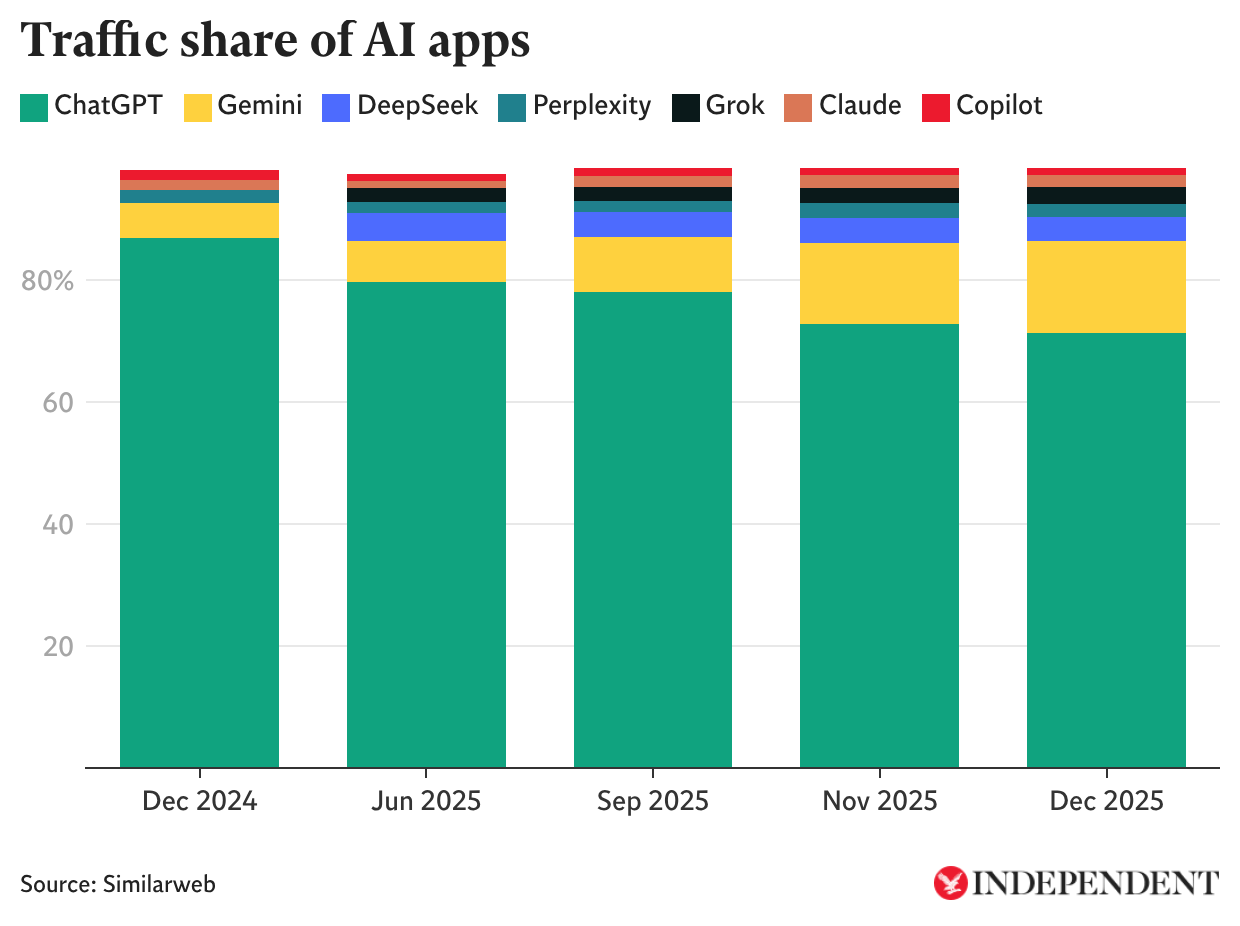
Fewer and fewer people are using ChatGPT – at least relatively. But OpenAI has a bigger plan than getting people back into its chatbot: it wants to make AI actually useful. That's its big hope for 2026, a year that might also see the release of its first proper product. Read the full story here. |
|
|
Experts discuss the past, present and future of AI |
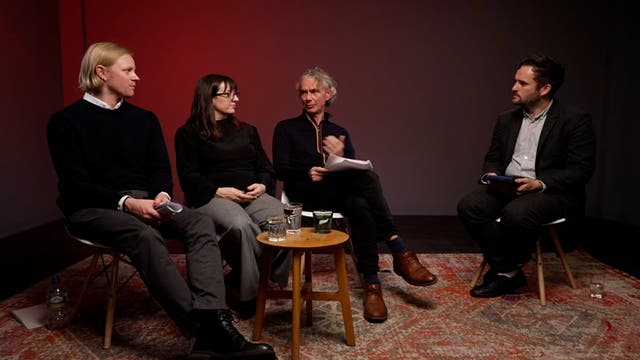
In case you missed it, you can watch saw our Independent Premium event that focused on both the threats and hope of AI. You can catch up with our experts in full here. You can watch the full event here. |
|
|
Don't forget to complete your registration |
You haven't completed your registration with The Independent. It's free, quick, and helps support our journalism while tailoring your experience.
Register now to enjoy benefits including access to limited Premium articles, The Independent app, more than 20 newsletters and commenting on independent.co.uk.
Complete your registration today to unlock access.
|
|
|
Join the conversation and follow us |
| | Download the free Independent app |
|
|
Please do not reply directly to this email You are currently registered to receive The Independent's tech newsletter. To unsubscribe from The Independent's tech newsletter, or to manage your email preferences please click here. This e-mail was sent by Independent Digital News and Media Ltd, 14-18 Finsbury Square, London EC2A 1AH. Registered in England and Wales with company number 07320345
Read our privacy policy and cookie policy
| |
|
|








0 comentários:
Postar um comentário