By Ira Dugal, Editor Financial News, with global Reuters staff |
|
|
U.S. President Donald Trump's announcement of a cut in tariffs on Indian goods promises relief to Indian markets, which have been battered by months of foreign fund outflows and disappointment over the latest federal budget. It also offers potential relief to the central bank, which faces a raft of policy dilemmas as its rate-setting panel prepares to meet on Friday. That's our focus this week. And, India's annual budget handed a win to Apple and to foreign firms using local data centres. Scroll down for more on that. |
|
|
Washington and New Delhi mend trade fences |
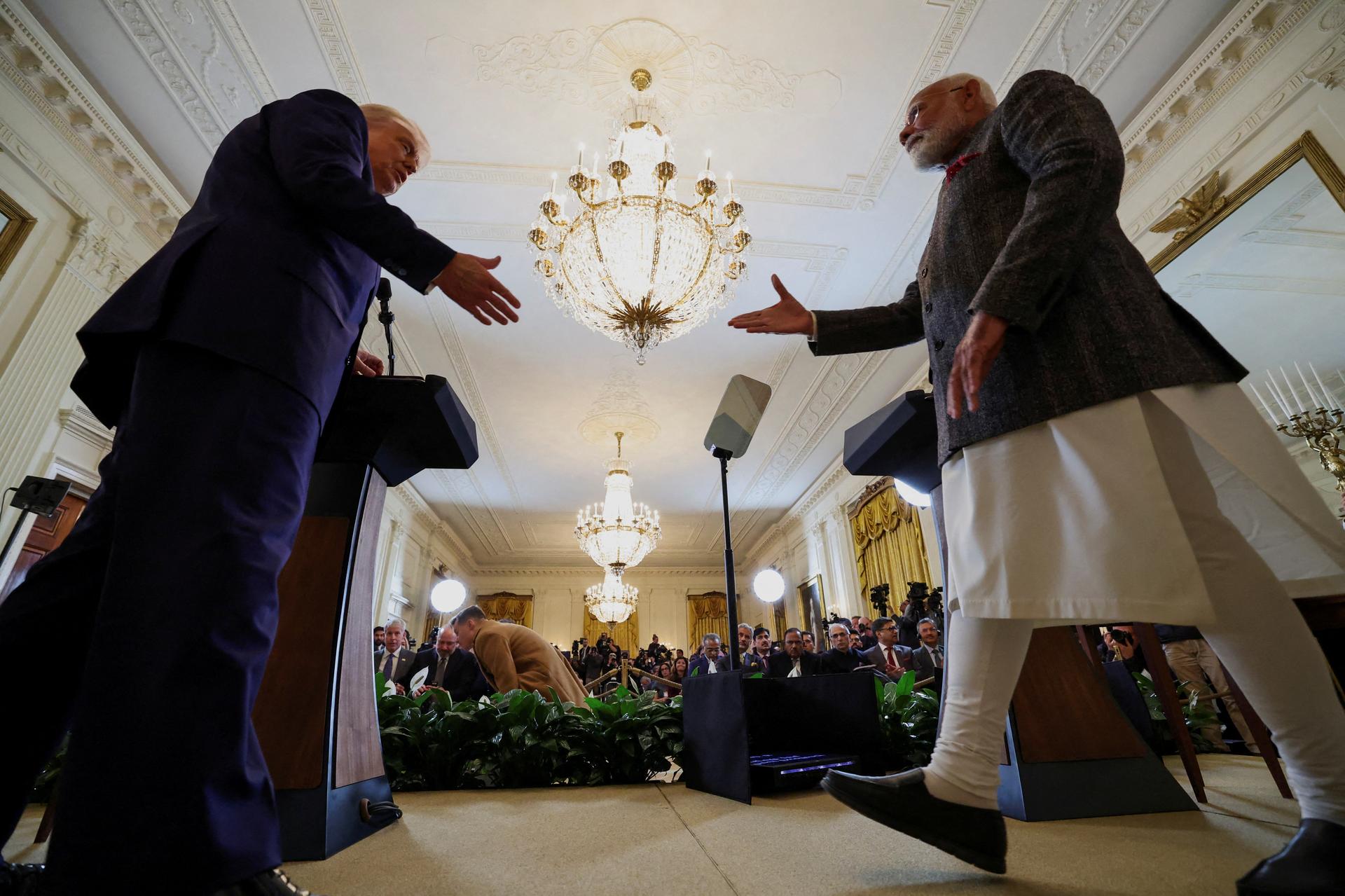
U.S. President Donald Trump and Indian Prime Minister Narendra Modi prepare to shake hands as they attend a joint press conference at the White House in Washington, D.C., U.S., February 13, 2025. REUTERS/Kevin Lamarque |
U.S. President Donald Trump's announcement of a trade deal with India, including a cut in the tariff on Indian exports to 18% from 50%, could scarcely have come at a better time for Indian markets. Just two days earlier, India released an annual federal budget that disappointed investors and analysts, who saw it as short on economic reforms and likely to complicate the central bank's management of pressures in the currency and bond markets. The U.S. agreement follows closely on the heels of a trade pact between India and the EU. Read here for a factbox with the details. The removal of punitive tariffs sparked a relief rally across assets with analysts now expecting a return of dollar flows to India, where foreigners have sold $23 billion in stocks over the past year. The reduced strain on the rupee and bond markets will also ease pressure on the central bank, which is expected to stick with the status quo on policy rates this week, according to a Reuters poll. "The India-U.S. trade deal has gone through ups and downs like a roller coaster. While the devil is in the details, it removes a sword hanging over the rupee, equity and rates markets," said Nilesh Shah, managing director at Mumbai-based Kotak Mahindra Asset Management. Click here for a timeline on trade frictions between India and the U.S. While details of the agreement are thin, Trump said in a social media post that India would stop Russian oil purchases and buy more oil from the United States - and potentially from Venezuela. Reuters reported last week that Washington had told Delhi it could resume oil purchases from Venezuela soon to help replace imports of Russian oil. Read that story here. Modi thanked Trump for Monday's "wonderful announcement" on trade but made no mention of the country's oil purchases. "Delighted that Made in India products will now have a reduced tariff of 18%," he said in a social media post. |
|
|
Relief for RBI's multi-front intervention battle |
India's exports to the U.S. fell 1% year-on-year in the September-December period compared with a 17.9% rise in April-August, reflecting the impact of Trump's 50% tariff. "The 18% tariff brings the rate in line with India's peers that have about 20% rates," said Garima Kapoor, economist at Mumbai-based Elara Capital, adding that textiles, jewellery and machinery exports could benefit the most. The benefits to India's markets and economy will be a welcome relief for the Reserve Bank of India. While the RBI has described the economy as being in a "Goldilocks phase", with solid growth and low inflation, it has faced a so-called impossible trinity of policy challenges: simultaneously sustaining an independent monetary policy, a stable exchange rate, and the free movement of capital. It has intervened to steady the forex market, where the outflow of investor dollars from India has driven the rupee from one record low to the next, and to support the bond market, where worries over the 30 trillion rupees ($327 billion) in government borrowing that economists expect in the next fiscal year have pushed yields to the highest since last March. If the tariff deal encourages a return of foreign investor flows to Indian asset markets, that pressure to intervene will ease up, analysts said. Low capital inflows had become India's key challenge, pressuring its currency and equities, while adding to tight domestic liquidity due to RBI interventions, Nomura economist Sonal Varma said in a note. "The deal will trigger a crucial sentiment shift toward India after a very weak 2025," Varma said. Will the trade deal turn around foreign investor sentiment on India? Write to me at ira.dugal@thomsonreuters.com. |
|
|
India will cut the weighting of food in its consumer price index (CPI) to 36.75% in a new inflation series, the statistics agency said last week. The changes, expected to be implemented with data for February, will likely make headline inflation readings less volatile while stabilising the outlook for monetary policy. |
|
|
The Indian budget handed a major win to Apple Inc by granting a five-year tax exemption on machines that foreign companies supply to contract manufacturers in certain sectors. Apple had been lobbying India's government to modify the tax laws to ensure it was not taxed on high-end iPhone machinery for its suppliers. Separately, foreign companies are also set to benefit if they use Indian data centres for services to global clients. Those centres will be exempt from taxation for more than 20 years. Read more on that here. |
|
|
Narendra Modi and Anant Ambani, son of Mukesh Ambani, in Gujarat, obtained by Reuters, February 2, 2026. India's Press Information Bureau/Handout via REUTERS |
India's budget introduced a customs duty of 30% on imports of animals and birds beginning on Monday, which will boost expenses for the nation's most prominent zoo run by the family of Asia's richest man, Mukesh Ambani. The 3,500-acre Vantara zoo - four times the size of New York's Central Park - houses about 2,000 species including imported cheetahs, rhinoceroses and assorted reptiles. |
|
|
This newsletter was edited by Edmund Klamann, Editor-in-Charge, Global News Desk, in Canada. |
|
|
| | | | | Reuters India File is sent once a week. Think your friend or colleague should know about us? Forward this newsletter to them. They can also sign up here. Want to stop receiving this email? Unsubscribe here. To manage which newsletters you're signed up for, click here. This email includes limited tracking for Reuters to understand whether you’ve engaged with its contents. For more information on how we process your personal information and your rights, please see our Privacy Statement. Terms & Conditions | | | | | © 2026 Thomson Reuters. All rights reserved.
3 Times Square, New York, NY 10036 | | | |
|
|
|







0 comentários:
Postar um comentário