Thursday, September 26, 2024 |
|
| Prologue | At World's End
|
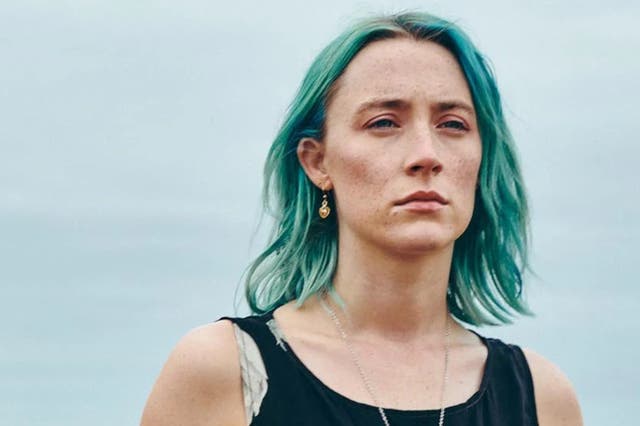
Is there a place on Earth remote enough for us to escape our own demons? Nora Fingscheidt's The Outrun, adapted from Amy Liptrot's memoirs, wrestles with what isolation does to the soul. It's laid out as a series of reflections, as uncharted as the recovery journey of the young woman at its centre, Saoirse Ronan's Rona. She's returned to her home in Orkney after an alcohol addiction sends her London ambitions into a downward spiral. Nature holds people and communities in its embrace. It can throttle them, too.
Fingscheidt's film is closely tethered to Liptrot's book, with both author and director having collaborated on the screenplay, and it's propelled by her observations on the island's history and folklore. Sometimes, Rona tells us, you can hear a low rumble in Orkney of unknown origin. Some say it's the sound of waves caught in the archipelago's subterranean caves. Others say it's a sign of secretive military experiments. Or, perhaps, it's the last stirrings of the slain stoor worm, a giant beast whose teeth form the islands themselves.
Read the full review here.
Out this week:
Saoirse Ronan delivers a phenomenal turn in The Outrun (****), based on Amy Liptrot's memoirs. |
|
|
| Written by Clarisse Loughrey |
|
|
If His Three Daughters plays like filmed theatre, despite being written and directed for the screen by Azazel Jacobs, it's because grief too often feels like performance. Katie (Carrie Coon), Rachel (Natasha Lyonne), and Christina (Elizabeth Olsen) are told every morning by their father's hospice carer, Angel (Rudy Galvan), that this will likely be his last day alive. They've prepared to grieve so much, and grieved the preparation, that a sickly kind of boredom has set in.
Day by day, the hallways in their father's apartment seem a little narrower, the ceilings a little lower. The film is a chamber drama that rarely steps out into the sun, populated by women who fit together like a pie chart of opposing personality types. Yet, Jacobs delicately toys with the boundaries between truth and artifice, between dishonesty and vulnerability. Our intimacy with these characters is earned by their own efforts to shed their steel-built defences. And it's all the more rewarding for it.
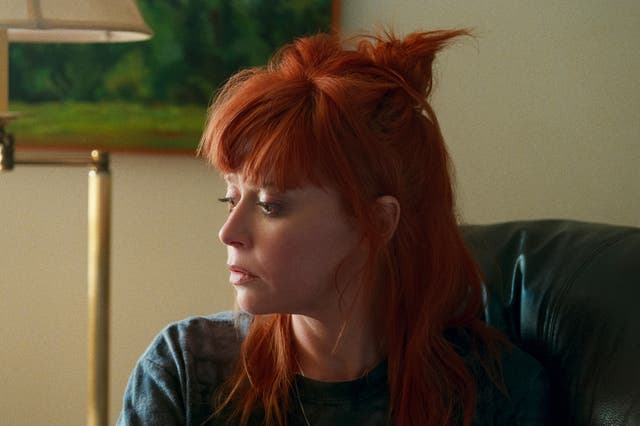
Rachel, at first, is the most likeable of the trio. She has Lyonne's fire-red curls and vinyl-scratch vocals, and fires herself like an arrow through every social situation. If she sees bulls***, she calls bulls***. But it's always disarming when Lyonne's eyebrows curl up, and those giant eyes widen a little, as if she'd just been electrocuted with sadness – it was key, too, to her Emmy-nominated performance in Netflix's time loop series, Russian Doll.
Her step-sisters – Rachel isn't related by blood, but this is the only father she's ever known – have turned up to their father's apartment, where she's been living and taking care of him, and declared it their new territory. Katie complains about her weed habit. She makes speeches that sound flat and oddly rehearsed, her arms democratically crossed like a therapist. Christina's singsong voice speaks almost exclusively about her daughter, at home a few thousand miles across the country. She's given herself the role of peacemaker, but performs it with the smallest touch of passive aggression, as Olsen brings her hand up to her chest like an affronted medieval maiden.
Read the full review here.
|
|
|
A document of where I've gone and the things I've seen |
Friday, 20 September
On this week's Fade to Black podcast I chatted to co-hosts Hanna Flint and Amon Warmann about Demi Moore's powerhouse turn in The Substance, and the nuanced work at the heart of His Three Daughters.
Sunday, 22 September
There are several ways to structure an X-Men marathon. Unfortunately, most of those ways end on a bad movie. Ours was Dark Phoenix.
Wednesday, 25 August
I caught Netflix's Nobody Wants This, which has brilliant chemistry between its leads Kristen Bell and Adam Brody, but can't seem to decide whether its a grounded limited series, romcom, or sitcom. |
Natasha Lyonne in 'His Three Daughters" |
|
|
The Society of Avid Film Watchers |
In Beyoncé's Lemonade, her historic 2016 visual album, a portrait of black femininity is presented as a series of romantic vignettes. Black women in long, white dresses – embellished with lace and high collars – sit perched in mossy trees, engaged in quiet communion. Processions of black women make their way across untouched beaches, towards the unspoken promise of rebirth and regeneration beneath the ocean's waves. There is immense beauty in how still and serene these moments are, as the women sit in communication with past traditions and the ancient roots of nature.
Critics were quick to point out that these tableaux are drawn directly from 1991's Daughters of the Dust, writer-director Julie Dash's masterful, often overlooked debut film. Set in 1902, it invokes the Gullah culture of the Sea Islands, which sit off the coast of the southeastern United States. It belongs to the descendants of enslaved people transported from central and western Africa, brought to the islands to work the rice, cotton and indigo plantations. Cut off from the mainland, the Gullah people were better able to preserve their African heritage and developed a creole language of their own, also called Gullah. Dash was inspired by experiences of her own father, whose family migrated from the Sea Islands to New York City in the early 20th century.
Daughters of the Dust focuses on the fictional Peazant family, who face a crucial moment in their own history – they've decided to leave the islands for the industrialised North, hooked on the promise of economic prosperity and cultural modernity. Some, however, are determined to stay behind. Rifts begin to form: Haagar (Kaycee Moore) heads up the leaving party, while her daughter Iona (Bahni Turpin) longs to stay behind with her secret love, a Cherokee boy named St Julien Lastchild (M Cochise Anderson).
Meanwhile, two cousins already settled on the mainland return for a farewell feast of shrimp gumbo and johnnycake, a cornmeal flatbread. Viola (Cheryl Lynn Bruce) arrives from Philadelphia with a Bible in hand, now a fervent Baptist. Yellow Mary (Barbara-O) retreats behind her bridal-like veil – the Peazants have denounced her as a "ruint" woman, a sex worker and wet nurse who arrives now with a mysterious young lover in tow (Trula Hoosier). Arthur Jafa's cinematography captures this family reunion in hazy, dreamlike tones. Under the rays of the afternoon sun, white dresses and pale sands give off an angelic glow. |
Unsurprisingly, Hollywood executives showed little interest in Dash's nuanced, contemplative script. She eventually made the film for only $800,000, using funds sourced from public broadcaster PBS. But it didn't take long for the praise to come flooding in. Jafa won the Best Cinematography prize at the Sundance Film Festival, while critics declared it a "revelation" and "a film of spellbinding visual beauty". When it first premiered in New York, it proved a sell-out success. As a result, Daughters of the Dust became the first film directed by a black woman to receive a general theatrical release in the United States. But this film – directed by a black woman, centred on the lives of black women – was labelled as a fluke. Dash never made another feature. Instead, she's worked steadily away from the spotlight, on television, commercials, and music videos.
It's a great loss to cinema. There is a need for films like Daughters of the Dust, which completely rejects the traditional, linear storytelling of the west in favour of something more lyrical. In an interview from 2016, Dash noted: "In [diasporic] culture we're not binary, we speak in rhythms and sensibilities, we're circular." Past and present create a dialogue with each other, interweaving and interlocking at key moments. There are two narrators in the film. One is known as the Unborn Child (Kay-Lynn Warren), the future daughter of Eli (Adisa Anderson) and Eula (Alva Rogers), who sometimes appears as a spirit darting in and out of frame. The other is Nana (Cora Lee Day), the elder matriarch, who dutifully upholds the old rituals. "We are two people in one body. The last of the old and the first of the new," she says, in reference to the Unborn Child. She views the migration as a threat – a potential severance of the bonds of family history.
While past and present tussle at the surface, the thrum of trauma lies steady beneath them. Older members of the family, the last generation to have lived under slavery, have had their hands permanently stained by indigo dye – an unshakeable reminder that the slave trade, amongst its many crimes, turned human beings into cogs in a machine. Eula was raped by a white landowner; she and Eli live in fear that Unborn Child might not be his. We watch as the Peazants wrestle with the burdens of their own history. Can they sail away from it to a new life? Can it be left behind? What might they lose in the process? Viola and Yellow Mary represent a possible future, but offer no answers. But Dash embraces the uncertainty. Daughters of the Dust was always about the conversation, not the conclusion. |
|
|
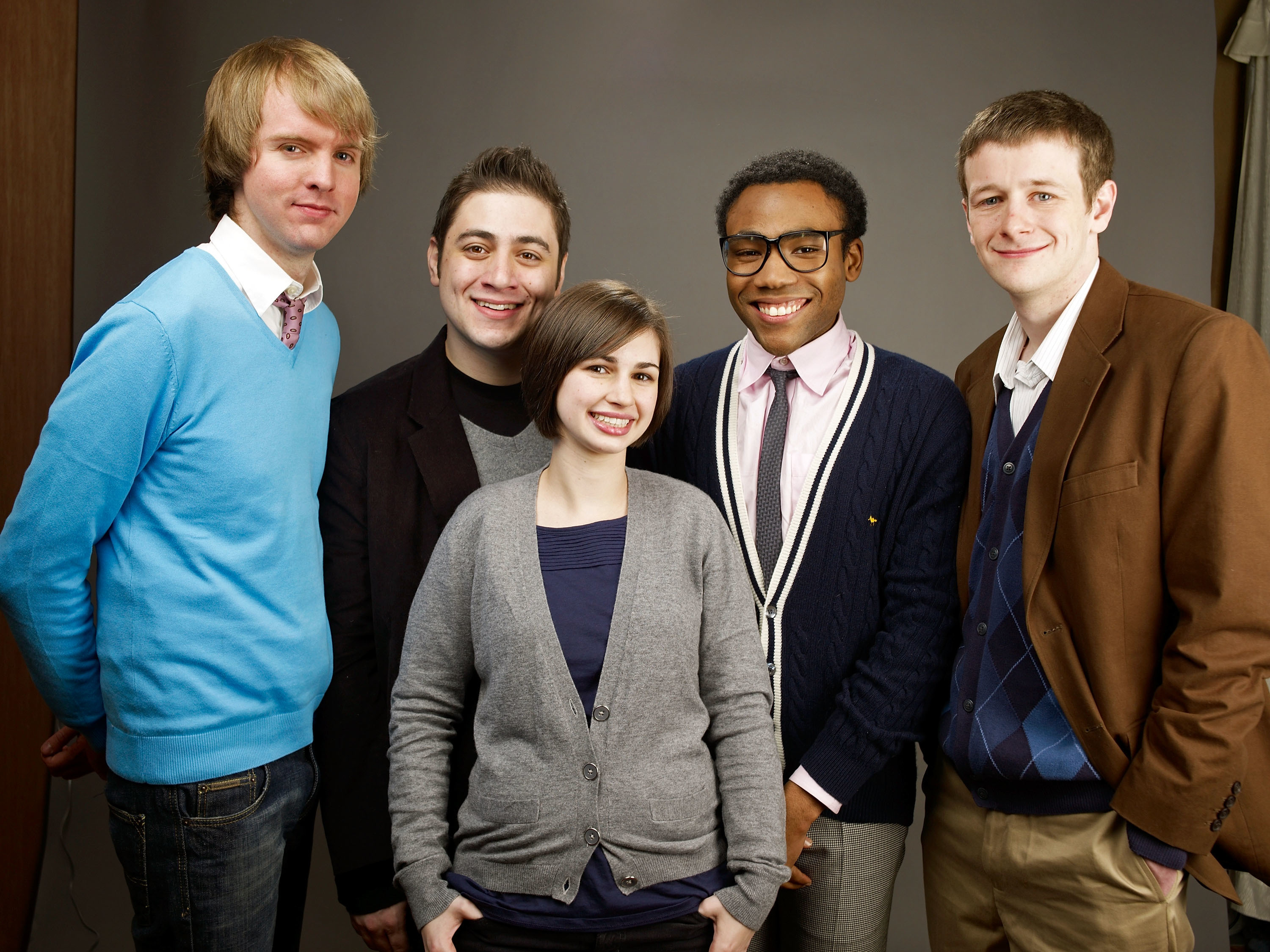
Actor DC Pierson, director Dan Eckman, producer Meggie McFadden, Donald Glover and actor Dominic Dierkes of the film "Mystery Team" pose for a portrait at the Film Lounge Media Center during the 2009 Sundance Film Festival on January 16, 2009 in Park City, Utah.
(Photo by Matt Carr/Getty Images) |
|
|
This month, I'll be revisiting the quarantine film club that started all of this and picking out some of my favourite entries. Next, it's Steven Shainberg's Secretary. |
|
|
At The Independent, nobody tells us what to think; we make up our own mind and aren't afraid to do things differently. Like our readers, we value honesty and integrity above outside influences. With your support, we challenge the status quo, uncover crucial stories, and amplify unheard voices. If you like what we do, do take out a subscription and help support the best quality online-only journalism. |
|
|
| Upgrade your home viewing experience – shop the best TV deals this month. |
|
|
Join the conversation or follow us |
|
|
Download the free Independent app |
|
|
Please do not reply directly to this email You are currently registered to receive The Independent's film newsletter. To unsubscribe from The Independent's film newsletter, or to manage your email preferences please click here. This e-mail was sent by Independent Digital News and Media Ltd, 14-18 Finsbury Square, London EC2A 1AH. Registered in England and Wales with company number 07320345
Read our privacy notice and cookie policy
|
|
| |






0 comentários:
Postar um comentário