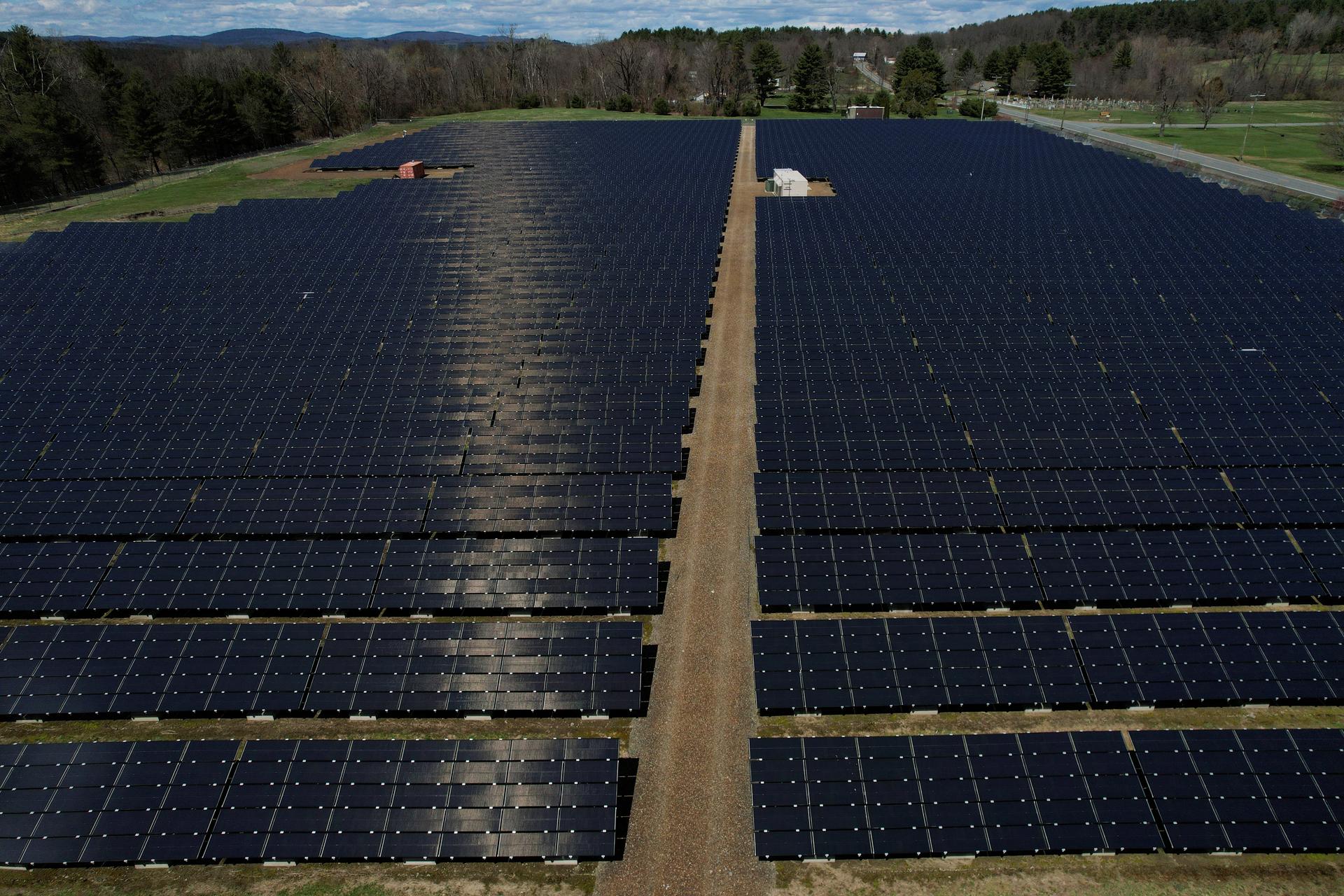
Hello! The Trump administration and its climate change law rollbacks are back as the focus of today's newsletter. This time, the Trump team took steps to rescind a Biden-era regulation that lowered fees for renewable energy projects on federal lands, saying the rule unfairly favored development of wind and solar facilities. The rule, which was finalized in 2024, formalized a roughly 80% cut in project fees for wind and solar energy developments on federal lands. Developers had complained for years that they were too high to draw investment. The Interior Department said that the White House would review the planned rescission before it was formally proposed and opened to public comment. The move aligns with U.S. President Donald Trump's goal to undo regulations introduced by his predecessor, Joe Biden, that were aimed at expanding clean energy and addressing climate change. Also on my radar today: |
|
|
Solar panels are arrayed in Northfield, Massachusetts, U.S. Picture taken with a drone. REUTERS/Brian Snyder |
Shortening approvals for oil and gas |
The renewables rollbacks come as the Trump administration announced a plan to shrink the time it takes to review potential land parcels on federal lands for oil and gas development by about half, to six months, the Interior Department said. "This policy puts us on a fast track to Energy Dominance — opening up more federal land for responsible development, cutting review times nearly in half, and sending a clear message that the United States is serious about job creation, low energy costs, and putting American energy first," Adam Suess, the Interior Department's acting assistant secretary for land and minerals management, said in a statement. The Interior Department's Bureau of Land Management said the parcel reviews, which consider whether oil and gas leasing is aligned with regional land use plans, will be conducted at the same time as congressionally mandated environmental reviews. The acceleration of energy permitting processes on federal lands has prompted concerns from environmental groups, who argue that the policies may prioritize corporate interests over public health and environmental protection. |
|
|
Some industry groups are pushing back against the various environmental cutbacks by the Trump administration. Trade group Advanced Energy United, which represents a range of clean energy, transmission, technology and transportation companies including NRG, Sunrun, Enel and Microsoft, launched a national ad campaign targeting lawmakers in five states whose districts benefit from investments spurred by the Inflation Reduction Act. The House Ways and Means committee proposed the phase-out or cancellation of several lucrative subsidies from Biden's signature climate law, the IRA. On the block are several related to wind and solar power, hydrogen, and other technologies meant to cut greenhouse gas emissions. The ads, which specify how much a congressional district has received in IRA-generated private sector and manufacturing investments, will run until a final budget bill passes in the House. Speaker Mike Johnson wants the bill passed by May 26. AEU did not divulge total spending on the ads, but called it a "six-digit" campaign. |
A woman reacts during the funeral of Palestinians killed in Israeli strikes, at Nasser hospital, in Khan Younis, southern Gaza Strip. REUTERS/Hatem Khaled |
- Gaza aid: A U.S.-backed humanitarian organization will start work in Gaza by the end of May under a heavily criticized aid distribution plan but has asked Israel to let the United Nations and others resume deliveries to Palestinians now until it is set up. The plan was initiated by Israel and involves private companies – instead of the U.N. and aid groups – transporting aid into Gaza to a limited number of so-called secure distribution sites, which Israel said would be in Gaza's south.
- WHO cuts: The World Health Organization has reduced its management team by half and will have to scale back operations, its director-general Tedros Adhanom Ghebreyesus said, four months after the United States announced it was leaving the agency and cutting funding. Ghebreyesus said the body and its member states must make difficult choices about what to prioritise, given a proposed 21% cut in the budget for 2026-2027 to $4.2 billion.
- Harvard v Trump: Keeping with Trump funding cuts, Harvard University expanded its lawsuit challenging the Trump administration's moves to cut off billions of dollars in funding after a federal antisemitism task force announced that eight government agencies will be terminating an additional $450 million in grants. Harvard argues the administration's sweeping demands violate the free speech guarantees of the U.S. Constitution's First Amendment and were instituted without following proper procedures. Click here for the full story.
- U.S. deportations: Judge Stephanie Haines, a U.S. federal judge in Pennsylvania appointed by Trump during his first term, ruled that the United States can use the Alien Enemies Act to fast-track the deportation of accused Venezuelan gang members, in what appears to be the first court ruling that backs the Trump administration's interpretation of the 1798 law.
- Meta AI data lawsuit: Austrian advocacy group NOYB, or none of your business, is seeking an injunction against Meta Platforms that could lead to substantial claims if the tech giant goes ahead with plans to use Europeans' personal data to train its AI models. Meta has cited legitimate interest under EU privacy rules for using users' data to train and develop its generative AI models and other AI tools that can be shared with third parties.
|
|
|
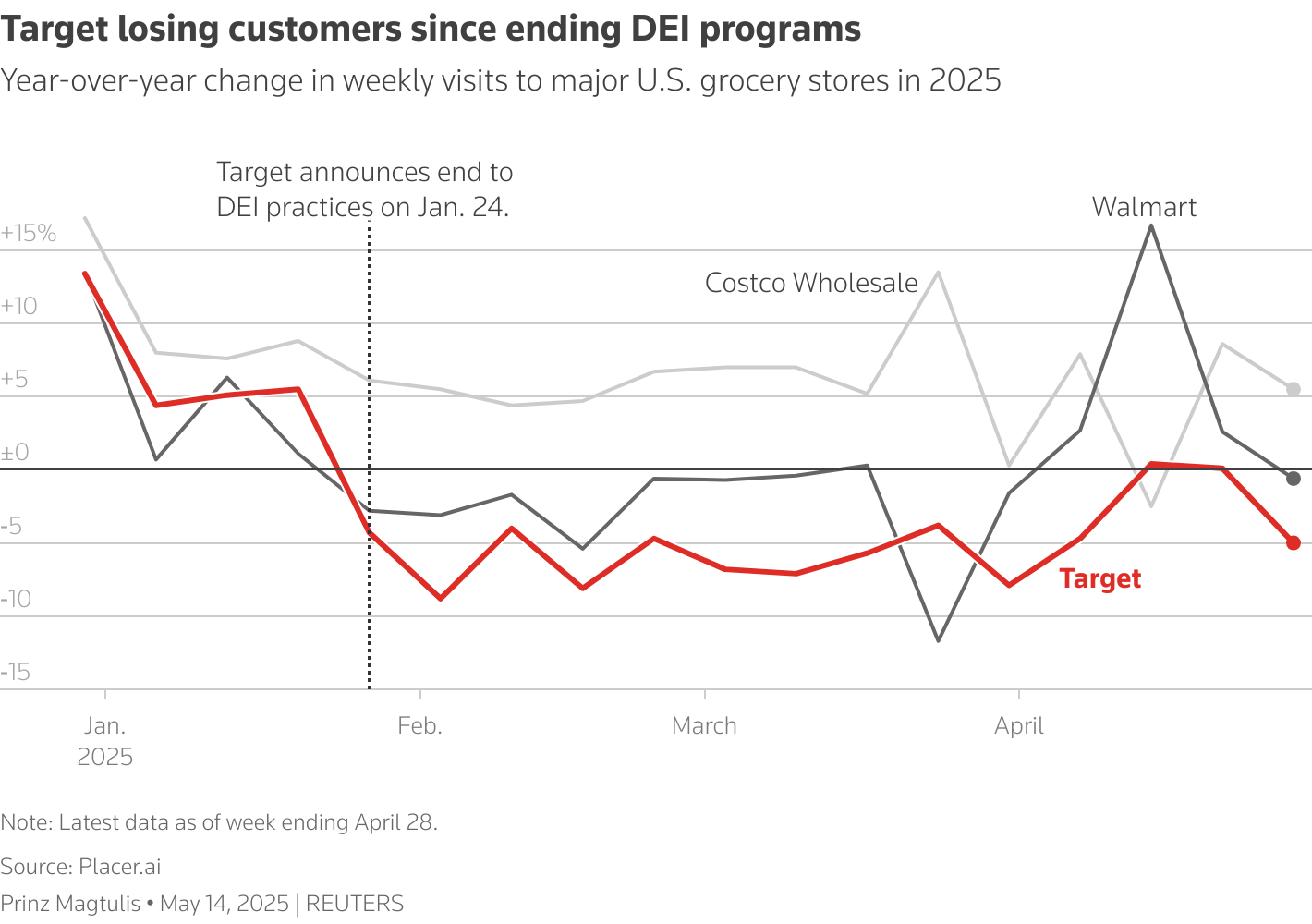
Consumers have voted with their wallets – Target has faced financial setbacks since scrapping its diversity, equity and inclusion program that included a goal to increase the number of Black employees by 20% over three years. A Target spokesperson said the new approach "is all about driving business results by increasing relevance with U.S. consumers and making Target a destination for talent." Click here for an in-depth Reuters feature about DEI programs in U.S. corporations. |
Panagiotis Mastoris, 38, a member of the Volunteer Forest Firefighters Rescue Team, checks a hose during a patrol, in Ekali, northern Athens, Greece. REUTERS/Stelios Misinas |
Today's spotlight is on the thousands of brave volunteer men and women firefighters who juggle day jobs with battling Greece's devastating summer blazes, sometimes dropping everything to go wherever they are needed. Greece's fire service is a mixed model of permanent staff and seasonal workers and has long been backed by volunteers, viewed by many Greeks as the heart of the country's firefighting efforts. Images of exhausted firefighters in blackened uniforms sleeping on the roadside are frequently posted online alongside messages of support. |
|
|
Sustainable Switch was edited by Emelia Sithole-Matarise. |
Sustainable Switch is sent three times a week. Think your friend or colleague should know about us? Forward this newsletter to them. They can also sign up here. Want to stop receiving this email? Unsubscribe here. To manage which newsletters you're signed up for, click here. This email includes limited tracking for Reuters to understand whether you've engaged with its contents. For more information on how we process your personal information and your rights, please see our Privacy Statement. Terms & Conditions |
|
|
|








0 comentários:
Postar um comentário