

SINCE OWLS WERE CARVED IN CAVES, artists and scholars have not only depicted the beauty of birds, but also have observed avians and anthropomorphized them into gods and guardians, symbols and superstitions. Ancient civilizations revered many birds and despised others. Think of the Egyptians and their ibises, monks and their intricate manuscripts, the eagles of Rome, croaking ravens of the tower of London, Northwest totem poles topped by ravens. Let’s bird through Crewdson’s world:
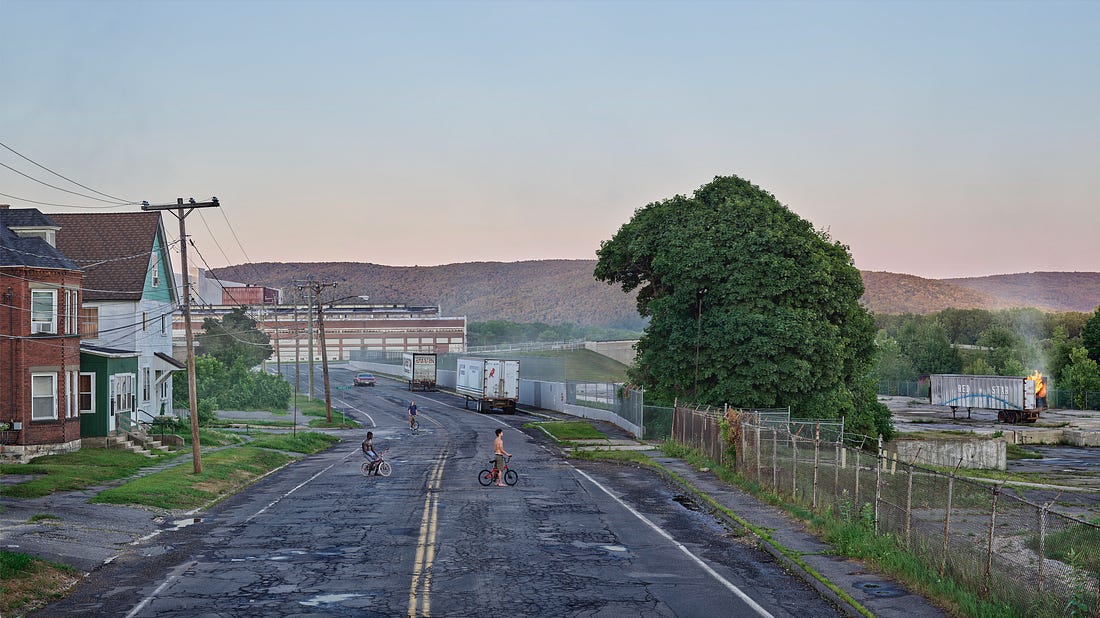
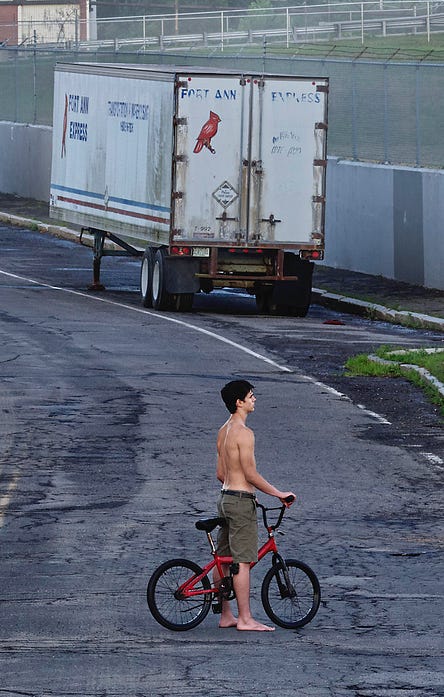
1. In his Red Star Express, three boys are motionless on their bikes staring. We stare along with them and find a semi on fire in an abandoned factory’s lot. Are the boys admiring their handiwork? The street glistens with sadness, the factory building in the background.
But wait! A small, bright, red cardinal decorates the rear door of a discarded semi parked along this desolate street. Is this a guardian of the boys, of the factory? or a representation of the loss of habitat, reducing the birds in the area to mere pictures on a truck door?
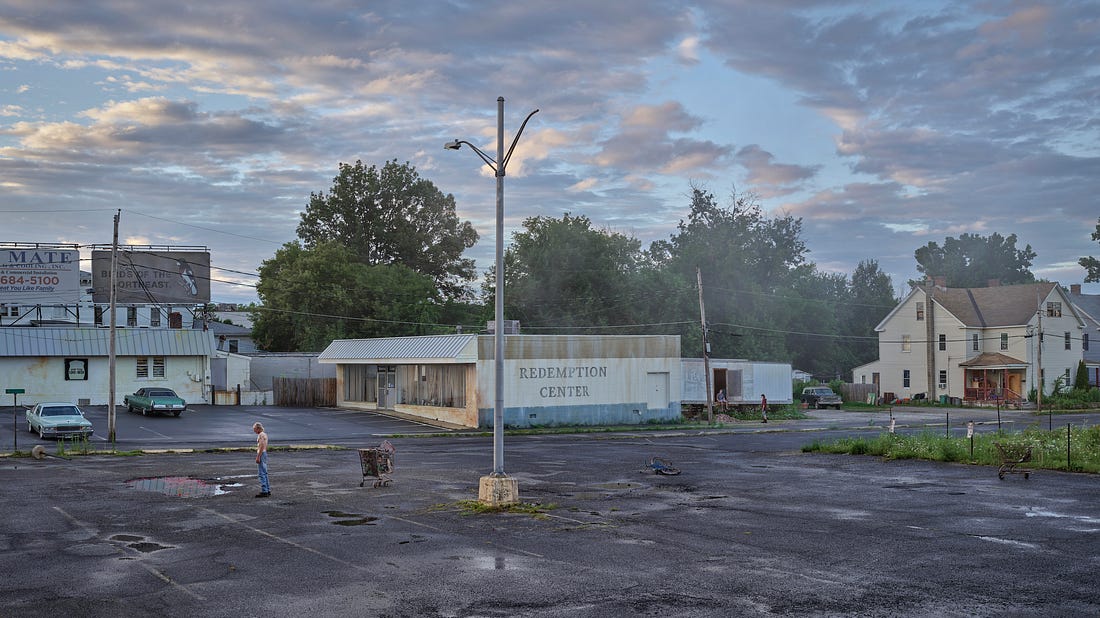
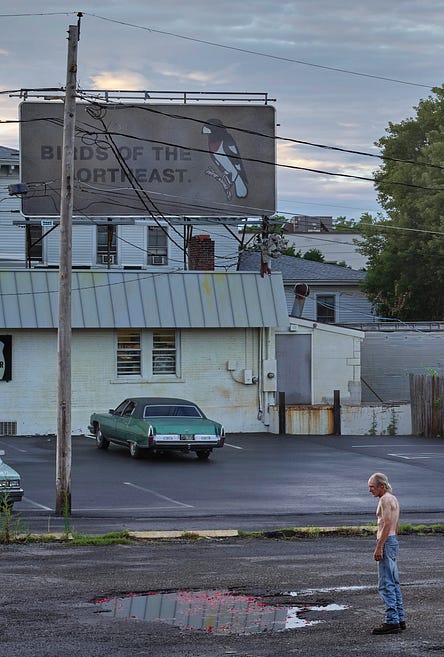
2. Another street scene Redemption Center, has a solitary man, feet together, arms at his side (like a mannequin before use, like doll house dolls not yet placed into an active situation), stares at a puddle red with leaves in a parking lot. A shopping cart full of bottles and cans is behind him. Another cart is a little further away. Across the street is a redemption center (what is being redeemed…this man’s soul? the recyclables in the carts?) Behind the center, two motionless young men are staring at a heap of returnables.
Above it all is a weathered billboard with a rose-breasted grosbeak and the words: BIRDS OF THE NORTHEAST. No live birds, no crows in the sky, no pigeons or sparrows drinking from the puddle. The billboard is like a gravestone.
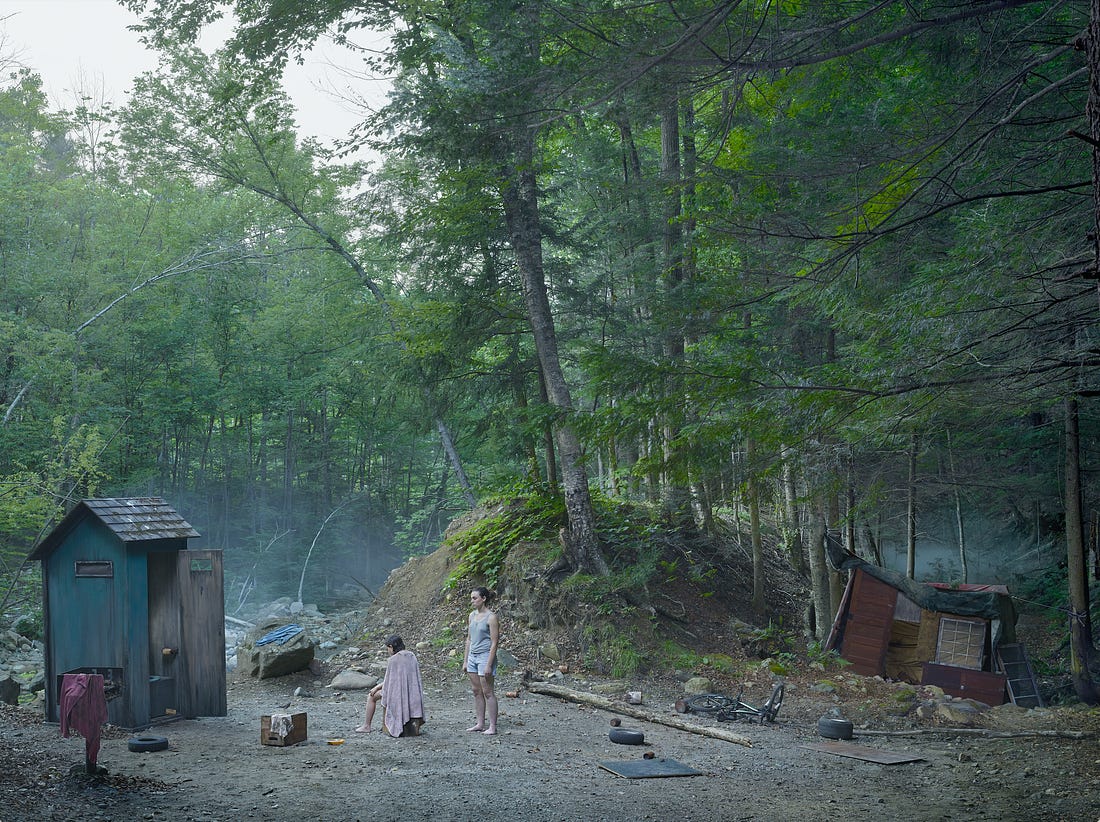
3. The Haircut: In a clearing in lush green woods by a not-visible stream, two children, one standing, the other sitting for a haircut, are seen between an open-doored outhouse with a roll of moldy toilet paper and a makeshift shelter complete with windows and a tarp for a roof. Are they living on their own in the forest?
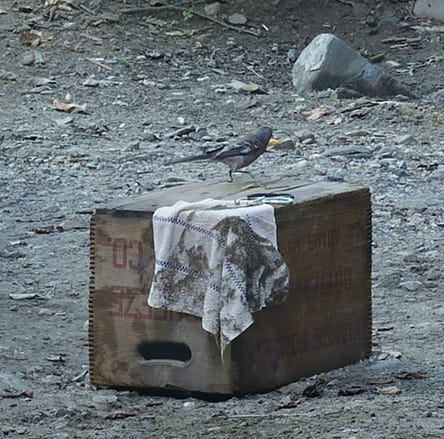
The area is more despoiled with old tires and a bike lying on its side. The overturned crate has a dish towel with the image of a wood duck on it, and standing near the draped cloth is a mockingbird, a little out of its territory. The mockingbird is peering at the children. The children are staring into the woods. The bird, too, is living in the woods when its normal habitat is open areas, fields and backyards. Could the bird feel the need to stay with the abandoned children?
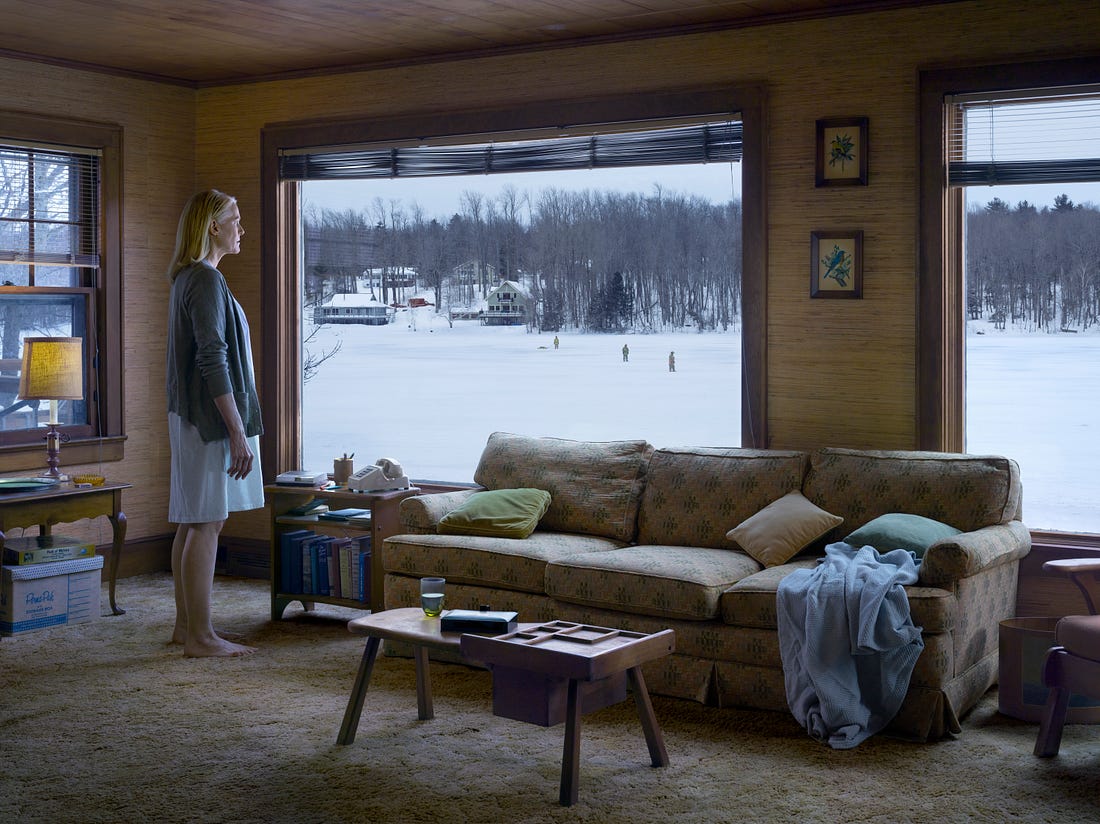
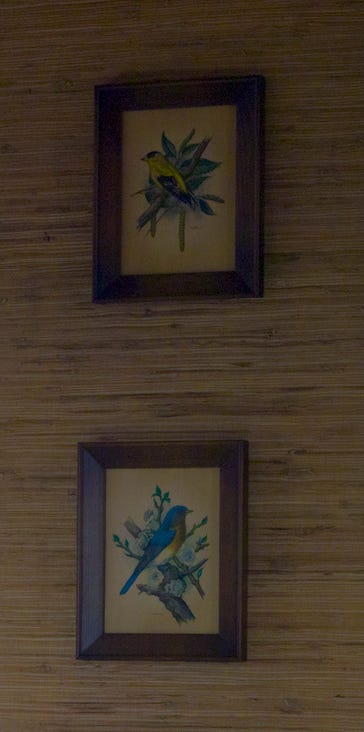
4. The Disturbance: Through the picture window, a woman in a housedress and sweater is looking out the window at a cold and snowy landscape with three solitary ice fisherman.
The only birds in this photograph are prints framed on the wall, a bluebird and an American goldfinch, allowing people to glimpse their beauty indoors when away from the natural world. Bright spots in shadowy gloom.
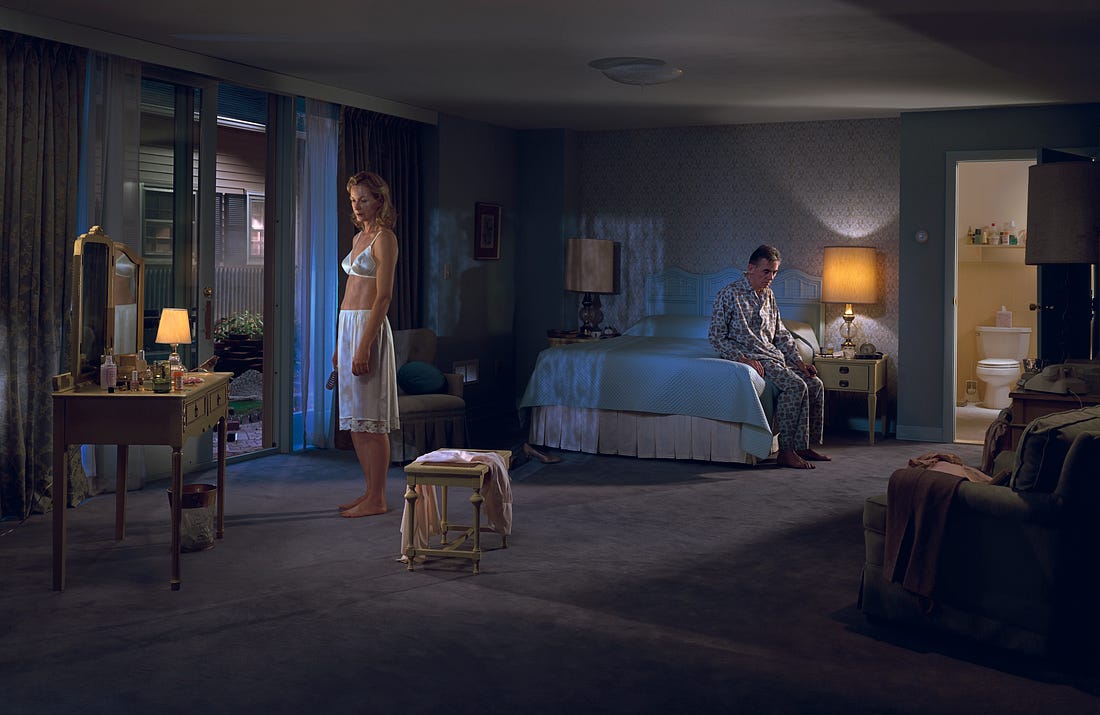
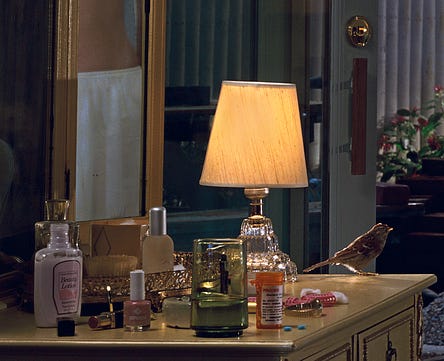
5. Untitled from Beneath the Roses: This portrait is of a man and women preparing for bed in a perfectly appointed room. Neither looks at the other. They appear so disconnected they could be in two different places. Both look more than pensive as if they were stunned into utter stillness and silence.
A sparrow perched on the vanity amid creams and sprays watches them.
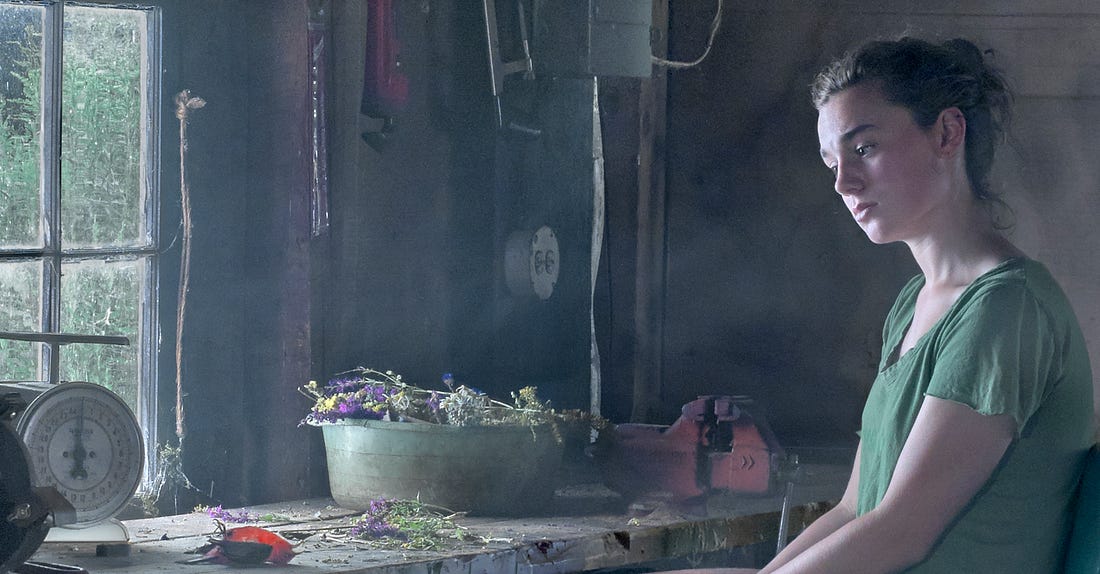
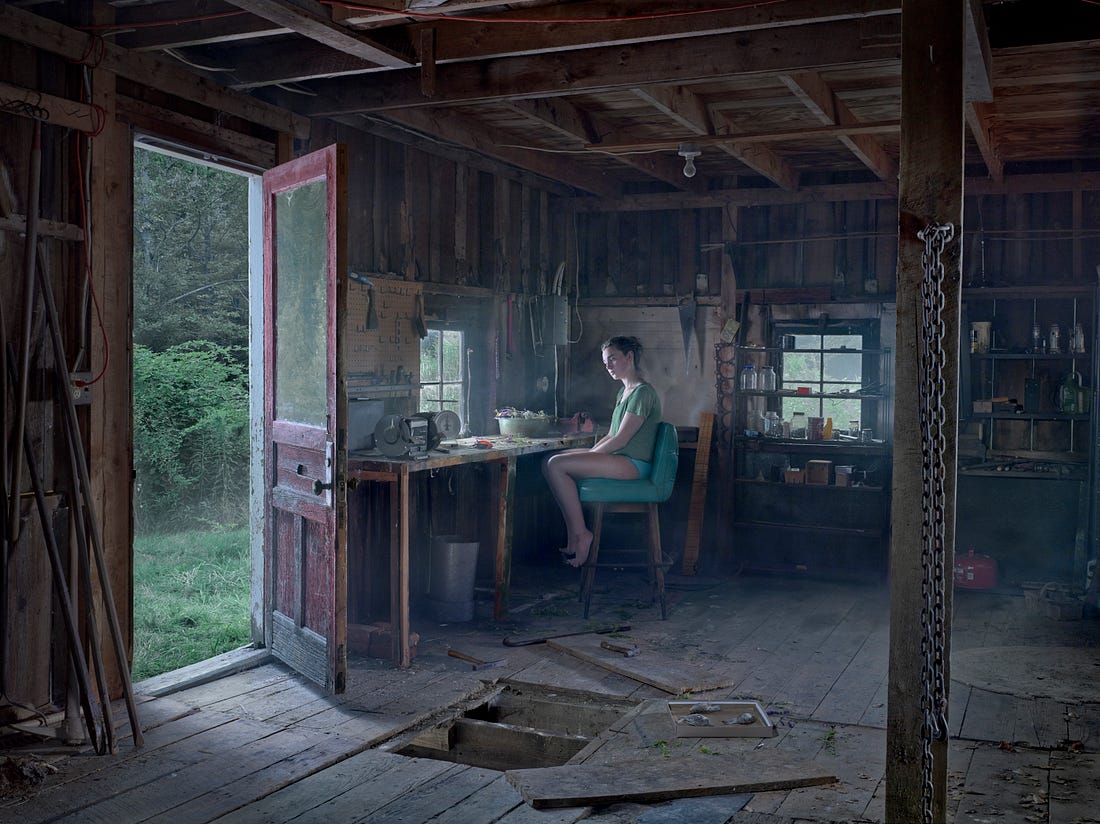
6. More complicated is the photograph of the young woman seated at a work station in a barn or cabin with a bird in front of her. It appears to be a scarlet tanager, but we only see the belly.
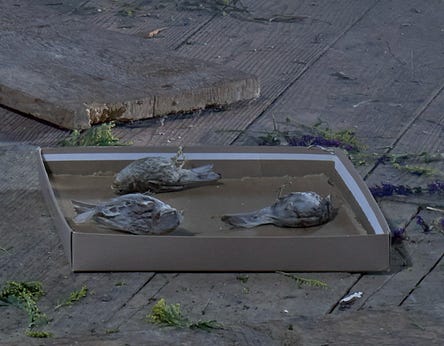
Three unidentifiable dead birds that could be sparrows or finches are on the floor in the flat top of a cardboard carton. What she is doing is not clear. This is not a taxidermist workshop; there’s no evidence of making feathered jewelry; the birds too small for food. Does she bury the birds under the house where the floorboards are pulled out?
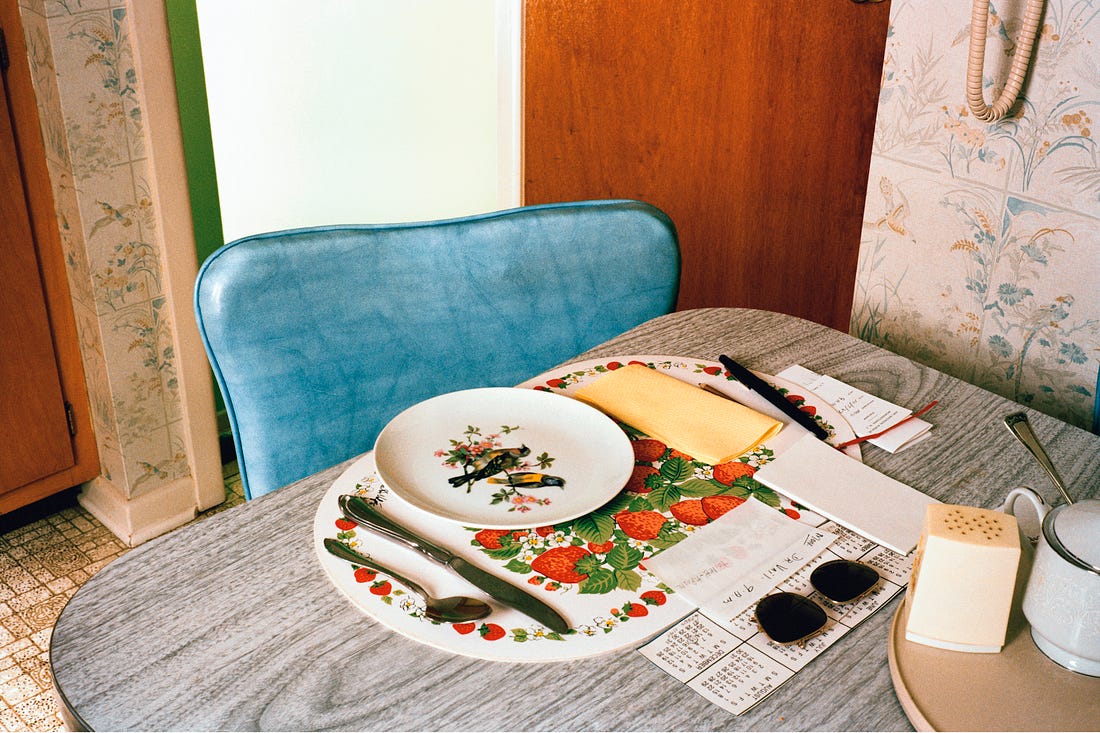
7. From Crewdson’s, Early Work, another indoor photo, this without people, shows a formica table and chair in a nook in a kitchen. The placemat is bright with painted strawberries, in contrast to the plate with a pair of black and orange birds, perhaps oriole but a species I am not familiar with.
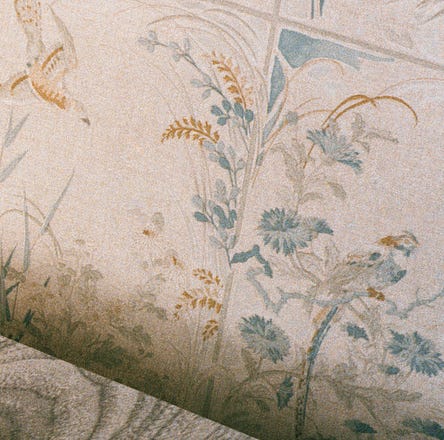
If you study the picture, you’ll see that there are even more birds on the faded tiling/wallpaper, stylized birds that defy ornithological categorization. Some look like flying hummingbirds or miniature pterodactyls; others like hybrid sparrow/grosbeaks. Artist visions of species that would not appear in a modern field guide. Other photographs from the Natural Wonder and Twilight series are strictly for the birds depicting how we humans have disrupted their world. People believe that there is no climate change and no need to monitor our use of toxins that are destroying the natural world.
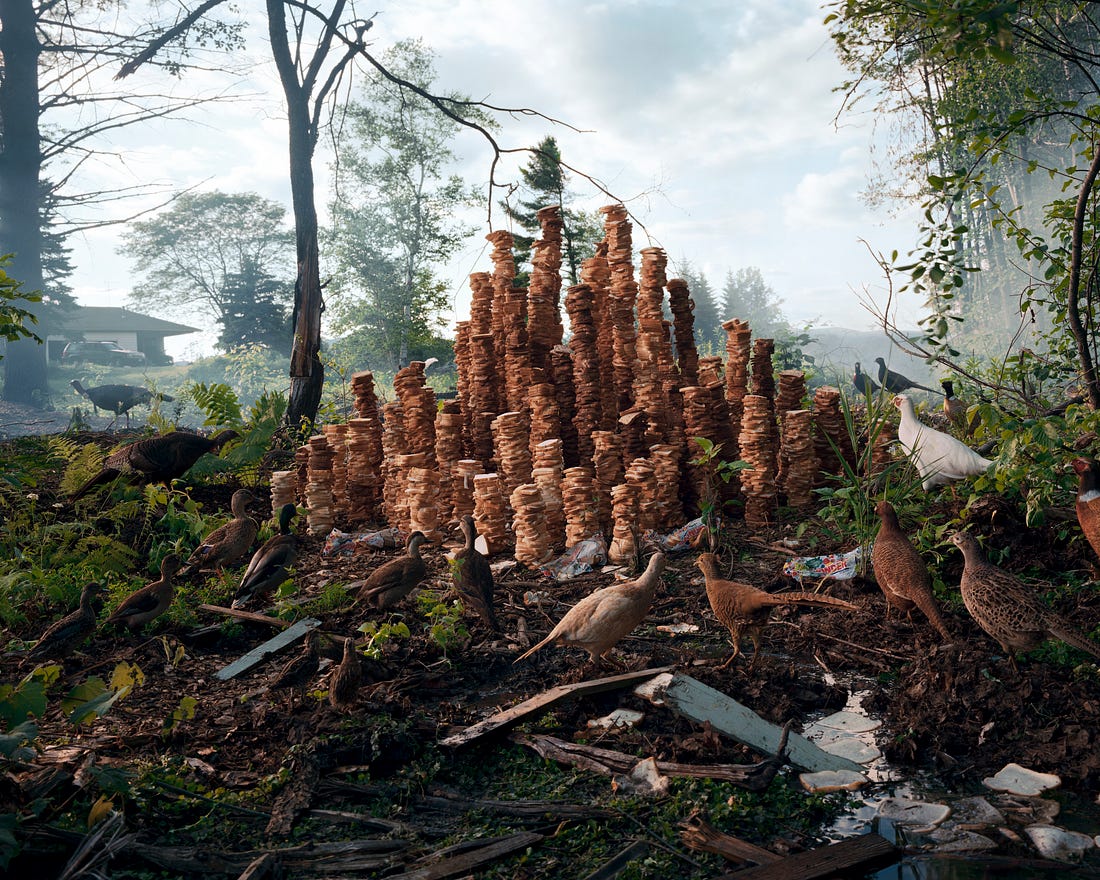
8. Stalagmites of Wonder Bread are surrounded by bevies of gallinaceous birds, a few ducks and a pair of wild turkeys. They could all be clucking: ‘We do not eat bread, but a handful of grains of wheat would be appreciated!”
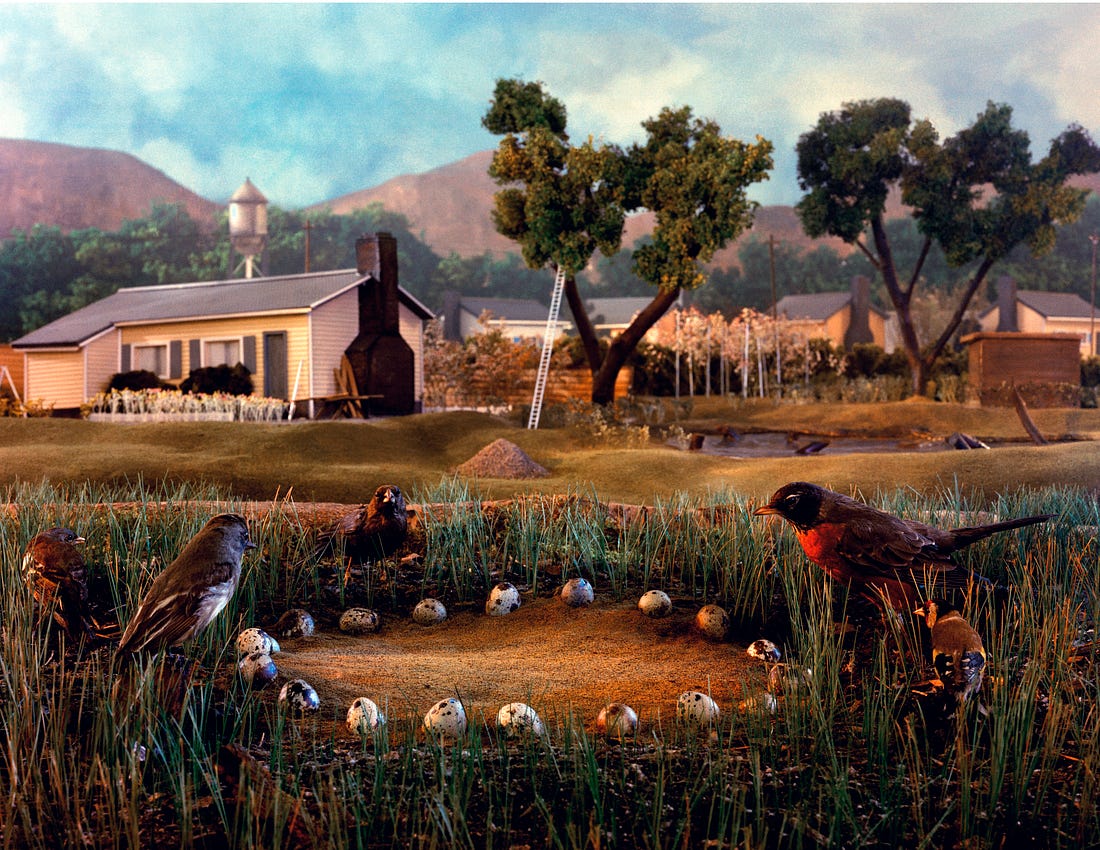
9. Another photo shows an avian pregnancy support group, a circle of mixed species birds standing guards over their sandlot nest with their speckled eggs. Do the birds—a robin, a blackbird and possibly a flycatcher—not notice the ladder leading into the leafy tree that enables egg snatchers to destroy their nests and steal their eggs while they live comfortably in their nearby house?
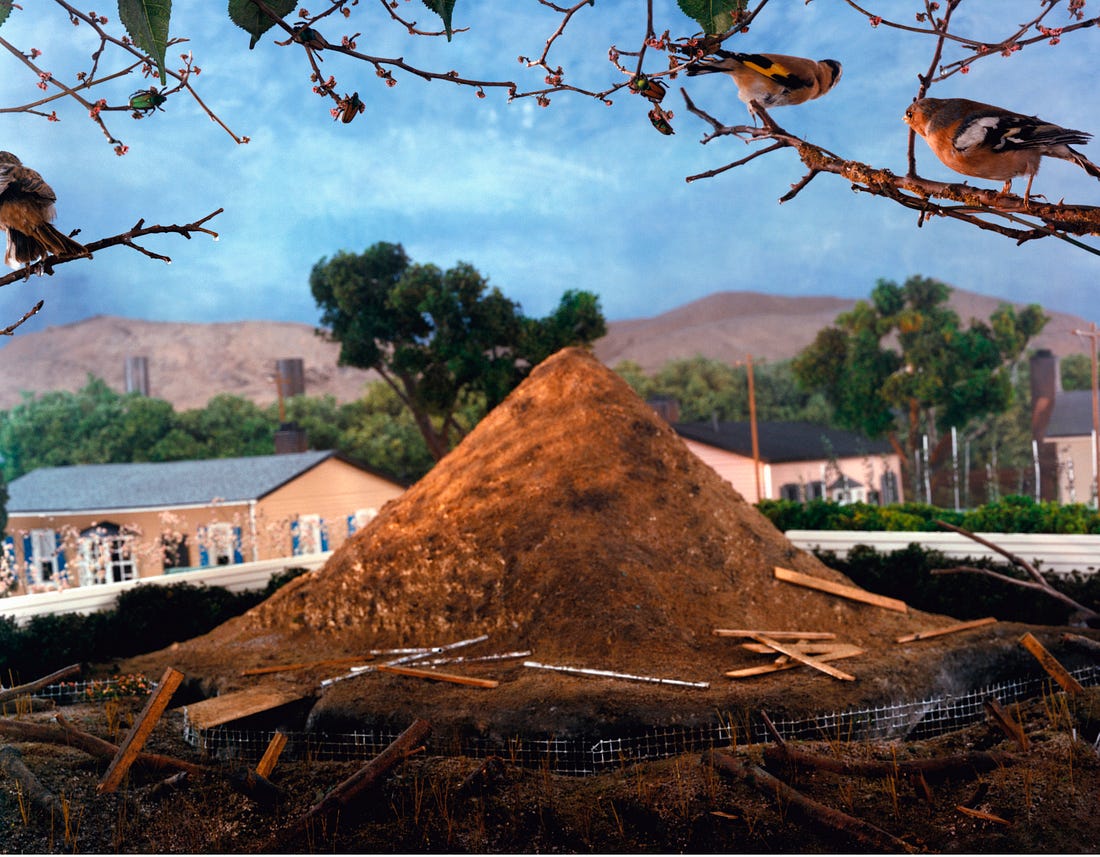
10. Three birds on branches stare at a disquieting scene. Just beneath the perching birds is a pyramid pile of dirt surrounded with planks and a short wire retaining wall fence, a construction site. A definite intrusion and the beginning of destruction of the birds territory. In an idle moment, I wonder if Crewdson, who is utterly meticulous in setting up his photographs, placed the two British (actually European ) bird species—the European goldfinch and the chaffinch—here to represent that major changes can happen: We sent the British packing and yet still allowed them to migrate back.
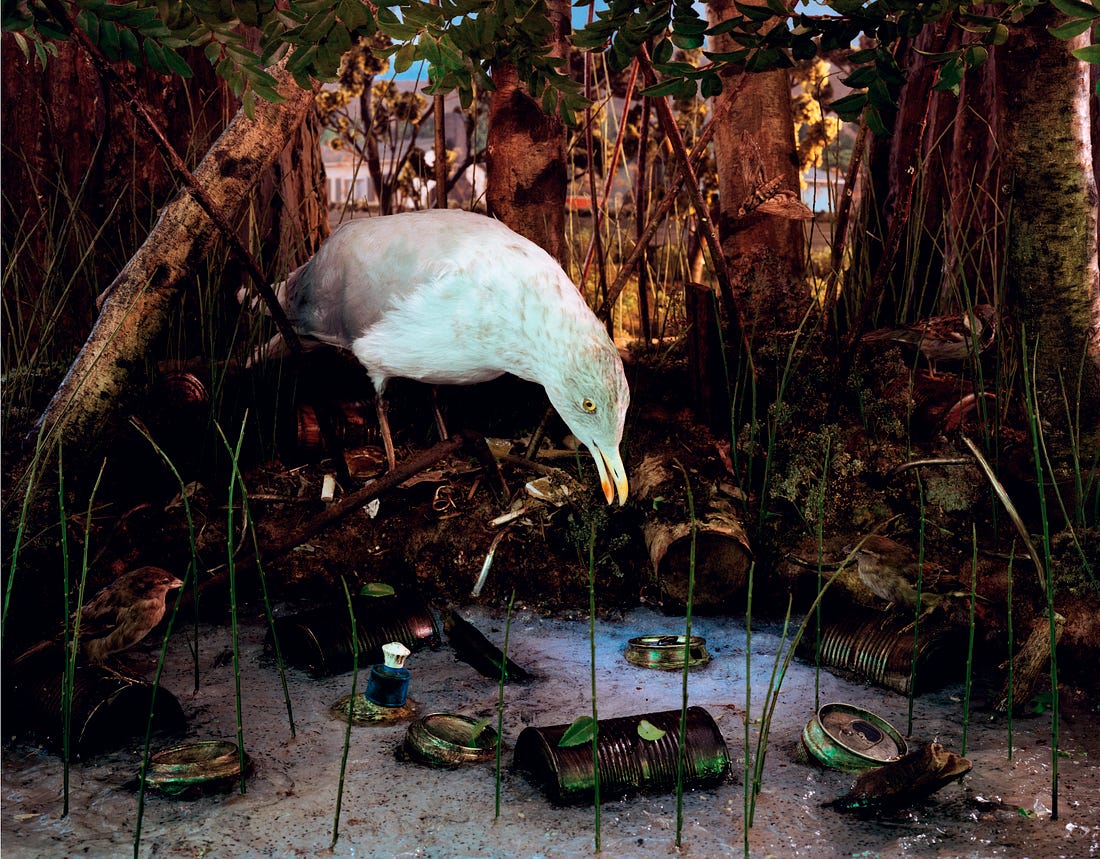
11. That poor immature gull that wandered into the woodlands away from its normal habitat near a sea, a river or a lake. The bird is thirsty, it needs water, but stares (like all the people of Crewdson’s photos) with a bright yellow eye into a vernal pool filled with beer cans and bottles floating among the weeds. Two house sparrows are hopping in to slake their thirst too. But even small woodland pools have been trashed by humans and made toxic to wildlife. The Crewdson checklist of birds is growing, while birds in the real world are dying daily from the thoughtlessness of human intervention and the utter callousness of corporate greed. Over time, five species in North America have become extinct with many more endangered as the people population increases. The photographs capture a post-edenic world where people don’t live in harmony with nature, but in non-communicating squalor, the birds persist as reminders of what has been lost. Clellie Lynch has been an avid birder since her childhood on the bird-rich eastern end of Long Island. She would go out with her parents who were avid birders themselves, having met on a Linnaean Society field trip. Since moving to the area, she has been writing articles for the Berkshire Eagle on nature and wildlife for twenty-five years. She and her husband Dan have birded throughout the world and seen over 1600 species. The Crewdson Trail Log is edited by Juliane Hiam. You're currently a free subscriber to Crewdson Trail Log. For the full experience, upgrade your subscription.
|
Guest Column: BIRDING THROUGH CREWDSON'S WORLD






Assinar:
Postar comentários (Atom)
0 comentários:
Postar um comentário