My family is far from alone. Since the start of the invasion, 1.9 million people, nearly 90% of Gaza's population, have been internally displaced – many of them forced to move over and over again as Israel expands its war into areas it told us would be safe. The occupation now controls large parts of the Strip, leaving less than 30% of Gaza's original area habitable and making freedom of movement impossible.
In mid-March, two months after it started, the ceasefire ended abruptly and the war's devastation resumed overnight. The bombardment intensified worse than ever, and by the morning, Rafah was surrounded by Israeli tanks. We were forced to evacuate for a fifth time, returning to a tent in Mawasi without any of the belongings I had managed to salvage from our shelled home.
On that day, I realised my old life would never return. For me, it was a new phase of the war, a new chapter of terror. I had to face that the relentless and violent bombing was not just a passing event, but our everyday reality – everything I knew from before the war was gone, just memories.
For more than a year, Rafah has been entirely under occupation, with no news of when we might be able to go home. The city is no longer as I knew it growing up. There is no safety, and freedom of movement is impossible.
Despite all the loss and suffering tied into displacement, it has reunited me with friends whom war stopped me from seeing for over a year. Hamdan, my friend from Khan Younis, Mahmoud from Gaza City, and Ramez from East Khan Younis; we all found ourselves in the same area, a small solace in all the devastation.
My friends and I began sharing our stories and sorrows every day. Mahmoud, with whom I went to university before its buildings were destroyed and our dreams were shattered, told us of how his family spent most of the past two years refusing to leave Gaza City, in the north of the Gaza Strip, choosing to endure the war in their home.
Then, last month, Binyamin Netanyahu's occupation announced its plan to fully occupy the city. The shelling intensified, and every time Mahmoud looked out of his window, he would see the trucks that were carrying more than half a million people and their belongings south.
Over 200,000 families remained in the city, though. Some had nowhere else to go, some could not afford the up to $5,000 it can cost to transport belongings and purchase tents, and some, like Mahmoud's family, simply did not want to leave.
Eventually, the shelling hit the neighbourhood where Mahmoud and his family lived, and became a daily occurrence. Several nearby tower blocks were destroyed. All services in the area collapsed; there was no potable water, or even dirty water, and no people on the streets or in the markets. Life became impossible. Mahmoud's family was finally forced to evacuate.
Mahmoud and I are no longer who we once were. We used to have breakfast together in the university cafeteria, walk through the lecture halls together to attend our daily classes, and go together to Gaza City's central library to borrow a book or one of the English novels. Now, we still see each other most days – living as we do in nearby camps – but our lives are so different now; we are unrecognisable from who we once were.
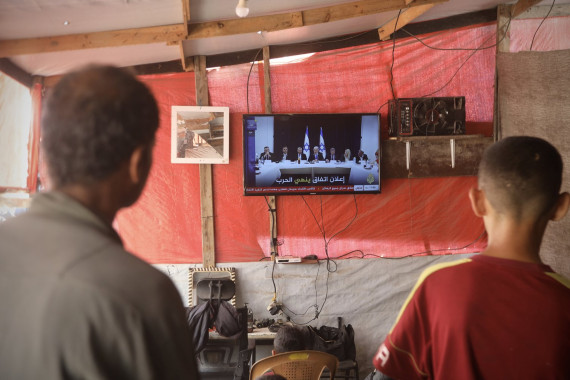
Two years have passed in which life has been on hold. Every day we have asked ourselves the same question: will this nightmare ever end? Then, last night, we finally heard the news that we have all been waiting for: Israel and Hamas appear ready to reach a peace deal.
The camp instantly came alive. Women began to ululate and children laughed, it felt as though everyone had been waiting for just one moment to breathe, a brief pause from this long fear. No one knows if this is truly the end or just another pause in the war, but today, we all need to believe that peace – even for a moment – is still possible.


0 comentários:
Postar um comentário