| Welcome, Weekenders! In this newsletter: |
| • The Big Read: Inside Benchmark's high-stakes pressure test |
| • Artificial Intelligence: The VCs who turned vibe code into whimsical passion projects |
| • Artificial Intelligence: Venerable Casio's surprise hit? An AI robopet |
| • WTF: Behind the scenes at our summit for the most powerful and influential women in tech, media and finance |
| • The Arena: WNBA owner Clara Wu Tsai has a $1 billion plan |
| • Plus, our Recommendations: "Camp Swamp Road," "The Running Ground" and "Down Cemetery Road" |
| |
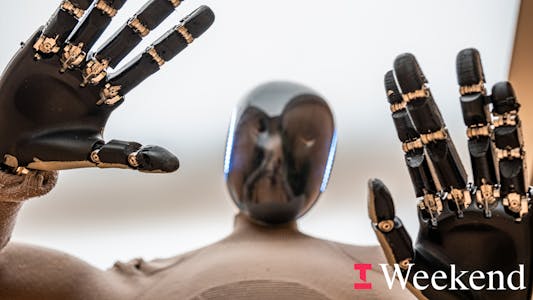
| Judging by nothing more scientific than the tweets and the memes, plenty of people would love to get their hands on a Neo. That's the humanoid robot given a surprise unveiling on Wednesday by 1X Technologies, a little-known startup run by a Norwegian CEO, Bernt Børnich, a jovial sort who presents himself as a mashup between a skateboarder and a Skarsgård sibling. |
| 1X plans to sell Neos for $20,000 a piece and also let people rent them for $499 a month. If everything goes according to 1X's plan, deliveries will begin next year as the startup makes a small batch of Neos available. That's a big "if," as YouTuber Marques Brownlee points out, but the Neo's relatively low price—and the chance it'll be ready next year—has ignited hopes that the era of advanced robotics at home is arriving sooner than expected. |
| Count me as one of those people who'd like a Neo, which sorta resembles a baby-faced C-3PO in yoga wear—but not quite for the same reason as many others, I'd imagine. I don't want one for me. I want one for my aging parents in rural America, where finding quality, dependable housekeeping staff is difficult. Would I pay $499 a month for a robomaid to get my mom off her feet a bit more? Hell, I'd pay double, triple—quadruple. (Generally, I think the potential for AI and robotics to meaningfully transform eldercare is an overlooked part of both markets.) |
| Still, it is trippy to consider the economy I'm so eager to see develop. While I lament about the lack of good housekeepers in Appalachia, they exist in plenty of other places, and widespread adoption of Neos would almost certainly depress their wages. That's, uh, obviously not great: We'd need to find ways to retrain those people for new jobs or face the macroeconomic consequences of greater unemployment. |
| Next, let's think about teleoperators, the industry term for the people employed by companies like 1X to remotely operate robots such as Neo. The robot will require some support from teleoperators to function, at least for the time being. I can picture a future where we've replaced large swaths of our world with teleoperated robots—as humanlike AI remains a quixotic concept, and the robots still need our help. |
| For teleoperation to achieve a financially viable scale, we'd probably have to treat teleoperators as we currently do call center staff—pay them a paltry amount and outsource many of the jobs. That's what we already do with some teleoperators. |
| Yeah, it's a weird future I'm describing, where the labor dynamics are the mirror inverse of what we saw in the pandemic. During lockdown, many blue-collar workers had to physically go to their jobs, while their white-collar counterparts didn't. It'd be the opposite if teleoperated robots replace the need for low-skill workers to turn up in person. Instead, those employees would stay home, and by contrast, in-person work would be a key signifier of economic and social status. (Hey, it'd be one way to end the work-from-home debate.) |
| Not everyone benefits from a planet full of Neos, and that tempers my excitement a little. Which, I think, simply qualifies as a very human response. |
| What else happened this week… |
| • Shopify's Tobias Lütke, who has called using AI a "fundamental expectation" for employees, caused a stir by saying he dislikes AI—specifically, AI note-taking apps. (Later, he offered a clarification: He's totally OK with those apps—as long as people use them in a way that's completely not how anyone uses them.) |
| • Actually, maybe conservatives are the real snowflakes. |
| • The Mercor kids, the youngest self-made billionaires ever, according to Forbes, seem to have an endearing earnestness, with CEO Brendan Foody describing their newfound good fortune as "definitely crazy," "very surreal" and "beyond our wildest imaginations." (Here's more about Mercor in this week's Big Read.) |
| • A startup that makes giant blueberries and other fruit has raised $150 million, including some more money from Ray Dalio. As I've previously noted, fancy fruit is flourishing! |
| • Depop, a shopping app, has "carved out a niche as a sort of Salvation Army for Gen Z." |
| • Let's be clear: @ArfurRock, the anonymously run X account that posts about startup valuations and has been previously confused as something like journalism, is, in fact, mostly a fundraising shill. |
| • The Economist is worried about the "definancialisation" of New York—the decreasing number of new Wall Street jobs—and how a Mayor Zohran might hasten it. For my part, I'm not gonna worry about Wall Street's decline until it's possible to actually get a table at Torrisi.—Abram Brown |
| |
|
|
 |
|
| Few venture outfits enjoy the sort of reputation Benchmark does. "Benchmark is royalty," said Will Bryk, CEO of Exa, which is one of the latest startups won over by the storied firm. |
| Still, unsteady sits the crown these days: Benchmark finds itself grappling with a startup landscape altered by the surge in AI companies, our Natasha Mascarenhas reports in Weekend's latest Big Read. The environment isn't an ideal one for how Benchmark has operated in the past, and partly in response, the shop has altered some strategies and poached a young gun as a new general partner. |
|
 |
|
| Among the technorati, AI-assisted coding is seen both as an incredible commercial opportunity—and a faddish hobby to pick up, our Jemima McEvoy finds. Venture capitalists like Acme Capital's Scott Stanford are filling their leisure time with vibe code side projects: Stanford, for one, has come up with Popcorn AI, an app that reads the news aloud in various musical styles. He insists his vibe coding exploits are for pleasure only. "I'm not doing this to give me another day job," he said. |
|
 |
|
| If Casio—yes, humble ol' Casio—succeeds, we may remember Moflins as one of the AI era's first standout consumer products, writes Jessica Roy, a returning contributor to Weekend. |
| Moflins, which are AI-equipped, Tribble-esque robopets, have already been a smash hit in the company's native Japan, and they're newly available in America, sparking anew thorny debates about how much intimacy we should share with the emerging technology and how that should differ for kids. Casio's |
|
 |
|
| Throughout the week, a number of our reporters filed regular dispatches from The Information's WTF Summit, which convenes the most powerful and influential women in tech, media and finance. Those stories are worth reading to get a sense of what these VIPs discussed—they're here, here and here—and in this Weekend piece, you'll find some behind-the-scenes pictures from the action in Yountville, Calif. |
|
 |
|
| The co-owner and governor of the New York Liberty appeared at our WTF Summit to talk about surging WNBA valuations, the rise of sports streaming and negotiations with the league's players over a new contract. |
| Abram Brown is the editor of The Information's Weekend section. You can reach him at abe@theinformation.com or find him on X. |
| |
 |
| Listening: "Camp Swamp Road" |
| Horry County, S.C., is a gun-lovin' part of America that enjoys a particularly expansive stand-your-ground law. More than 30 states have such legislation, granting people the right to shoot and kill an armed intruder. Most require someone to try to retreat from the encounter before firing—but not South Carolina, which, as The Wall Street Journal's Valerie Bauerlein notes, "creates some challenges for law enforcement." |
| I think Bauerlein, a Southern native, is putting it politely. From my carpetbagger's perspective, Horry County sounds like frontier territory in what amounts to a redneck Wild West. |
| Granted, such a locale does make a grand setting for a true crime podcast like Bauerlein's "Camp Swamp Road," a co-production from Spotify and The Journal, which examines the 2023 shooting of 33-year-old Scott Spivey. Initially, local police decided the incident on that titular backcountry street fell under South Carolina's stand-your-ground law, and they didn't charge the man who killed Spivey. In actuality, the truth of the matter seems to exist within the remarkable cache of audio recordings obtained by Bauerlein; together with her narration, they form much of "Camp Swamp Road," giving the pod a real sense of sweaty-brow intimacy.—Abram Brown |
| Reading: "The Running Ground" by Nicholas Thompson |
| Part memoir, part runner's manifesto, "The Running Ground" covers a good amount of ground. There's much about the ins and outs of marathoning and the training author Nicholas Thompson has put into his decadeslong passion for ultradistance races. That'll resonate with other ubercompetitive amateur athletes. Thompson has churned through elite running coaches the way other people cycle through psychotherapists. The other major portion of the book contends with a more universal challenge: a problematic parent. |
| Of course, the two are related for Thompson, who threads the halves together with the eloquence you'd expect from a veteran editor of Wired, The New Yorker and The Atlantic. As a kid, he picked up his running hobby from his father, Scott, an erudite but self-destructive fellow. Their mutual interest bonded them deeply, and as such, Thompson had an intimate view of his father's steady disintegration. He has tried to forestall suffering the same fate by following the straightforward ethos his father once espoused: right foot, left foot—right foot, left foot. "Running is the simplest of sports," Thompson writes. "But if we look closely, it can teach us about the hardest things in life."—A.B. |
| Watching: "Down Cemetery Road" (Apple TV) |
| Television dramas, unless stated otherwise, should not be watched for their verisimilitude. The best example of that right now may be "Slow Horses," the MI5 comedic drama based on books by Mick Herron. The entire conceit of that brilliant show, starring the inestimable Gary Oldman, is that a bunch of loser spies repeatedly save the day for Britain while the real spies at MI5 are nowhere to be seen; it recently returned with its fifth season. Meanwhile, Apple TV has a new show based on an early book by Herron, "Down Cemetery Road," and it's even more outlandish than "Slow Horses." Nevertheless, this drama is worth watching, if only for Emma Thompson's brilliant performance. (It also stars Ruth Wilson, whom you might remember from "The Affair.") Don't expect the plot to make any sense at all. But it's fun.—Martin Peers |



0 comentários:
Postar um comentário