Greetings from London! Traditional U.S., European and Asian automakers have to juggle a great deal in today's world, from supply chain issues to Trump's tariffs and the need to invest in the expensive transition to electric vehicles. All while trying to fend off an onslaught of lower-cost – not to mention well-made – models from Chinese automakers eager to grow market share in Europe and emerging markets. There are around 150 active automakers in China, and with huge consolidation expected over the coming years, that – depending on which expert you talk to – could be whittled down to 10 to 20 over the next decade or so. But Chinese automakers are also expected to take market share from traditional automakers, which must figure out how best to fend off that competition. More partnerships are expected between non-Chinese automakers looking to pool resources as they battle to survive in the most turbulent period for the industry in over a century. Which brings us to today's Auto File… |
|
|
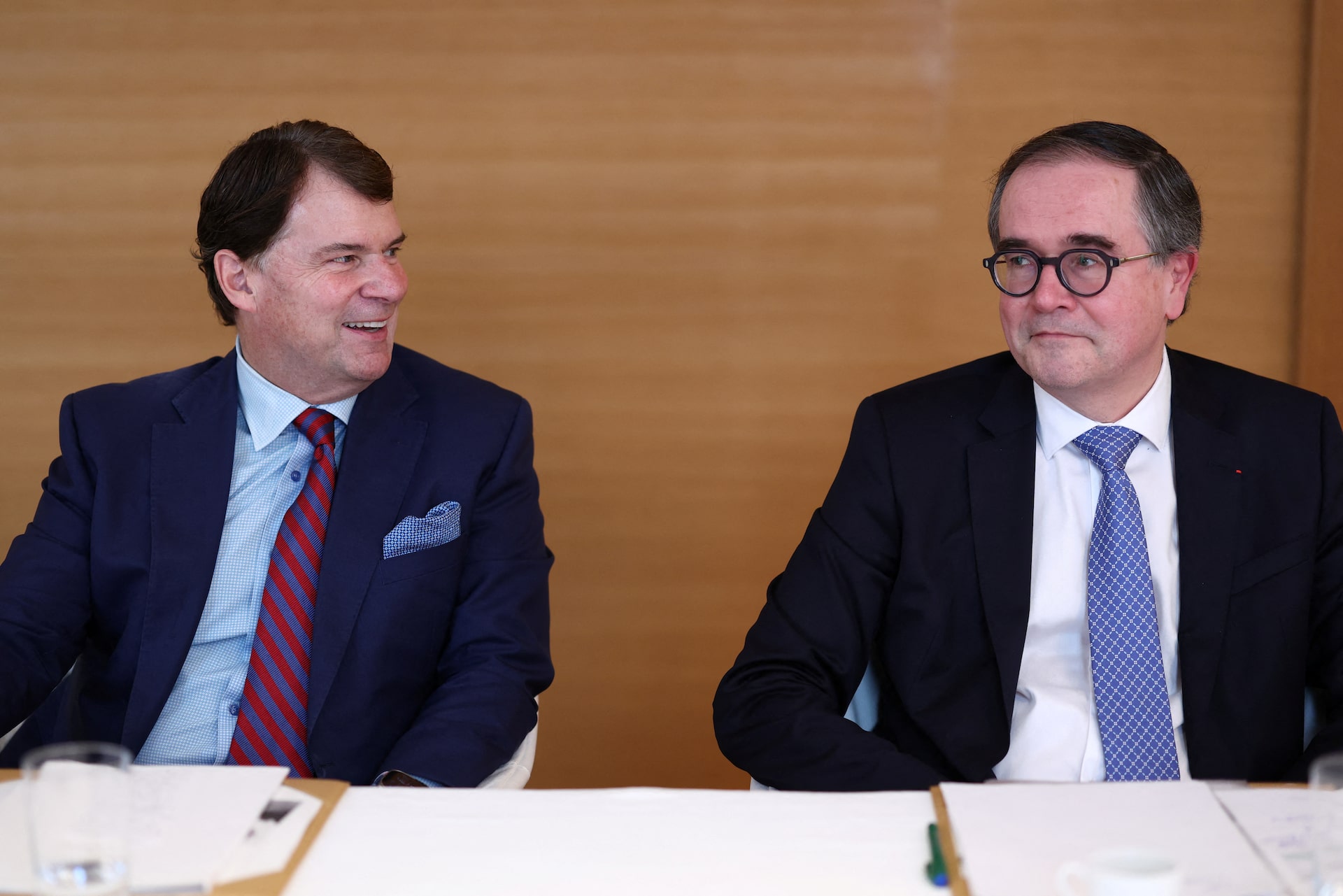
Ford's Farley and Renault's Provost talk Chinese competition - REUTERS/Tom Nicholson. |
Ford, Renault take on Chinese EVs |
Well aware of the competitive threat posed by lower-cost Chinese EVs, Ford and Renault have formed a strategic partnership. The two automakers will jointly design affordable passenger EVs on Renault's platforms that the French company will then produce at one of its plants in northern France for Ford to sell in Europe. The deal provides Renault with revenue and better factory utilization to offset its fixed costs, while providing Ford with an asset-light way to sell small EVs that it does not produce itself and would cost too much to develop. Besides a relentless focus on competing with the Chinese on cost, two things stood out from a press conference with Ford CEO Jim Farley and Renault CEO Francois Provost on Monday in Paris. The first is the speed with which the two legacy automakers reached an agreement – it came just nine months after a team of Renault engineers visited Detroit to discuss possible cooperation. The second is that the two companies are also going to team up on developing and producing vans to compete against the Chinese. There are not many Chinese vans on sale in Europe, but Farley and Provost were clear there will be soon and they are readying to fend off the competition now. "The Chinese will come soon and that's why I don't want to wait," Provost told assembled reporters. |
|
|
We don't have many station wagon photos - REUTERS/Joe Penney. |
Psst, wanna buy a station wagon? |
When I was a kid our family spent a year in the U.S. upper Midwest. My dad went in search of a temporary set of wheels and came home with a 1973 Ford Torino station wagon he bought for $200. That station wagon was the size of a tank and got about 11 miles to the gallon – though no one cared because gasoline cost about 70 cents a gallon back then. Why the trip down memory lane? Well, the Trump administration says that its proposals to roll back fuel economy standards could mean the return of station wagons, right down to "a little wood paneling on the side," Transportation Secretary Sean Duffy said on CNBC. In a smart analysis of what the Trump administration is proposing, Reuters colleague Valerie Volcovici points out that while the proposed new fuel economy standards - 34.5 miles per gallon on average by 2031, down from the previous target of 50.4 miles per gallon – would cut the average vehicle price by $930, consumers would end up paying much more at the gas pump. You can read more about it here. Set aside the fact that the U.S. market is an overwhelmingly SUV market today because Americans love the comfort they provide. Nothing is impossible, but it is highly unlikely that consumers would want to shift to station wagons, no matter how much Secretary Duffy misses that wood panelling. |
|
|
Milan Nedeljkovic, new BMW CEO on the block - REUTERS/Andrew Boyers. |
BMW has chosen a new CEO to replace Oliver Zipse, who was expected to leave soon as his contract had already been extended beyond the German premium automaker's age limit of 60 years. The company's current head of production Milan Nedeljkovic will take over the helm at BMW next May. Nedeljkovic, who has been at the company since 1993, will have to hit the ground running. Faced by the double whammy of U.S. tariffs and falling sales in China, BMW cut its 2025 earnings forecast in October, and is now banking on the first model from the all-electric "Neue Klasse" series to drive growth in 2026. The incoming CEO was instrumental in getting the Neue Klasse to production, so is seen as a safe pair of hands to lead BMW moving forward. |
|
|
Stellantis' U.S. hybrid bet |
Stellantis' new CEO Antonio Filosa says the world's No. 4 automaker is going to focus on hybrids in the U.S. market, continuing a shift away from his predecessor Carlos Tavares' focus on fully electric cars. Just to make sure no one got the wrong end of the stick, Filosa emphasized that this does not mean plug-in hybrids, but regular hybrids where a slightly bigger battery can power the car for short periods of time and cut fuel consumption. Stellantis lost share in the U.S. market – its main profit driver – under Tavares and Filosa has pursued bringing back the powerful, big combustion engines that the automaker's customers love. |
|
|
Volkswagen will invest 160 billion euros ($186 billion) through 2030, CEO Oliver Blume said, reflecting belt-tightening as it faces a major crisis in its two key markets, China and the United States. A U.S. agency has asked Waymo to answer more questions after Texas officials said the Alphabet unit's self-driving vehicles had illegally passed school buses 19 times in recorded incidents since the start of the school year. China's Changan will launch vehicles from its electric Avatr and Nevo brands in Europe over the next two years and is considering selling light commercial vehicles on the continent as well, the automaker's global design chief said. The European Commission is reviewing tariffs on Volkswagen's Chinese-made EVs, which the automaker hopes could be replaced with an annual import quota and minimum price mechanism. Spain will provide nearly 1.3 billion euros to support its EV market and industry in 2026 as part of a plan to lift the share of EVs produced in the country to 95% by 2035. Tesla has launched the new, lower-priced version of its Model 3 car in Europe, two months after its U.S. debut, aiming to boost sales as competition intensifies and demand slows. Think your friend or colleague should know about us? Forward this newsletter to them. They can also subscribe here. |
|
|
Auto File is sent weekly. Think your friend or colleague should know about us? Forward this newsletter to them. They can also sign up here. Want to stop receiving this email? Unsubscribe here. To manage which newsletters you're signed up for, click here. This email includes limited tracking for Reuters to understand whether you've engaged with its contents. For more information on how we process your personal information and your rights, please see our Privacy Statement. Terms & Conditions |
|
|
|







0 comentários:
Postar um comentário