When Google unveiled its latest artificial intelligence model in November, three years after the launch of ChatGPT, the tech giant described it as a "new era of intelligence". Gemini 3 was faster than its rivals, better at reasoning, and achieved a record score in Humanity's Last Exam – a test designed by AI safety researchers to identify artificial intelligence that can meet or surpass human intelligence.
Google's announcement contained the same kind of bombast that has become common with the launch of new models from major AI firms. But this time it seemed different.
Early users were quick to spot that the new AI model was not just an iterative update, but a whole new way of using the technology. Marc Benioff, the chief executive of Salesforce, described the leap in "reasoning, speed, images, video… everything" as "insane".
In a post to X, the tech boss wrote: "I've used ChatGPT every day for three years. Just spent two hours on Gemini 3. I'm not going back."
He was not alone. Artificial intelligence pioneer Geoffrey Hinton, who is sometimes referred to as the "Godfather of AI", said in an interview that Google was now "beginning to overtake" ChatGPT", adding, "my guess is Google will win."
Another analyst declared Gemini 3 as "the best model ever" after it beat every other model in 19 out of 20 industry-benchmark tests that companies use to measure an AI's capabilities. The only one it took second place in involved coding, which Anthropic's Claude model came top.
Its success led ChatGPT creator OpenAI, to declare a "code red", three years after Google declared its own code red in response to the launch of ChatGPT.
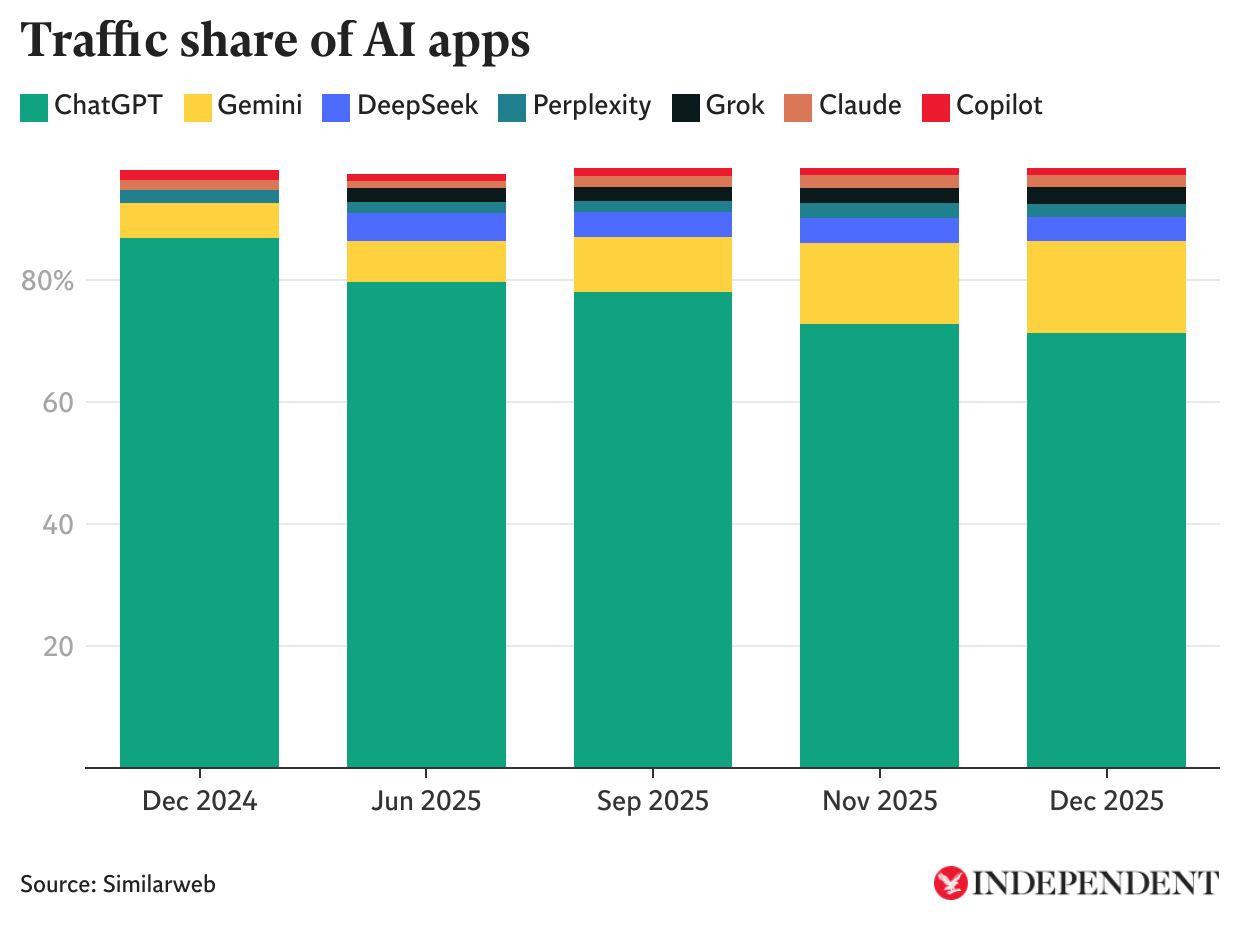
The pace of advances left some questioning how Google achieved it in such a short space of time, with the standalone Gemini app launching just last year (see the chart below). Those working for the tech giant have explained the "secret" to Gemini's success by saying that they simply improved everything. But the real reason may be far more insidious.
For more than two decades, Google has been the gateway to the internet. Its search engine is the way most people access and find information on the web, with publishers and content creators relying on it to send traffic their way.
Websites give Google's search crawler bots special access in order to appear on the results page, with every click allowing the sites to gain visitors and monetise them through online ads, subscriptions and sales.
But as the internet now shifts away from search to AI – with so-called zero-click searches now accounting for more than 60 per cent of all queries – Google has taken its privileged position as the dominant search engine to gain significantly more access to the web than anyone else.
As the so-called "middle-man of the internet", security firm Cloudflare acts as a protective barrier against cyber attacks for more than 20 per cent of the web. This gives it a unique perspective into how companies are using AI bots to crawl websites in order to train their models.
I spoke to Cloudflare boss Matthew Prince recently, and he told me that the amount of access Google has to the web compared to its rivals is "astonishing". Its AI crawler bots have the same access as its Search crawler bots, allowing them to see paywalled sites and other content indexed for its search results.
"If you believe that whoever has access to the most data will win, then Google will always have an advantage in the market, which no one will be able to overcome," he told me. "That seems pathologically unfair."
Google sees more than four times more of the web than ChatGPT creator OpenAI, and more than five times more than Anthropic, Meta and Microsoft.
"There is a massive structural advantage to being Google, and if you want to ask, 'Why did Gemini just leapfrog OpenAI and everybody else in the space', it's not because of the chips, it's not because of the researchers, it's not because they're smarter – it's because Google has access to more data, and it's giving an unfair advantage," Prince said. "I worry that the market for AI will never catch up."
If he's right, then the AI race may already be over, and Google could soon monopolise artificial intelligence in the same way it did with online search.













0 comentários:
Postar um comentário