You can replace this text by going to "Layout" and then "Page Elements" section. Edit " About "
Pague com LPs do Mister Colibri
Quer comprar celular,Tablet,pen drive, GPS e muito outros produtos e ainda podendo pagar tudo em LPs ?Pois saiba que isso é possível,basta você visitar o site downloadstotal.com e realizar a sua compra com toda tranquilidade e segurança!!!
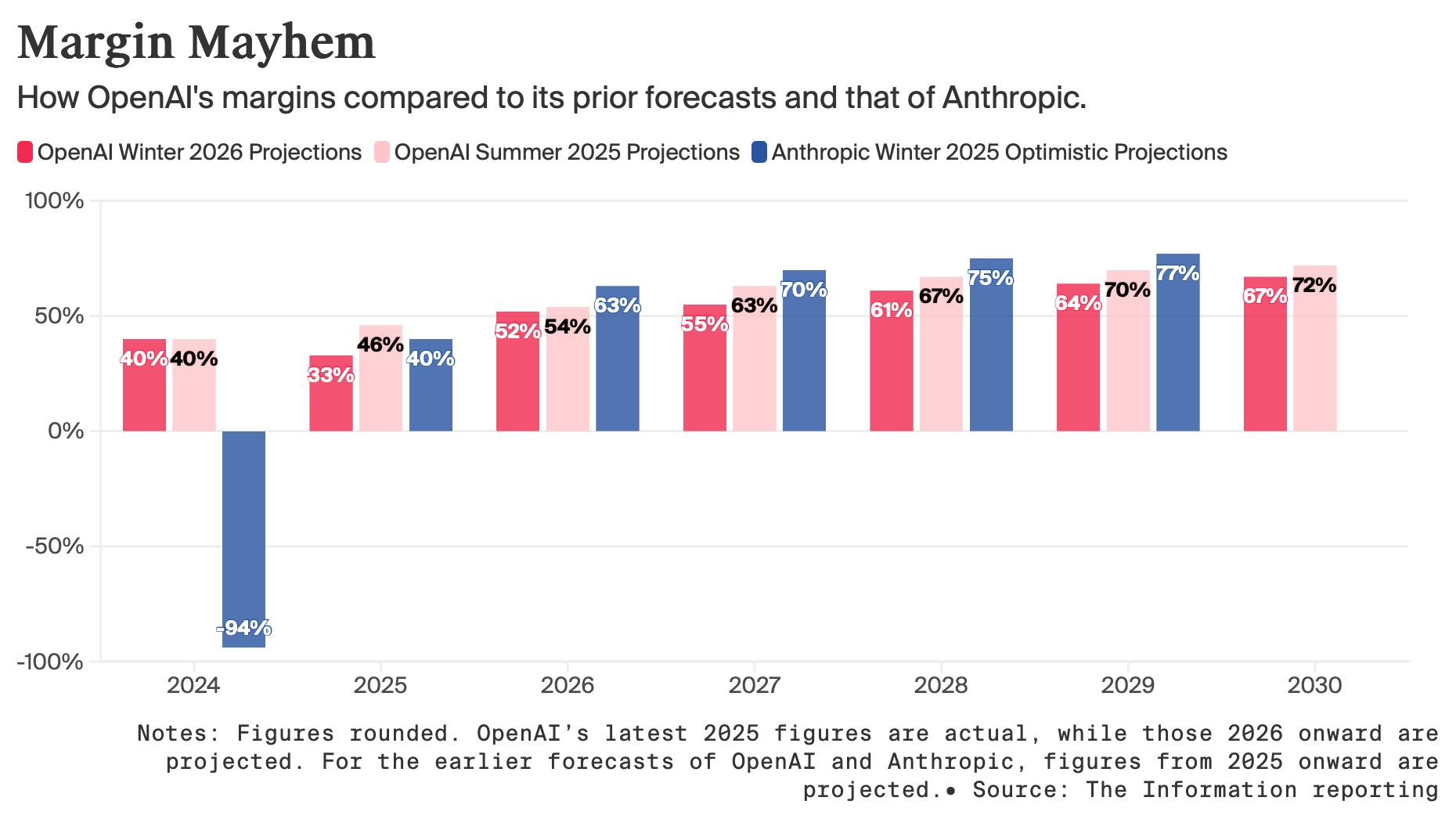
OpenAI has become increasingly optimistic about the revenue it expects to generate from both consumers and businesses, pushing up its projections for the next five years. Clouding those forecasts, however, are escalating cloud server costs that have outstripped revenue growth. Those pressures were stark last year, when OpenAI's gross margins fell to 33% from 40% in 2024, missing its own forecasts of 46%. Archrival Anthropic, which also recently raised its revenue forecasts, said in December it anticipated 2025 gross margins of 40%. While that's a big improvement from a negative 94% gross margin in 2024, it was still 10 percentage points short of Anthropic's earlier goal.
Please join The Information at the New York Stock Exchange on Monday, April 27, to hear from top executives and investors on how the rapid buildout of AI is reshaping tech, finance, and capital markets. Learn more here.
Welcome back! It's Sri.
OpenAI has become increasingly optimistic about the revenue it expects to generate from both consumers and businesses, pushing up its projections for the next five years. Clouding those forecasts, however, are escalating cloud server costs that have outstripped revenue growth.
Those pressures were stark last year, when OpenAI's gross margins fell to 33% from 40% in 2024, missing its own forecasts of 46%. Archrival Anthropic, which also recently raised its revenue forecasts, said in December it anticipated 2025 gross margins of 40%. While that's a big improvement from a negative 94% gross margin in 2024, it was still 10 percentage points short of Anthropic's earlier goal.
For both companies, one of the main culprits was a jump in inference costs, the payments they make to cloud providers to power AI models when customers talk to their chatbots or use models through an application programming interface.
OpenAI quadrupled its inference costs last year, to $8.4 billion, higher than the $6.6 billion it forecast last summer. It has told potential investors it had to buy more expensive access to servers due to higher than expected demand for its services.
Cloud providers typically charge a higher rate to rent their servers on demand, known as spot instances, rather than reserving them in advance.
Anthropic's 2025 inference costs, meanwhile, were expected to rise more than three times to $2.7 billion, also higher than the company had projected, though it's not clear why.
The fact that both companies' margins worsened as more people used its services is notable, because the average cost of renting computing power fell throughout the year and the companies have consistently said they're finding ways to run large AI models more efficiently.
One reason OpenAI's margins likely slipped is that it spends a lot of money powering ChatGPT for nonpaying users. Of OpenAI's 910 million weekly users, only about 5% are paying customers, I've reported. Last year, nearly half of its total inference costs, or $3.9 billion, supported those nonpaying users, versus $4.5 billion for paying users, the company's financial forecasts show.
Another factor is the type of AI these companies run. Last year OpenAI introduced video generator Sora, which takes more server power to run than text-based queries, as well as reasoning models that require more computing power to calculate answers than traditional large language models do.
The company also allowed users to experiment with new compute-intensive features before eventually introducing user limits. Those features included the GPT-4o model, which became popular for generating images in the style of Studio Ghibli, a Japanese animation studio, according to a person with knowledge of the company's efforts.
There's a bright spot, however. OpenAI has gotten more efficient at serving paying users: Its compute margin—the revenue left after subtracting the cost of running AI models for those customers—was roughly 70% in October, an increase from about 52% at the end of last year and roughly 35% in January 2024.
OpenAI plans to generate more revenue from nonpaying users, mainly in the form of ads and e-commerce, and by selling subscriptions to more of those users. In January, for instance, it introduced an ad-supported ChatGPT subscription priced at roughly $5 to $8 per month worldwide.
This year, OpenAI expects to spend about 66% of its $14.1 billion in inference costs on serving paying customers. By the end of the decade, it estimates 94% of its roughly $85 billion in inference costs will support paying users. That year, 2030, it projects that its gross margin will rise to about 67%.
Still, the recent financial performance of OpenAI and Anthropic raises questions about how they will hit their respective targets of 60%-plus gross profit margins by the end of the decade, which would put them in the same ballpark as some of today's best-of-class, publicly traded software companies.
OpenAI and Anthropic seem to have no problem getting investors to cover these costs. But eventually they'll need to prove that the business these users generate more than offsets the costs of supporting them.
Play with the pros. Join The Information for two intimate days of tennis and conversation, featuring on-court time with Madison Keys and Darren Cahill and discussions on tech leadership and innovation. Request an invite today.
Join The Information at the New York Stock Exchange on Monday, April 27, to hear from top executives and investors on how the rapid buildout of AI is reshaping tech, finance, and capital markets




0 comentários:
Postar um comentário