Saturday, February 28, 2026 |
|
|
I spent part of this week watching Gordon Ramsay open a £20m restaurant complex on Netflix, and the other part sitting in a pub in Borough Market eating raw tuna dressed with coconut and lemongrass.
One of those felt like "modern dining". The other actually was.
The pub in question was the Globe Tavern, where chef Tom Geoffrey is currently running Barang, a Cambodian pop-up that feels worlds away from the polished glass towers of 22 Bishopsgate. Geoffrey is British, not Cambodian, but shaped by years spent there, and his food reflects that kind of porous, cross-cultural instinct that defines so much of what we now call British cooking.
The raw tuna – folded with compressed melon, lemongrass, coconut and lime – was softer and creamier than the sharp, citrus-heavy ceviche you might expect. The fried quail arrived as two crisped wings arranged like a deep-fried crown, perched theatrically enough to wear if you fancied it. We ate it instead.
Over dinner, with friends who run an English-Thai restaurant in London, we found ourselves circling a question: what actually is modern British dining in 2026? Is it a multi-concept empire with hard hats and investor decks? Or is it a British chef cooking Khmer flavours in a Borough pub for a room of industry lifers and curious regulars?
That question has been lingering because, in the name of research (I promise), I also watched Netflix's Being Gordon Ramsay and ITV's The Heat this week – essentially Love Island with knives. They reflect something interesting: not just how dining has changed, but how food television has too. Bigger, shinier, more personality-driven, more about pressure and spectacle than plates.
Which makes somewhere like Barang feel quietly radical.
That tension – between institution and intimacy, spectacle and survival – runs through this week's pieces.
In my essay on Being Gordon Ramsay, I look at what the documentary doesn't quite say: that scale changes the meaning of risk. A multimillion-pound operating loss is a recalibration for a hospitality empire. For most chefs, it's extinction. The jeopardy may look similar on screen; the consequences are not.
The Heat, meanwhile, packages kitchens as flirtatious reality drama – rooftop drinks, bombshell arrivals, ritual demotions to pot wash. Entertaining, yes. But it sits awkwardly alongside an industry that is grappling with burnout, inequality and brutal economics. Food TV has always been theatrical. Now it's edging into parody.
Away from the cameras, there are quieter stories that matter more.
Victoria Young's interview with Ryan Riley, founder of Life Kitchen, is the emotional heart of this week's newsletter. Riley's work helping cancer patients rediscover the joy of food has earned him a British Empire Medal – but his reflections on grief, illness and what success actually costs are what stay with you. In a week of glossy kitchen drama, it's a reminder of what food is for.
On the health front, Tim Spector joins our Well Enough podcast to argue that food is "not just about calories – it could improve your mood". From fermentation myths to the gut-brain axis, he makes the case for diversity over dogma. Which brings me, somewhat sheepishly, to my own recent kitchen habits.
I've entered a crispy rice phase. Cook it, let it steam dry, then blast it under the grill until the edges go shatteringly golden. This week I've been folding it through with tinned tuna, cucumber, avocado, mayo and sriracha, with an aggressive amount of sesame seeds on top. Batch cooking is the only way I survive deadlines.
I'm also making a conscious effort to eat more fibre – something Spector would surely approve of. Tinned beans are having a moment in my kitchen. This weekend's plan is a caprese-style butter bean traybake: tomatoes collapsing into olive oil, basil, maybe a burrata because I'm feeling fancy. It feels virtuous without being punishing.
Ian Theasby and Henry Firth of BOSH! tell us this week that going teetotal at 40 felt like unlocking a cheat code. More plants, less booze, better sleep. Whether you're running ultra-marathons or simply trying to get through nursery pick-up without a headache, there's something in that.
Elsewhere, we look at why shoppers are reportedly swapping "posh" eggs into cheaper cartons (spoiler: it's largely pointless), Rosamund Hall shares her foolproof guide to buying better wine without being fleeced, and we round up sandwich recipes that prove the humble butty deserves more respect.
If there's a theme tying all of this together, it might be this: food is at its most interesting not when it's loudest, but when it's thoughtful. Not when it's scaling vertically, but when it's stretching sideways – across cultures, across budgets, across moods.
| |
|
Why shoppers are stealing 'posh eggs' – and why it's pointless |
|
|
Shoppers are reportedly swapping premium eggs into cheaper cartons in a bid to game supermarket prices. They may as well save themselves the bother, says Hannah Twiggs
|
Eggs, for most of modern supermarket history, have occupied the same mental category as salt or bin bags – things you buy absent-mindedly, rarely linger over and almost never covet.
Which makes the recent reports of shoppers discreetly transferring "posh" eggs into cheaper cartons less a petty crime story than a curious cultural shift. Somewhere between the rise of heritage breeds, rich yolks and artfully pastoral packaging, the humble egg appears to have undergone an unexpected promotion: from kitchen staple to small, brown status symbol.
They're not the only ones. Salt used to be just salt. Now it's Maldon, Himalayan or something smoked and hand-harvested from a Scandinavian fjord. Olive oil is the same: Waitrose stocks no fewer than 73 different bottles online (I counted). Oil from Italy, Spain, Greece, infused with chilli, garlic, basil, in plastic, tins, pouches and sprays. It's no longer just something to fry onions in, but a lifestyle choice.
Eggs, improbably, are the latest victim of this premiumisation. What was once a straightforward purchase now comes in tiers. A box of supermarket own-brand eggs might sit between £1 and £2, still 59 per cent higher than five years ago. Move a shelf above, however, and the numbers change tone. Clarence Court's Burford Browns are £3.35 for six. St Ewe's Rich Yolks climb to £4.24. Purely Organic pushes higher still: £5.20 for a half dozen, a price that would have once seemed absurd for something that comes out of the wrong end of a chicken.
The variations do not end there. Rich yolks, golden yolks, big yolks. Free-range, organic, barn. Bluebell Araucana, Chestnut Maran, Leghorn Whites, Blacktails, Longstock Gold. Duck eggs, quail eggs, liquid eggs. The modern egg aisle is no longer just a grocery fixture but a taxonomy of aspiration...
Read the full article here
|
|
|
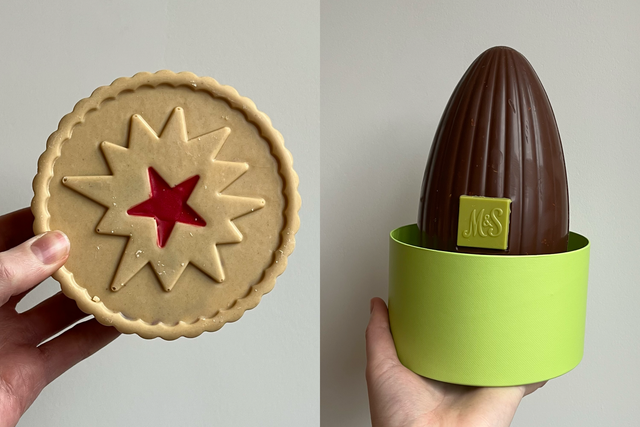
| The best Easter eggs for 2026, taste-tested |
|
|
Don't forget to complete your registration |
We've noticed that you still have not completed your registration to The Independent. Registration is a free and easy way to support our journalism. It allows us to better understand our readers and tailor your experience. |
By registering, you'll also gain access to a range of exclusive benefits, including: |
- Limited access to Premium articles
- Access to The Independent app
- Access to more than 20 newsletters
- Commenting on independent.co.uk
|
|
|
|
|
|
|
|
|
|
|
| More tasty recipes inside |
Enjoy endless inspiration with recipes, interviews and more in your latest Indy/Eats food and drink magazine, one of your Independent Premium subscription benefits |
|
|
| A bright, achievable plant-based cookbook from the BOSH! founders that makes "healthy" feel effortless. BOSH! More Plants delivers 30-minute recipes built around variety, flavour and accessibility, from one-pot weeknight meals to batch-cook staples. It's a manifesto as much as a recipe book: more plants, more joy, less fuss – and proof that vibrant, everyday food doesn't have to be complicated.
|
|
|
Join the conversation and follow us |
|
|
Please do not reply directly to this email You are currently registered to receive The Independent's IndyEats newsletter. To unsubscribe from The Independent's IndyEats newsletter, or to manage your email preferences please click here. This e-mail was sent by Independent Digital News and Media Ltd, 14-18 Finsbury Square, London EC2A 1AH. Registered in England and Wales with company number 07320345
Read our privacy policy and cookie policy
|
|
| |














0 comentários:
Postar um comentário