| Welcome, Weekenders! In this newsletter: |
| • The Big Read: What Anthropic's Pentagon feud means across Silicon Valley |
| • Artificial Intelligence: Otters, Minesweeper and Will Smith's spaghetti dinner—the at-home tests for judging AI's abilities |
| • Plus, Recommendations—our weekly pop culture picks: "Murder at the U," "End of Days" and "How to Get to Heaven From Belfast" |
| |
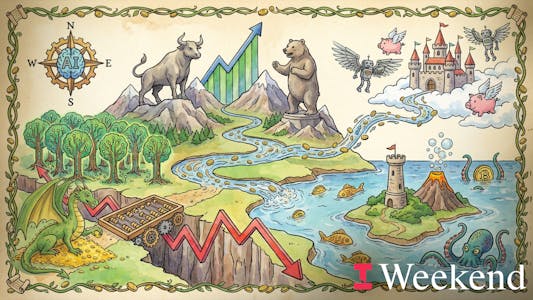
| A couple days ago, a piece of science fiction caused a good amount of fuss, with Citrini Research's "thought exercise" on the economic consequences of agentic AI prompting a stock sell-off and then counterefforts by the Wall Street establishment to discredit it. |
| The piece, titled "The 2028 Global Intelligence Crisis," is written in the humdrum style of an analyst's report. (It is to AI economics what the recent book series by Elliot Ackerman and former Admiral James Stavridis—"2034," "2054" and "2084"—is to world war.) On the qualitative measures of an English class, the missive is not especially compelling; author James van Geelen, who founded Citrini, is no undiscovered Asimov. |
| The reaction to Citrini's piece took people by surprise: How could we possibly take a fiction piece so seriously? Even the article's main author, van Geelen, expressed shock that it had attracted such a level of attention. "If I thought that stocks were gonna move on this," he said between client meetings in Miami, "I wouldn't have made it free." |
| But I'm surprised that he's surprised. Fiction moves markets all the time. |
| Every day, investors choose to buy into some corporate line or another that's no more rooted in actual truth than a response from a Magic 8 Ball. After all, a company's stock price is just a reflection of shareholders' expectations, and those expectations are largely formed by what a business says it will do in the future. (They're also governed partly by what analysts and professional prognosticators like Citrini say a business will do.) |
| No one likes to think about how most CEOs speak in fictional terms, but they do. Rather, we prefer to consider it in a different light: Their words aren't fiction—they're forward-looking statements subject to risk and uncertainty! (It's the type of creative, wishful thinking people use to rebrand the Tenderloin as Lower Nob Hill.) |
| Really, capitalism is just a giant game of make-believe. We pretend and hope and wager that a fiction isn't actually fiction, that it is instead reality. This mindset is the bedrock beneath the entire system we all enjoy so much, and it's operated as such for centuries. But we generally don't go around talking about being a bunch of fiction addicts. If we fessed up like that, we'd undermine the system, which has steadily enriched everyone who has been willing to keep up appearances and keep their money in it. |
| The AI era has attracted a giant wager on a very new thing, and we're starved for any sort of information on how it's all going. So no wonder people took what Citrini published so seriously: Its work of fiction sounded a lot like the fiction we've already agreed to accept as fact at a time when everyone is hungry for more facts. |
| What else from this week… |
| • To go up against OpenAI, Elon Musk has hired attorney Marc Toberoff, a longtime Hollywood fixer. Most generously, I might label Toberoff a bulldog. Ari Emanuel calls him "a scorpion." A former opponent has a different take: "ambulance chaser." |
| • In a very colorful Harper's Magazine piece is this nugget: Roy Lee, creator of AI school-cheating tool Cluely, is the son of a pair of entrepreneurs who started a…college prep agency. |
| • The Economist senses that we're in the midst of a "war against PDFs." |
| • A man was fiddling around with his robovacuum and accidentally learned he could take control of thousands of the Chinese-made devices, sparking fears that the Chinese government could use vacuum cleaners to spy on Americans. My thought: Go on, spy all you want—just make sure to get that spot behind the bed. |
| • In a different example of American ingenuity, teenagers have learned how to unlock the cellphone pouches schools use to lock away smartphones during classes. |
| • "AI tools are like taking a helicopter to drop you off," famed mathematician Terence Tao tells The Atlantic. "You miss all the benefits of the journey itself. You just get right to the destination, which actually was only just part of the value." |
| • As The New York Times has defined him, the online celebrity known as Clavicular is "a calculating product of a hyperactive digital culture that rewards the violation of taboo." Playboy has now cast him in, uh, different terms: as a "radical submissive."—Abram Brown (abe@theinformation.com) |
| |
|
|
 |
|
| Anthropic's refusal to cooperate with the Defense Department is having ripple effects across Silicon Valley. |
|
 |
|
| AI enthusiasts are turning to their own personally devised tests and benchmarking exercises to better understand the technology's rapid development. |
| |
 |
| Listening: "Murder at the U" |
| For as long as the University of Miami has been famous, the football-proud school has also been infamous, beginning with its Catholics versus Convicts rivalry against Notre Dame in the '80s, then followed by a financial aid scandal in the '90s and Nevin Shapiro's Ponzi scheme in the aughts. |
| But perhaps the darkest moment in the college's history is the murder of defensive end Bryan Pata, the subject of "Murder at the U," the latest podcast from ESPN's excellent documentary unit, 30 for 30. In November 2006, police found Pata shot dead outside his apartment. It would take them another 15 years to charge anyone with the crime, with an investigation that stretched from the university's campus to Miami's Little Haiti neighborhood, a gang-ridden section of the city where Pata grew up. Along the way, the ESPN correspondents covering the story found themselves more deeply involved in its outcome than they could've possibly imagined.—Abram Brown |
| Reading: "End of Days" by Chris Jennings |
| The bloody altercation between federal agents and the Weaver family—a heavily armed clan who believed the apocalypse was nigh—has been reduced in our collective memories to something along the lines of "the showdown at Ruby Ridge," which gives the violence there a dusty, down-home quality to it, like some forgotten chapter of Old West history. Yet the vivid retelling of it in "End of Days," from former New Yorker staffer Chris Jennings, asks us to revisit that mindset. He casts the events from 1992 as a reflection of the enduring appeal of such apocalyptic, conspiracy-ridden thinking and an early example of how American media has turned to grisly violence and true crime to fuel an increasingly always-on audience. |
| When the Weavers made their last stand, "the mess in North Idaho looked like one last gasp of the blood- and ideology-sodden twentieth century," Jennings writes. "Three decades on, Ruby Ridge looks more like the start of something than its finale."—A.B. |
| Watching: "How to Get to Heaven From Belfast" |
| What I really crave from my many streaming video options is something surprising—something different, something that's not a rehash! But the unexpected is often hard to find on Netflix, whose shows too often appear to have employed AI to incorporate numerous elements from previous popular shows. "How to Get to Heaven From Belfast," the latest production from "Derry Girls" creator Lisa McGee, is one of the rare exceptions. It's a laugh-out-loud-funny murder mystery set in Northern Ireland, focused on four women who've been friends since high school. The comedy has echoes of the off-the-wall laughs of "Derry Girls" and the dark humor of "Bad Sisters," another Irish comedy, that one from Sharon Horgan. And unlike with much of the dreck we're subjected to, you'll find it hard to guess the mystery's secret.—Martin Peers |





0 comentários:
Postar um comentário