A Reuters Open Interest newsletter |
|
|
What matters in U.S. and global markets today |
By Mike Dolan, Editor-at-Large for Finance and Markets |
|
|
- The U.S. issued fresh guidance on Monday to commercial vessels transiting the Strait of Hormuz as tensions simmered between Washington and .
- The Trump administration is set this week to overturn an Obama-era scientific finding that serves as the legal basis for .
- India is in talks with Brazil, Canada, France and the Netherlands over deals to jointly explore, extract, process and recycle .
- Japanese Prime Minister Sanae Takaichi's election victory on Sunday could usher in a period of heightened volatility in the country's currency and bond markets, .
- Australia's wholesale electricity prices fell to the lowest in four years in 2025, validating claims that renewables can help lower consumer power costs, .
| |
|
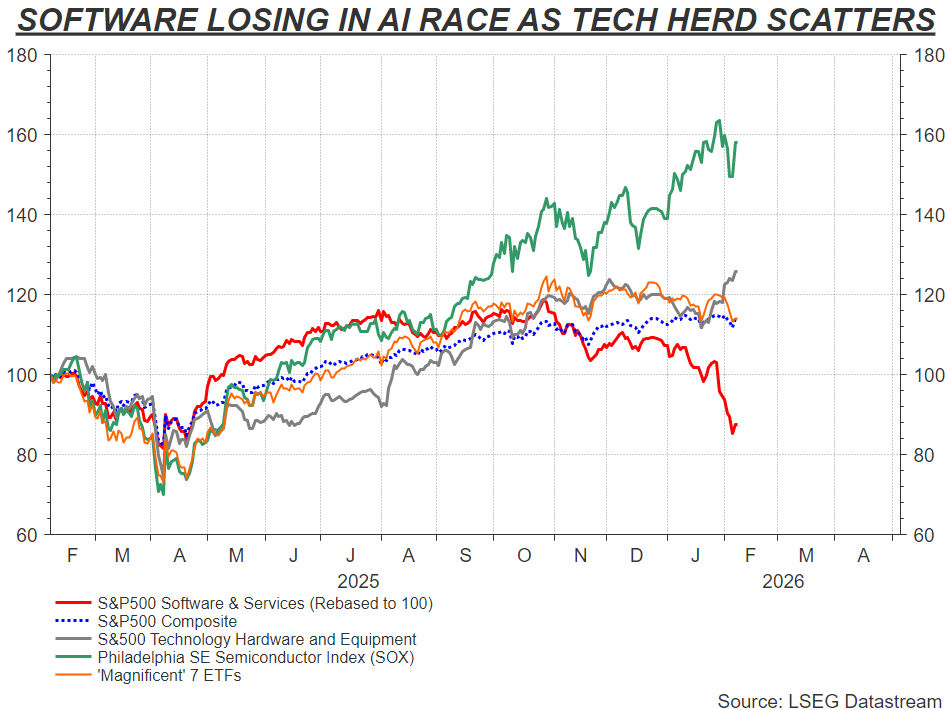
Three factors seem to be weighing on the greenback once again - a post-election surge in the yen, accelerating gains in China's yuan to near three-year highs, and some market trepidation about a weak U.S. employment report tomorrow. The yen's bounceback appears to be a case of 'sell the rumor, buy the fact' surrounding Prime Ministers Sanae Takaichi's fiscal plans. The currency had been floundering for months, but now it seems more comfortable with the growth and interest rate implications of fresh stimulus alongside a more stable political horizon. The yuan surge comes ahead of the Lunar New Year holidays next week, and is likely being supported by reports that Chinese regulators have warned local banks and investors about over-concentrated holdings of U.S. Treasury bonds and the dollar. The U.S. currency is at its lowest point since May 2023, having fallen almost 6% against the renminbi over the past year. The other big focus yesterday was the bounceback in U.S. mega-cap tech stocks after last week's wobble over news of capex plans totalling more than $650 billion for 2026. Some of that will, of course, be debt-financed. Alphabet announced on Monday that it would raise another $15 billion in high-grade bonds. This follows Oracle's announcement of a new debt sale last week. The five major AI hyperscalers issued $121 billion in U.S. bonds last year, compared with an average of $28 billion per year in the previous four years. Meantime, President Trump's administration plans to spare tech giants such as Amazon, Google and Microsoft from upcoming tariffs on chips as the hyperscalers build out their AI data centers, according to the Financial Times. Elsewhere, UK markets had a nervy day on Monday as drama intensified around Prime Minister Keir Starmer's appointment of Epstein-linked Lord Peter Mandelson as U.S. ambassador in 2025. But the ruling Labour Party backed Starmer late on Monday, calming both sterling and gilts. Back on Wall Street, Wednesday's January employment report is coming into view, with White House economic adviser Kevin Hassett saying on Monday that people "shouldn't panic" if they see weak numbers. Before that, though, the December retail sales report will take center stage today. |
Roaring global growth train emerging from 2026 fog |
The chaotic newsflow, geopolitical shape-shifting and wild market swings of 2026 have clouded one basic signal: the global economy is racing forward. Market takes this year have covered everything from the dollar and Federal Reserve independence to precious metals swings, NATO tensions, Japanese elections and even carnage in software stocks. This has all left investors breathless in 2026. And we're only six weeks in. But, as Morgan Stanley strategist Andrew Sheets points out, all of this noise masks a "powerful overlapping signal worthy of respect". A cyclical whoosh is underway in the global economy. |
Graphics are produced by Reuters. |
|
|
Graphics are produced by Reuters. |
China's yuan surged to its strongest in nearly three years against the dollar, underpinned by heavy corporate demand for the local currency ahead of China's biggest festival. But the move was also spurred by reports on Monday that Chinese regulators have advised financial institutions to trim holdings of U.S. Treasuries because of concerns over concentration risk and market volatility. |
- U.S. December retail sales, Q4 employment costs, December import costs
- U.S. 3-year note auction
- New York Fed releases Q4 2025 Household Debt and Credit Report
- Dallas Fed President Lorie Logan and Cleveland Fed President Beth Hammack both speak
- U.S. corporate earnings: Cloudflare, Coca-Cola, Ford, Hasbro, S&P Global, Spotify
|
|
|
Want more smart, engaging financial analysis in your inbox? Subscribe to Trading Day by Jamie McGeever, a daily newsletter delivered just after the market close. And check out Reuters Open Interest (ROI), an essential new source for data-driven, expert commentary on market and economic trends. You can find ROI on the Reuters website, and you can follow us on LinkedIn and X. |
Opinions expressed are those of the author. They do not reflect the views of Reuters News, which, under the Trust Principles, is committed to integrity, independence, and freedom from bias. |
Morning Bid is sent every weekday morning. Think your friend or colleague should know about us? Forward this newsletter to them. They can also sign up here. Want to stop receiving this email? Unsubscribe here. To manage which newsletters you're signed up for, click here. This email includes limited tracking for Reuters to understand whether you've engaged with its contents. For more information on how we process your personal information and your rights, please see our Privacy Statement. Terms & Conditions |
|
|
|
|






0 comentários:
Postar um comentário