A look at the day ahead in European and global markets |
|
|
By Wayne Cole, Chief Correspondent, Treasury |
|
|
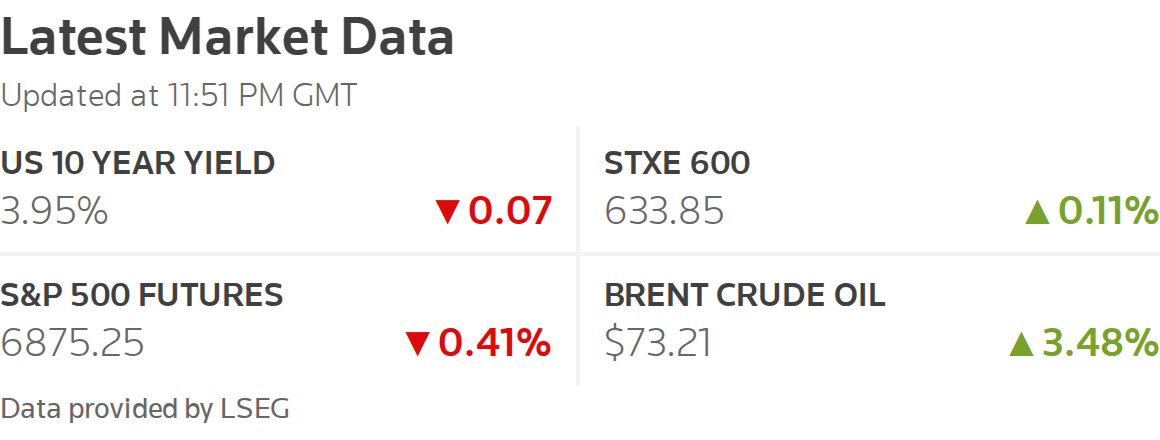
OK, so this is shaping up as a proper global energy shock, like the 1970's version. Though it is unique in being by choice, or at least the choice of one man. Brent cleared $100 at the open and never looked back, reaching a top of $119.50 so far. The crude benchmark is currently up 25%, which would be the biggest daily rise on record if it holds, and brings its gains since President Trump ordered the attack on Iran to a thumping 60%. |
|
|
Numbers typically linked with recession |
The German share price index DAX graph is pictured at the stock exchange in Frankfurt, Germany, January 20, 2026. REUTERS/staff |
Those are the sort of numbers that are typically associated with world recession. The globe is less oil intensive these days, and there are some other sources of crude, but analysts agree it is not enough to weather a prolonged conflict. And it does look like being lengthy. Trump's call for "unconditional surrender" and Iran's choice of the son of the former hard-line supreme leader as the new hard-line supreme leader would seem to make it hard for either side to back down. A glance at shipping tracker Marine Traffic shows tankers are not braving the Strait of Hormuz and, given the way Iran is flinging ordinance around, might not even if war insurance was available and affordable. With crude not flowing, some Gulf states are running out of storage and scaling back production, which is a lengthy process to resume. That's showing up all-too quickly in fuel prices. Around half of Europe's jet fuel comes through the strait, sending prices to record highs equivalent to about $190 per barrel. |
Graphics are produced by Reuters. |
|
|
Airline stocks get hammered |
Airline stocks across Asia were hammered on Monday, though you might not have noticed amid the general carnage. The Nikkei is off around 7%, South Korea 8% and Taiwan 5%. European share futures are down anywhere from 1% to 3%, and Wall Street futures around 2%. Bond yields are up globally as investors hedge the risk of accelerating inflation, and how that might constrain central banks from easing policy even should economic activity slow. Spiking prices for liquefied natural gas, jet fuel and fertiliser are all set to make it costlier to, say, heat homes, take a holiday or buy food. For U.S. consumers, the real sore spot is always petrol - it's a liquid not a gas. Wait until prices at the pump rise 10%, 20% or more, the resulting howl of pain could prove loud enough to end a war. |
Graphics are produced by Reuters. |
|
|
Key developments that could influence markets on Monday: |
- ECB board member Piero Cipollone and Euro zone finance ministers at Eurogroup meeting in Brussels
- Sentix investor confidence, German industrial output
|
|
|
Opinions expressed are those of the author. They do not reflect the views of Reuters News, which, under the Trust Principles, is committed to integrity, independence, and freedom from bias. |
|
|
| | | | | Morning Bid is sent every weekday morning. Think your friend or colleague should know about us? Forward this newsletter to them. They can also sign up here. Want to stop receiving this email? Unsubscribe here. To manage which newsletters you're signed up for, click here. This email includes limited tracking for Reuters to understand whether you’ve engaged with its contents. For more information on how we process your personal information and your rights, please see our Privacy Statement. Terms & Conditions | | | | | © 2026 Thomson Reuters. All rights reserved.
3 Times Square, New York, NY 10036 | | | |
|
|
|







0 comentários:
Postar um comentário