How old is too old to start exercising? |
|
|
Hello! Physical ability peaks at 35. Or at least, that's the headline takeaway from a 47-year study by the Karolinska Institutet in Sweden. For anyone younger, this feels like a lot of pressure. For anyone older, it's rather disheartening news. Yet I recently spoke to coach Ed Haynes, who trains hundreds of people of all ages – including his 76-year-old mother. Despite lacking the strength to hold a plank at 59, she now cranks out pull-ups, plays golf three times per week, swims most mornings and does plenty of other exercise besides. So is she the exception that proves the rule? No. Rather, she reinforces the study's results. "It is never too late to start moving," lead author Maria Westerståhl says. "Our study shows that physical activity can slow the decline in performance, even if it cannot completely stop it. "…individuals who started being physically active in adulthood improved their physical capacity by 5–10 per cent." Haynes' story is further proof that nuance tells us a more reliable story than an eye-catching headline. That is the theme of this week's newsletter: |
"Something that comes up a lot with my clients is biological age," says Haynes. "Strength peaks around 35 and your body's ability to recover is in decline [from this point], so people think they've missed the bandwagon and there's no point in training. But many of these studies are based on people who have been training consistently from a young age." Exercise has immense value at any age – a recent interview on strength training's many longevity merits made that clear. And if you are able to adopt a healthier routine than you had in your 20s, 30s or 40s, alongside some smart training methods, it is entirely plausible that you could become fitter now than you were then. "You can still have your highest level of muscle mass in your 60s, and be hitting strength PRs in your 70s, because you're so new in your training journey," Haynes says. "The best time to start is now. You're just going to have to manage your training and fatigue in a smarter way as you get older." Haynes is responsible for two of this week's featured articles. In the first, he shares how he trained his mum to become her fittest self in her 70s. In the second, he reveals the six small lifestyle changes anyone can make to enjoy an immediate uptick in their health. In another recent interview, I discussed all things posture with experienced physiotherapist Alex Morrell. His viewpoints might surprise a few people. "There is no link between posture and pain," he tells me. "Most people assume that back problems and back pain are linked to poor posture, and slouching in particular. But there is zero scientific research to support that." Again, value can be found in the nuance of his statement. He argues that "the best posture is the next posture" – in other words, humans are built to move, so staying in any position for hours at a time is likely to be unkind to your body. Your body adapts to what you consistently ask it to do. If you sit down for most of the day with your hip flexor muscles in a shortened position, your body might tighten them to become more efficient at sitting, sometimes leading to dysfunction in the hips and surrounding areas. Morrell's remedy is delightfully simple: "If I'm slouching, I might sit more upright for a bit; if I'm sitting upright, I might slouch a bit more. If I've got the luxury of a standing desk and I feel stiff and sore while sitting down, I'm going to stand up. Or I might go and stretch my legs – go to the loo or make a coffee. "It's just about doing really simple things in a simple way, rather than catastrophising and exaggerating the impact of being at a desk." So what is our takeaway today? Well, you're somewhat spoilt this week, for I've settled on two. Firstly, exercise and movement are beneficial at all ages, and if you don't do all that much currently, the best time to start is now. Secondly, you will see a lot of health headlines nowadays designed to provoke strong reactions – pride, fear, guilt, comparison. Scratching beneath the surface and giving a nod to the nuance at play usually delivers a more measured, helpful message. Hope this helps! Harry |
|
| Is even one drink really too much? |
|
| I don't drink. I gave up a few years ago, simply because the after-effects weren't treating me particularly kindly, and I found I was chatty enough without it. But I also understand the value of alcohol for many people. Social connection is a fundamental pillar of better health. But in a world where face-to-face interactions are dwindling and loneliness is a growing concern, anything that gets us out of the house and forging connections has its merits. This piece from Leah Hardy dives into the science surrounding alcohol's health impacts, as well as her personal interpretation of its risk–reward ratio as someone in remission after aggressive cancer treatment. | |
|
Would you give your child a melatonin gummy to help them sleep? |
I found this piece from my colleague Helen Coffey incredibly interesting – even as someone without children. How to get a better night's sleep really is the million-dollar question, and there is plenty of money to be made from products promising an improved snooze. But should we be so quick to turn to pharmaceuticals to solve our sleep problems, or are there other ways to access the land of nod with greater ease? |
|
|
Do these five things daily for 90 days |
When people want to become healthier, they tend to make massive changes in their lives. This will likely work for a while, but because they haven't built a framework of habitual behaviours around it, these overhauls rarely last. A more sustainable – and often more effective – approach is to make small, manageable tweaks, forge them into habits, then build on them gradually over time. This is the logic behind performance coach Dan Lawrence's concept of daily non-negotiables – small acts that, done daily, compound to deliver impressive health benefits. Here, he recommends five that will make "a profound difference" to your health in 90 days. |
|
|
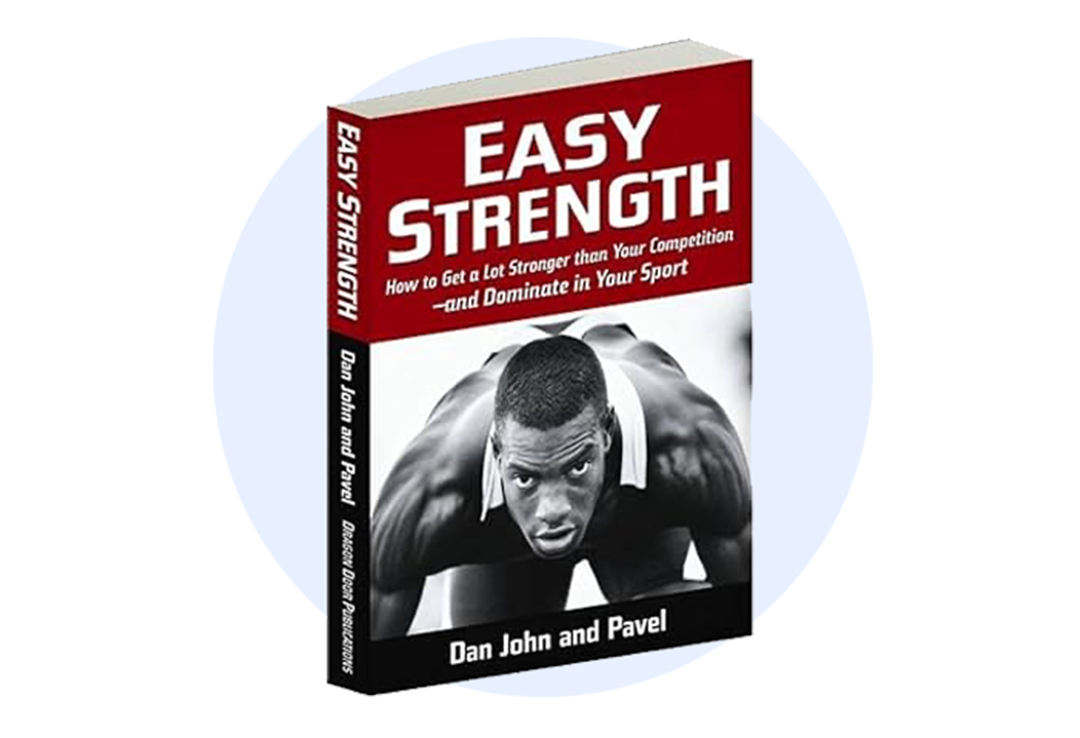
Easy Strength by Dan John and Pavel Tsatsouline |
It takes a certain intelligence to use complex terms that confuse people. It takes far more talent to distil those terms into something everyone can understand. Having interviewed Dan four times now, I've found this is his speciality. Where other fitness figures look to showcase their knowledge of technical language, Dan delivers digestible, actionable and understandable insights into the training techniques that actually work – drawn from his decades of experience working with top sports teams and the armed forces. The same applies to his friend and co-author, Pavel. This book leans more towards those interested in participating in sport, whether for fun or competitively, but there are still plenty of excellent takeaways to be had. |
|
|
| This week, I was fortunate enough to find myself in a hotel. I headed to the on-site gym in search of a solid strength training workout and was met with the usual collection of treadmills and a few light dumbbells. If you've been reading this newsletter for a while, you'll know that successful strength training needs to challenge the muscles. This persuades the body to spend its resources on making them bigger and stronger – and it's easier said than done with light dumbbells. But weight is not the only variable we can play with when determining how challenging our strength training workouts are. We can increase the number of sets and reps we do, choose more challenging exercise variations (e.g., swapping goblet squats for Bulgarian split squats), or increase the amount of time our muscles are working – AKA, time under tension. I opted for this last option and did the workout below. Step one: Pick four exercises, each with a different focus. For example, I chose burpees to raise my heart rate, dumbbell bent-over rows to work my back muscles, squats to strengthen my legs, and press-ups to work my chest and shoulders. Step two: Start a running clock. Step three: Perform the first exercise for 30 seconds, rest for 30 seconds, then repeat this sequence for the second, third, and fourth exercises. Step four: Continue this for the time you have available, or pick a multiple of four as your target total workout time. You can progress this workout over time by altering the work:rest ratio in each minute. When alternating between 30 seconds of work and 30 seconds of rest feels manageable, try 40 seconds of work and 20 seconds of rest, then 50 seconds of work and 10 seconds of rest. When this feels manageable, you can switch to trickier exercises, increase the weights you are using, or raise the total workout time. And there you have it – a progressive workout format that will serve you well for weeks on end. |
| |
|
|
| I sit down a lot. Most people do. My favourite movement for countering the effects of this is, ironically, named after one of the places I sit down most frequently: the couch stretch. Here's how to do it – a demonstration can also be found in this article: Step one: Place your left knee on the floor against a wall or sofa so your shin extends vertically upwards. Step two: Step your right foot forward so you're in a lunge position, with your left thigh and torso forming a straight line. Step three: Think about tucking your hips by squeezing your glutes (buttock muscles), and trying to pull your rear knee forward to contract the hip flexors. If you can't access this position, move your back knee away from the sofa so your shin is at an angle. When in place, I like to add some movement by reaching down to the floor, then extending my arms overhead and bending from side to side for bonus mobility perks. Whatever you do on one leg, repeat on the other. "If you're doing sports like running and cycling, or you're doing a lot of sitting, it can cause a tightening of the quads and hip flexors," says flexibility expert Tom Merrick. "The nature of these activities means you're encouraging that flexed-forward, tightened position of the hips. The couch stretch provides more of an extended position – the opposite experience to the stuff you would normally do day to day." |
| |
|
| Certain foods may hold more nutritional value than others, but adding one thing to your diet is not going to overhaul your health. Instead, the important thing for long-lasting health is to develop nutritious and calorie-appropriate dietary patterns. In other words: aim to eat well most of the time. When trying to do this, many people change absolutely everything they eat, switching to the keto, Atkins, or Mediterranean diets. But I've found this rarely works, as they're incredibly hard to stick to. Instead, what works for me is making small adjustments to things I consistently eat. For example, if you want to lose weight and you know you eat three biscuits with your tea each day, change it to one or two. If you want to build muscle, add an extra portion of protein to your regular dinner. In my experience, the effects of doing this soon add up. |
| |
|
| Do something positive for your health in the first five minutes after waking up. This might be drinking a glass of water, doing a couple of stretches, or even stepping into the garden for a moment (this is one for when the sun eventually shows its face again pre-7 am). Each of these acts has benefits, of course. Early sunlight can moderate your circadian rhythm and improve your sleep; water hydrates and can improve cognitive function; morning movement rids your body of the stiffness that stationary hours in bed can bring. But that's not my favourite perk. It reinforces the identity that you are someone who actively chooses to do healthy things. If the first thing you do after waking makes you feel great, at a time when life has yet to pile pressures on you, I've found healthier choices tend to come more easily as the day progresses. |
| |
|
Enjoying the benefits of the gym, without a gym |
| |
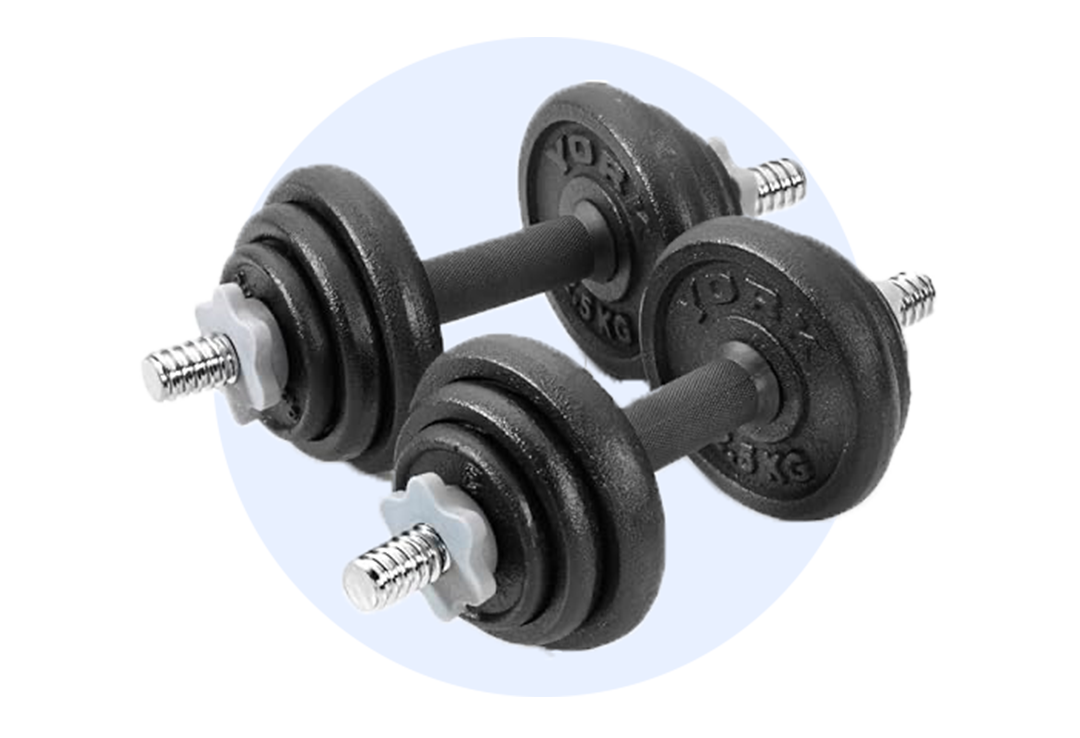
One of the most valuable things you can do for your health is to choose to be a healthy person. Let me explain. If you're someone who thinks, "I have to go for a run/to the gym," the run or gym session isn't going to be an appealing prospect, and you'll likely sack it off at the first opportunity. If you think, "I get to go for a run/to the gym," or "I want to go for a run/to the gym," it becomes something to look forward to – something that gradually becomes second nature. I found this when I first tried to go to the gym as a painfully shy, gangly, football-obsessed teen – I hated it. It was only when I bought an at-home dumbbell set like this one, read every fitness magazine I could get my hands on, and taught myself the technique and science behind lifting weights that I truly fell in love with it. If you want to build confidence for strength training, hiring a qualified trainer or attending classes is always my first recommendation. But if you, like me, feel a bit intimidated by the gym environment at first, a fairly affordable pair of weights in your living room is a great way to get plenty of practice reps under your belt. |
|
|
A discussion with women's health advocate Cherry Healey |
On this week's episode of the Well Enough podcast, host Emilie Lavinia speaks to TV presenter and women's health advocate Cherry Healey. She shares her unexpected perimenopause journey, the misdiagnosis crisis facing women in their forties, and why she believes perimenopause is actually "the main event," not menopause itself. The episode is available to listen to here, with the full video online here. |
|
|
These were the most popular stories in last week's newsletter: |
|
|
Join the conversation and follow me |
|
|
Please do not reply directly to this email You are currently registered to receive the Well Enough newsletter from The Independent. To unsubscribe from the Well Enough newsletter from The Independent, or to manage your email preferences please click here. This e-mail was sent by Independent Digital News and Media Ltd, 14-18 Finsbury Square, London EC2A 1AH. Registered in England and Wales with company number 07320345
Read our privacy policy and cookie policy
| |
|
|


0 comentários:
Postar um comentário