We've got quite solid research showing that these policies are undermining integration opportunities, undermining the ability of people to find a foothold in the labour markets, because you can't start working sooner, because you have to wait and undergo all these sorts of different things before you perhaps can get into language courses. Whereas what would be most useful would be that you requalify your education or learn the language. I mean, there are all these sorts of interlocking dynamics.
There's an interesting discussion coming up now because Denmark, like so many other countries in Europe and around the world, actually needs labour migration.
What was the way that migration and movement happened across Europe in the 1800s or the early 1900s? Was mobility always this intensely contested?
We know from archaeology, we know from economics and historical economics, development, all these things, that access to mobility throughout human history has remained super important for economic growth, for cultural and technological exchange. And of course, ultimately for survival.
Mobility and access to mobility were originally restricted by geography; it's hard to cross water or mountain ranges. And there have been a lot of studies on empires that suggest that an empire has to be a geographically defendable territory. that sits, at least to some part, geographically.
So with technology and mass transportation, today's access to mobility – how you move, how easily, how long you can stay – is overwhelmingly determined by law, but it's not a single set of laws, and that's the really difficult thing.
We can think about refugee law or labour migration laws sort of like particular pillars and something that lawyers would think of as regimes, but the ways that mobility at large is governed is like transportation law – it's the international aviation law, it is maritime law and law of the sea – it's labour law, it's free movement law. It's national immigration codes, it's now health also… we all experienced that after Covid.
And to your example and question about how people moved in, say, the late 1800s or early 1900s? Many scholars would describe that as a kind of early globalisation phase. You could board a ship to the 'new world' in North America, so it opened up mobility opportunities also beyond the super-rich, the elite avant-garde that were always mobile. In response, this was also the period when many states started introducing more restrictive national border control and requiring documents.
And then that developed further in the post-Second World War period, when you had massive amounts of displacement in Europe. This is also why the original formulation of the 1951 Refugee Convention applied only to Europeans displaced as a result of the war. There was a massive displacement situation and you needed to have a kind of common system of rights, and it's perhaps also why the refugee convention was one of the first human rights instruments that was negotiated after the war.
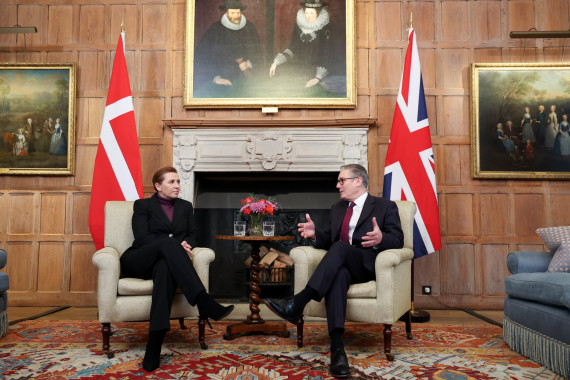
Before you go, a month or so ago, the British and Danish prime ministers co-authored an op-ed in The Guardian where they said they were going to call upon the European Convention on Human Rights to be modernised to account for this new world of migration. What are they asking for and why?
I actually think their choice of words is quite spurious because what they're actually asking for is a devolution, a kind of un-modernisation.
When we look at the European human rights regime – the convention and the court – it used to be interpreted more towards European citizens or people within the territories of European countries. There was barely any immigration case law.
But since the 1990s, there's been this growing case-log. On the one hand, expulsion cases applicable to asylum cases – people who are getting expelled based on maybe criminal behaviour or losing their residence permits – but also very importantly, family unification. So a lot of cases around that. Also, a number of cases around extra-territorial migration control that European countries have always relied upon in order to do what they're clearly not allowed to do, or are unwilling to do, at home.
So the European human rights regime has come to play an undeniably larger role when it comes to migration and asylum. That has come in tandem with the development of these more restrictive policies after the end of the Cold War.
The issue of whether or not the European Court of Human Rights should play this type of role when it comes to migration has been a recurrent debate for at least the past 15 years. The UK has been pointing its finger at the court for more than 20 years, especially after 9/11, as an obstacle to expelling criminally convicted or terrorist suspects who are foreign.
What it will mean in practice is a very open question. Some scholars suggest, and I would tend to agree, that all this is a kind of political signalling; you don't necessarily need a very formal thing. I think it's an open question where we're going to see a direct confrontation with the system as it works today, or whether it is another example of this kind of political signalling going on.



0 comentários:
Postar um comentário