I mean, it's even simpler than that. If you can't get oil, you have to pay more for it. The more you pay for oil, the less cash you have to give to your people, the angrier they get, and they're more likely to throw you out right on the street, complain about the price of bread, et cetera.
The second kind of signal that you talked about is the movement of people. I'm thinking about how the near collapse 15 years ago of the Syrian regime resulted in this refugee crisis which transformed politics in Europe for a generation. Are we at risk of seeing something similar like that playing out again?
I very much hope that we don't have a repeat of that. Not just obviously because of the impacts on populist politics in the West, but also because that would mean that there are boots on the ground in some of these places and there is the kind of devastation and breakdown of law and order of state control that accompanies invasions, and civil wars, such as we had in Syria.
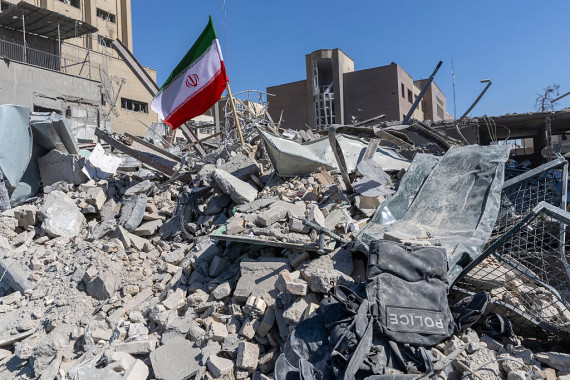
Although obviously the bombing is leading to devastation [in Iran]. We don't know if it hasn't reached the level that would lead to a vast movement of people from a country like Iran out to the broader world.
Now, two things could happen. We could see a spread in this kind of disruption in the area that would cause movements of people from other countries with lower state capacity than Iran, which does have enormous state capacity.
But also what you are seeing at a different level is perhaps a movement to the elites one way or the other. Elites who, perhaps, looked at some places in the Gulf as a refuge in a haven for quite a while, and it is possible that that is no longer the case. So you'll see movement at a different level of people.
How serious do you think that is? I can understand that a week or a month of bombings in the Middle East could shake this idea of Dubai as a safe haven or the UAE is a safe haven, or Qatar as a safe haven. But do you think that risk is overblown? That in six months from now, air defenses are back. The Gulf continues to do business. Rising oil prices mean that the Gulf has even more money than it had previously, and so actually it's like the go-go days all over again.
I think that all of those things will be true, there will be more money. That business as usual will continue once this has died down. Except it'll be a little bit deceptive as compared to the past.
Abu Dhabi and Dubai are different: One does have oil wealth, which is Abu Dhabi, and one essentially doesn't, which is the Emirate of Dubai. And Dubai exists purely as a product of what it has to sell to people who move there. And what it has to sell is this notion that it is a place beyond the contestations of politics.
It is a place beyond the troubles of taxation and politics and geopolitics and regional turbulence and rioting on the street. And, you know, it's all the comforts of home, whatever home you may be from. So you'll have the same brands that you have in Kensington, and the same household staff that you have in Defence Colony in New Delhi, but completely detached from actual reality. And that's the promise. That is the appeal that Dubai has.
I think that that promise has been punctured a little. It is in that sense a very interesting conflict. Have we seen conflicts like these before where a country under attack cannot get back at its aggressor and so essentially decides to wreak devastation in the neighborhood?
I mean, not in this very obvious way, but you could argue that the Russian Federation does that. It's angry at, I don't know, the UK, the US, at history, but what it clobbers is Georgia and Ukraine. North Korea will be angry at the US but we'll threaten Japan.
So this is what the weak do. Um, even if they're pissed off, they, you know, they, they always, um, they may be pissed off at the. It's true in politics as well. You're pissed off at the elite, but you bash up your neighbor...
You can read the rest of this interview here, or listen wherever you get your podcasts.



0 comentários:
Postar um comentário