Hello!
This week, the United Arab Emirates said it will leave the Organization of the Petroleum Exporting Countries (OPEC) group, which came as a huge shock for the rest of the alliance.
This latest turbulence in the oil and gas industry got me thinking about the movement to phase out fossil fuels and whether this was a positive omen for environmentalists and anti-Big Oil campaigners or whether there was a catch.
Although OPEC and its allies will lose some of their power over the oil market when the UAE leaves on May 1, the rest of the producer alliance is likely to stick together to coordinate oil supply policy, OPEC+ delegates and analysts said.
But what did attendees at the first Conference on Transitioning Away from Fossil Fuels in Santa Marta, Colombia, think?
Keep scrolling to find out more, but before you do, here are some fascinating tech, social and governance stories on my radar:
|
|
|
|
Sheikh Mohamed bin Zayed Al Nahyan, President of the United Arab Emirates. Abdulla Al Neyadi / UAE Presidential Court/Handout via REUTERS
|
The UAE will become the largest oil producer to quit OPEC, a heavy blow to the organization and its de facto leader Saudi Arabia.
It’s also the fourth producer to leave OPEC+ in recent years, and by far the biggest. Angola quit the bloc in 2024, citing disagreements over production levels. Ecuador quit in 2020 and Qatar in 2019.
The current members of OPEC are: Saudi Arabia, United Arab Emirates, Kuwait, Iraq, Iran, Algeria, Libya, Nigeria, Congo, Equatorial Guinea, Gabon and Venezuela. I cut a line here
There has been tension between the UAE and Saudi Arabia over the Emiratis' production quota, which stands at 3.5 million bpd.
The UAE has asked for a bigger quota to reflect the fact that it had expanded capacity as part of a $150 billion investment program.
Rumours of the UAE's exit from OPEC+ have circulated for years amid worsening relations with Riyadh over conflicts in Sudan, Somalia and Yemen. The UAE has also grown increasingly close to the United States and Israel.
|
|
|
|
A win for fossil fuel phase-out? |
I spoke to multiple environmental groups and think-tanks who attended the conference in Santa Marta who said they saw this as an opportunity to build momentum around a fossil fuel phase-out.
Guy Prince, head of energy supply, at independent financial think tank Carbon Tracker, said that the UAE’s decision highlighted a weakening supply coordination among producers at a time of geopolitical strain and growing uncertainty about long-term oil demand.
“This is exactly what countries and financial institutions recognized in Santa Marta, where nearly 60 governments discussed coordinated planning to manage declining fossil fuel revenues and reduce exposure to energy price shocks,” said Prince.
Louise Hutchins, convener at the environmental campaign group Make Polluters Pay Coalition, said the move created a clear sense of momentum.
“Governments, cities, states and civil society are collaboratively working out how to get off this dangerous fossil fuel roller coaster. At the same time, fractures like the UAE’s move away from OPEC underline how unstable and contested the fossil fuel system has become,” said Hutchins.
But there’s a catch. Although many civil society groups see this as a win for sustainability, some people like ActionAid International’s global lead on climate justice Teresa Anderson, saw many countries in Santa Marta expressing real anguish at their vulnerability to fossil fuel price fluctuations.
“There’s a hunger to be free from the economic and climate harm of fossil fuel dependence,” said Anderson.
"That is precisely why Santa Marta's reforms must be delivered: debt cancellation, an end to Investor-State Dispute Settlement, and rules that give Global South countries the technology access and policy space to build their own futures," said Dr Ketakandriana Rafitoson, executive director at Resource Justice Network.
|
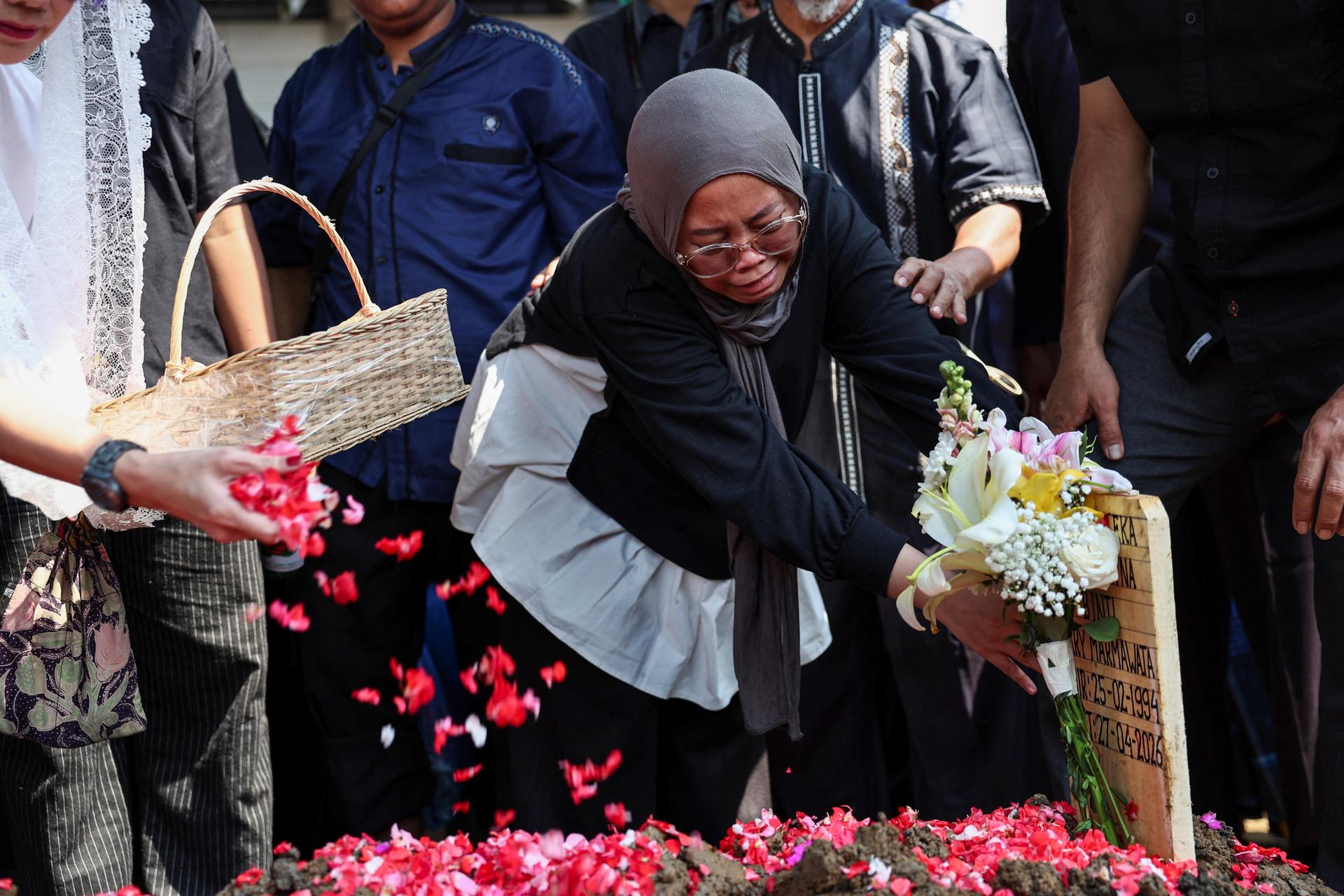
Putri, sister of Nur Aina Eka Rahmadhyna, who was killed in the deadly collision, reacts during the funeral of her sibling. Bekasi, Jakarta, Indonesia. REUTERS/Willy Kurniawan
|
- Women’s safety in Indonesia train collision: A collision between a commuter train and a long-distance train near the Indonesian capital Jakarta killed 16 women, with another 88 injured, Agus Harimurti Yudhoyono, Indonesia's senior minister for infrastructure said, as the accident mangled a carriage reserved for the use of women to avoid sexual harassment in crowded trains.
- ‘Child Alert’ in Sudan: Five million children across Sudan's Darfur region are facing extreme deprivation, the United Nations children's agency UNICEF said, issuing an emergency warning, known as a "Child Alert", over the situation as the civil war in the country enters its fourth year. The warning is used sparingly by UNICEF and is designed to signal that a situation has reached a critical threshold.
- Ghana-US health deal: Ghana’s government has rejected a bilateral health deal with the U.S., a source familiar with the negotiations told Reuters, balking at terms requiring the sharing of sensitive health data, the source said. The same issue sank talks with Zimbabwe this year and also prompted a court to suspend implementation of Kenya's deal pending the hearing of a case filed by a consumer protection group.
- US Supreme Court immigration case: The U.S. Supreme Court heard arguments concerning moves by President Donald Trump's administration to strip humanitarian protections previously provided by the government to more than 350,000 people from Haiti and 6,100 from Syria, as part of Trump’s crackdown on immigration.
- US Soybean Board women: Click here for a feature on how the Trump administration rejected four women farmers selected by their peers for the United Soybean Board, as three of the women suspected the decision was based on gender amid Trump’s broader push to eliminate diversity, equity and inclusion policies in government. Reuters could not determine the U.S. Department of Agriculture’s reason for rejecting the candidates.
- UK Palestine Action case: Britain's interior minister, Shabana Mahmood, sought to uphold a ban on pro-Palestinian group Palestine Action, which it has designated a terrorist organisation, after a court ruling that the move unlawfully interfered with freedom of expression. London's High Court ruled in February that the ban was unlawful, although it remains in force pending the outcome of the government's appeal.
|
|
|
|
The U.S. Supreme Court gutted a key provision of the Voting Rights Act - making it harder for minorities to challenge electoral maps as racially discriminatory under the landmark civil rights law - in a victory for Louisiana Republicans and Trump's administration.
The ruling hollows out Section 2 of the Voting Rights Act, which Congress enacted to bar electoral maps that would result in diluting the power of minority voters in Louisiana, where Black people make up roughly a third of the population.
|
|
|
|
Sustainable Switch was edited by Elaine Hardcastle.
|
|
|
|
|
|
| |
|
|
Sustainable Switch is sent three times a week. Think your friend or colleague should know about us? Forward this newsletter to them. They can also sign up here. Want to stop receiving this email? Unsubscribe here. To manage which newsletters you're signed up for, click here. This email includes limited tracking for Reuters to understand whether you’ve engaged with its contents. For more information on how we process your personal information and your rights, please see our Privacy Statement. Terms & Conditions |
|
| |
© 2026 Thomson Reuters. All rights reserved.
3 Times Square, New York, NY 10036 |
|
|
|
|
|







0 comentários:
Postar um comentário