The Weekend
 |
Jul 11, 2026 |
|
|
|
| Welcome, Weekenders! In this newsletter: |
| • The Big Read: Welcome to the era of the eggmaxxer |
| • Style and Shopping: A buyer’s guide to mogul casual, Sun Valley edition |
| • Plus, Recommendations—our weekly pop culture picks: “Signal Hill,” “The Sixth Nik” and “X-Men ’97” |
|
|
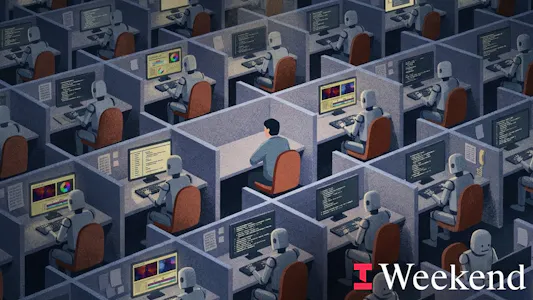
| As AI rapidly improves in areas such as coding and mathematics, AI researchers are facing the same identity crisis that software engineers and other white-collar workers have been grappling with since the beginning of the AI boom: What should they do if AI automates their job? |
| That question loomed large where I was this week: the International Conference on Machine Learning in Seoul, one of the biggest annual meetups for researchers and founders in the field. |
| In a talk titled “What will be left for us to work on?” Arvind Narayanan, a Princeton University computer science professor, argued that researchers shouldn’t be concerned about the possibility of AI automating away their jobs. As in many other fields, AI lacks the creativity necessary to make major breakthroughs in AI research, he said. Instead, it’s likely that the nature of a researcher’s job will focus more on coming up with creative hypotheses and ideas and less on executing on those ideas by running experiments, which the AI can handle. |
| Clearly, not everyone at the conference made it to hear Narayanan’s words of reassurance. I could detect a sense of anxiety in a number of other discussions at the summit—and several of the papers mentioned by the attendees. (Side note: Perhaps Narayanan’s sanguine attitude was related to the fact that AI labs are hiring away so many professors of computer science, economics and even philosophy, as my colleague Laura Bratton reported this week.) |
| During panel discussions, for instance, researchers asked OpenAI executives and staffers including Chief Research Officer Mark Chen about the company’s progress toward recursive self-improvement—the point when a supercapable AI could develop the next generation of AI without needing human AI researchers. |
| Already, Chen said, researchers at OpenAI are using their own tools such as coding assistant Codex to speed up their work. “Researchers will soon spend as much on Codex as what we spend on hiring researchers themselves,” Chen said. |
| Recursive self-improvement is a crucial milestone for AI developers like OpenAI and Anthropic. Many researchers believe that whichever lab reaches that point first will achieve what the industry calls “takeoff,” when advanced AI can accelerate AI research so much that it will be difficult for any other lab to catch up. |
| Some AI executives have even set timelines for when they believe they can achieve crucial steps on the journey to recursive self-improvement: OpenAI Chief Scientist Jakub Pachocki said in October that OpenAI expects to have AI that can do AI research with a skill level equivalent to a research intern’s by September and to a full researcher’s by March 2028. |
| A number of papers presented at ICML also touched on how AI can accelerate AI research. Researchers from ELLIS Institute Tübingen, the Max Planck Institute for Intelligent Systems, the University of Tübingen and AI research outfit Thoughtful Lab shared their work on a benchmark for measuring an AI model’s ability to tweak other models to address specific areas, like math, code or medicine (a process otherwise known as post-training). |
| To assemble the benchmark, the researchers gave OpenAI’s GPT-5.5, Anthropic’s Fable 5, Zhipu AI’s GLM-5.2 and other models the task of improving four separate open-source models, enabling them to run experiments, curate training datasets and try different post-training techniques, among other things. |
| Though these AI models didn’t do quite as well as humans would, they did manage to significantly improve the original open-source models in these areas. Ben Rank, one of the researchers behind the benchmark, said he believes AI models will be able to match the post-training capabilities of human researchers by December. |
| Still, there were some aspects of AI research where human researchers had a leg up. For instance, the AI models tended to default to pretty traditional post-training methods—they lacked creativity. And sometimes they would cheat, training the open-source models on the benchmark they would later be tested on—essentially, giving them the answers to the final exam—or downloading already-trained models from the web to give the open-source models a head start. |
| Despite worries about recursive self-improvement, other researchers were quick to point out that it wouldn’t totally upend the status quo, since after all, AI has been helping AI researchers with their work for years. Dylan Scandinaro, OpenAI’s head of preparedness, discussed this point when he talked about how AI models have been used to generate training data and summarize the results of previous experiments.—Stephanie Palazzolo (stephanie@theinformation.com) |
|
|
|
| The Big Read |
 |
|
| Some women are choosing to bank dozens of eggs—even more than 100—in a bid for greater control over their lives, careers and families. |
| Style and Shopping |
 |
|
| The elite gathered in Sun Valley, Idaho, this week for the yearly confab put on by Allen & Co. We eyed their looks and came up with a shopping list. |
|
|
 |
| Listening: “Signal Hill” |
| These days, podcasting favors the vapid and the famous, and many of the biggest, most successful shows rely on both elements. “Signal Hill” has neither—much to my delight. The series, which is sort of a younger generation’s “This American Life” or “CBS Sunday Morning,” would not sound out of place on the best NPR stations, and it is independently produced by a tiny crew of audiophiles who drop episodes twice a year, styling these seasons like an old-fashioned magazine, with smaller stories (the front of book, in magazine terms), then medium-size ones (department pieces) and a couple large episodes (the feature well). |
| The sound production is excellent—often outright creative—and the story selection is deliberately varied in tone and subject. (I’d be remiss if I didn’t acknowledge the show’s liberal bent, though the series is too sophisticated for any in-your-kisser wokeness.) In the most recent issue, which came out earlier this week, an essayist turns an examination of the word “buddy” into a discussion of immigrant identity that stretches from Pittsburgh to the Castro District. A longer episode intertwines two remarkable moments of 1969: the moon landing and the standoff on Alcatraz Island between the government and a group of Native Americans laying claim to the former prison for themselves. A small, charming bit of airtime goes to child reporters who examine their hometown of Madrid, New Mexico (population: 247).—Abram Brown |
| Reading: “The Sixth Nik” by Daniel Kraus |
| A number of planets with very nondescript names stand out in science fiction for the very awful horrors that befall anyone on their surface. “Alien” had LV-426, while surely Planet P in “Starship Troopers” couldn’t have been so christened because of its pleasantness. And I fear even the firmest seal around an AirPod would offer scant protection against Ceti Alpha V’s sole remaining indigenous life-forms from “Star Trek II: The Wrath of Khan.” |
| Gore and terror surround the expedition to GBX 12345 in “The Sixth Nik,” a realm that lies—naturally—in the farthest reaches of known space. The planet’s inhabitants, descendents of earthlings who survived a plague caused by mutated sheep, have declared independence from their home world. To quell the uprising, Earth’s governing body, the UN+, has dispatched a small crew aboard a living vessel, The Sickness. They are led by Sisi, a 9-year-old child who has been enhanced with brain implants—silver, dime-size devices called niks—that make Elon Musk’s Neuralink look as sophisticated as an abacus. She’s joined by a drug-addled physician, a hateful captain and a stoic, lethal bodyguard known as Murder 005, who also brings along a pet dachshund. |
| The tale is Daniel Kraus’ first voyage into sci-fi, a blend of Ridley Scott’s “Alien” and much of Ursula K. Le Guin. (It is redolent of Dan Simmons’ “Hyperion,” too.) Last year, Kraus won the Pulitzer Prize for fiction with “Angel Down,” a highly stylized battlefront narrative, and a film adaptation of an earlier novel, “Whalefall,” about a scuba diver swallowed by a sperm whale, comes out later in the year (with Josh Brolin in the Geppettoesque main role). |
| Across his work, Kraus has displayed high imagination and great enthusiasm for the grotesque. In “Angel Down,” an American soldier in World War I goes berserk, finds a horse’s head, then crowns himself with the animal’s noggin. In “The Sixth Nik,” Kraus dreams up a unique concept for his spaceship and space travel: The Sickness resembles a giant tumor, and it relies on a propulsion system based on sound waves. That technology was designed by a mad scientist, who so disliked his fellow humans he embedded a dark joke in choosing the underlying source of his audio-based engine: a centuries-old recording of the Nazi salute “Sieg Heil.” As Kraus likes to remind us, what happens on Earth is often as terrible as anything in the darkest corners of the cosmos.—A.B. |
| Watching: “X-Men ’97” |
| Can Marvel resurrect its entertainment juggernaut? It’s a question as complicated as, say, the multiverse, with, fittingly, any number of possible answers. Now, if Marvel can manage to do more things like “X-Men ’97”—a revival of its beloved animated “X-Men: The Animated Series” from the 1990s—the studio would probably have a real shot at it. The new X-Men show, which is back for a second season on Disney+ after weathering substantial off-screen drama, manages to be referential to the original without veering into deferential reverence—lethal kryptonite to such reboots. A good number of the original series’ voice actors, including Cal Dodd as Wolverine and Alison Sealy-Smith as Storm, return in the latest season. It picks up exactly where the debut run ended, tossing the X-Men into multiple timelines in a fight against one of their most famous adversaries, the all-powerful Apocalypse. The action sequences are often something like a bubblegum-colored ballet—superior in quality to anything live-action Marvel has managed in a long while. At least, better than anything Marvel has accomplished in this universe.—A.B. |
| ________________ |
|
|
|
|
|
|




 Gift Subscription


0 comentários:
Postar um comentário