The Weekend
 |
Aug 22, 2026 |
|
|
|
| Welcome, Weekenders! In this newsletter: |
| • The Big Read: AI promises to cure cancer. Scientists feel existential dread |
| • The new robotics ‘arms race’: Who can do the craziest hype video? |
| • Plus, Recommendations—our weekly pop culture picks: “Dan Taberski’s Manifesto,” “A Tender Age” and “The End of Oak Street” |
|
|
| With surprising swiftness, data centers have become the bête noire of the left, the right and seemingly everyone between those two poles. That poses an immense problem for Silicon Valley, even if it is an issue partially of the industry’s own making. |
| My colleagues at The Information have been following the mounting opposition to data centers with our data center moratorium tracker for several months. And an amazing array of additional examples has recently arrived that further illustrate how widespread the sentiment has grown. Weeks ago, Greg Abbott, the Republican governor of anything-goes Texas, brought the construction of 1,800 data centers in that state to a standstill over concerns about their power and water use. And then on Tuesday, Josh Shapiro, the Democratic governor of Pennsylvania, issued an executive order that tightly restricts data center expansion in his state. |
| Then there was the pee ad that went viral on Wednesday from Liquid Death and the beer company owned by ex-NFL stars Travis and Jason Kelce: The two startups joined up to cajole people to consume copious amounts of weak pilsner and canned water, urinate and then mail off their bodily fluids to a stockpile, which they promise to share with data centers to use in their liquid-cooling systems. They’re kidding, I think, but I can’t entirely be sure: Neither Liquid Death nor the Kelce brothers’ Garage Beer would comment for this story. (According to TechCrunch, it’s theoretically possible to use urine to cool data centers. Take that as you will.) |
| Fresh polling data attached startling numbers to the unease around data centers, and those figures—from Embold Research, a nonpartisan San Francisco–based polling outfit, and HeatMap Pro, a media startup focused on climate change—went even more viral than the pee ad. A full 75% of Americans now oppose data centers, up from 42% a year ago, according to the data. |
| Data centers now exist in the same category as in-laws, colonoscopies and black licorice: They’re a source of near-universal dislike. According to Embold’s polling data, opposition outweighs support by 43 percentage points among Republicans, 65 points among independents and 75 points among Democrats. |
| The sharp increase over the past year shocked Embold Research c0-founder Mike Greenfield when he looked over the data. “When people would ask me, ‘What has surprised you about polling in general?’ I say it’s how steady things are—and how much people don’t change their opinions. This has obviously been an exception to that,” said Greenfield, a former PayPal and LinkedIn analytics scientist who started polling in 2017. The zealous opposition to data centers has few historical comparables, he said, though he thinks it’s similar to the kind of sentiment that led to Prohibition. |
| To state the very obvious, opposition to data center construction is a grim subject for Silicon Valley, since those facilities sit at the heart of AI. It’s a risible situation for tech, which has exacerbated public unease around the projects. Among other things, the industry picked a deeply foolish metaphor to talk about data centers, likening them to the factories that powered the industrial revolution. Yes, factories were essential to 19th-century modernization. They were also dreadful places replete with human suffering. We might as well have just said: Data centers are great—they’re just like dungeons, coal mines and dental operating rooms. |
| At this point, I don’t think anyone can clearly predict whether the ultimate outcome to the data center discourse will resemble what happened with fracking, which handily survived a wave of opposition in the 2000s, or whether it’ll mimic what happened to nuclear power, which very much did not survive the opposition that mounted in the 1970s and 1980s. The exact consequences of data center expansion are squishy unknowns. Or, as Yale professor Yuan Yao recently put it in a lengthy but fair-minded piece about data centers, “The environmental impacts of data centers are real, but they are also highly context-dependent.” |
| Another part of what happens to data centers seems to come down to whether Silicon Valley can pull together on a coordinated public relations campaign that’s more than AI will be great—trust us, you dummies. “Claude Code is an amazing tool,” said Embold Research’s Greenfield. “But I don’t think the companies building data centers have done an amazing job of telling their story to the average voter—the average person—outside of Silicon Valley.” |
| To a degree, parts of the industry have begun to follow the advice Lulu Cheng Meservey, the highly regarded public relations maven, has voiced: “The most tried and true PR tactic is just give people stuff.” According to Bloomberg, Oracle, which has pinned enormous hopes on AI infrastructure, has donated money to local charities near its Project Jupiter data center in rural Texas—even shifting some cash over to become a sponsor of Dino Dig, a theme park where kids excavate fake dinosaur bones. And as my colleague Amy Dockser Marcus notes in this week’s Big Read, Anthropic, OpenAI and Google have all tried to reposition AI as a means for curing terrible diseases. That has enraged traditional scientists, who think it’s unfair hype, but as far as charm offensives go, offering people cures for cancer is definitely catchy marketing. |
| A couple things I can more easily foresee: Tech spending in the midterm elections is going to go absolutely nuts. Take the recent note that the National Republican Senatorial Committee, which is responsible for getting Republicans elected to the Senate, sent to a slew of major AI companies: It warns that data center opposition could cost Republicans an Ohio Senate seat and amounts to a direct poke in the ribs for pro-AI super PACs to up their contributions. I also think consumer AI hardware is gonna have a tough time: Will things like OpenAI’s Jony Ive–designed, hockey puck–shaped device will be dead on arrival? Will enthusiasm for Meta’s smart glasses will drastically plummet? (Controversy has already been growing around the glasses’ ability to make covert video recordings.) Data centers have attracted mass consternation because they’re a physical embodiment of a technology many people fear. I wonder how many people will want to walk around wearing items that conjure the same anxieties.—Abram Brown (abe@theinformation.com) |
|
|
|
| The Big Read |
 |
|
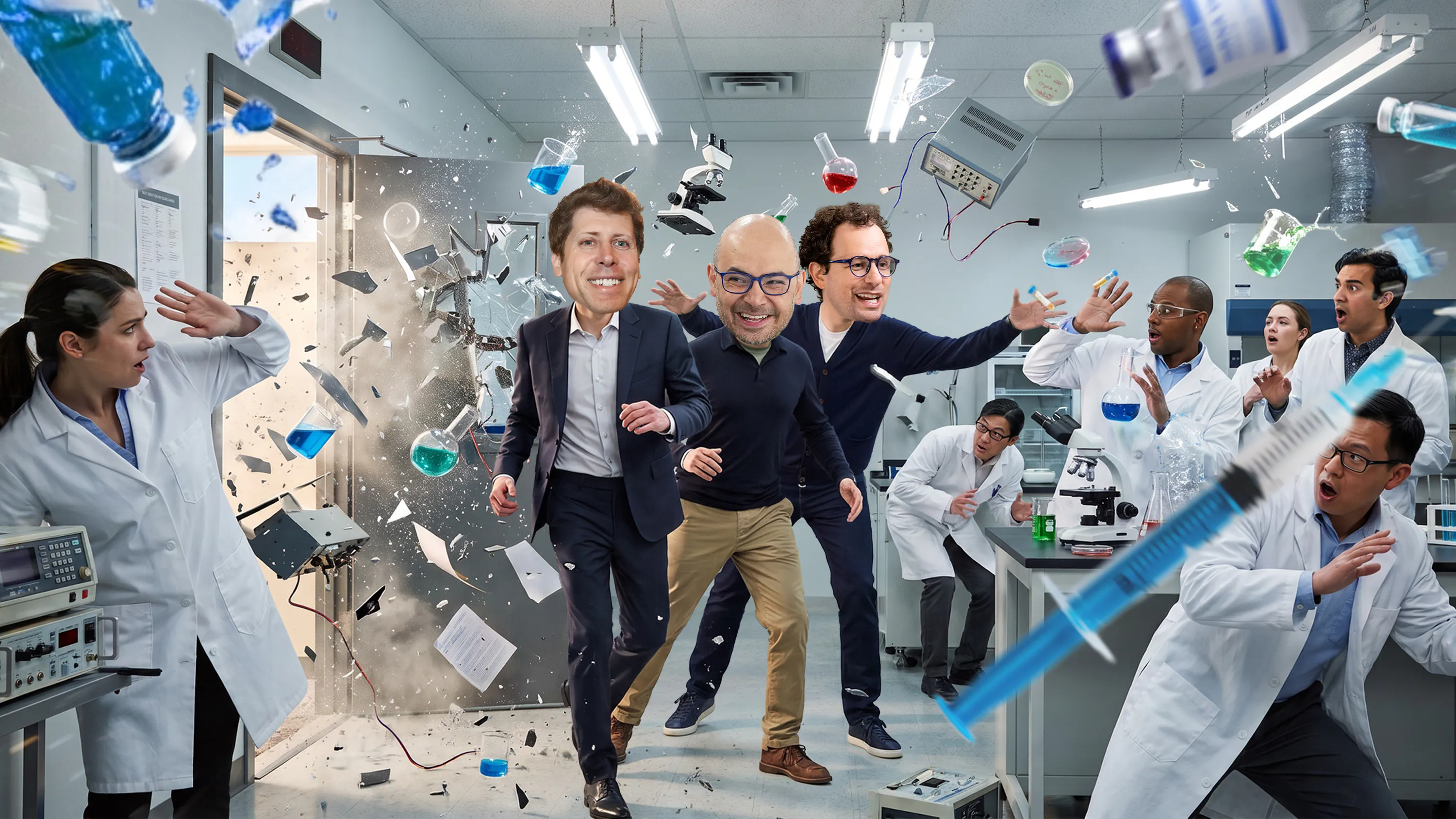
| Traditional researchers see promises of fast AI cures as an attack on their field’s established rules and an attempt to declare victory without proof. |
 |
|

| Since many robotics startups are years away from actually selling anything, they badly need attention-grabbing promotional footage to maintain interest. |
|
|
 |
| Listening: “Dan Taberski’s Manifesto” |
| Dan Taberski is a fellow of many interests and wry humor. He’s been a “Daily Show” producer, a low-level Clinton economics aide and a creator of “Destroy Build Destroy,” a Cartoon Network reality show that pitted teams of kids against each other in a race to build things like an amphibious vehicle and a battering ram. More recently, he has enjoyed an excellent run as a podcast impresario, turning his friendship with Richard Simmons into the biographical “Missing Richard Simmons” and reexamining the aftereffects of the Sept. 11 attacks in “9/12,” one of the finer pods of 2024. |
| Having built something of a name for himself, he has now moved onto an Audible-produced series with his name in the title: “Dan Taberski’s Manifesto,” a personal essay in audio form that examines various manifestos from across the centuries. (The title’s metaness lies in Taberski’s self-assigned task over the six episodes to draft his own manifesto about what makes an efficient manifesto.) For the series, Taberski conducted considerable research. (“I’ve been mainlining manifestos for months,” he acknowledges as the series opens. “As many manifestos as there are gripes about the world and big ideas to fix it.”) This involved reading the manifesto behind the Arab Spring; the pro-cigarette manifesto penned by painter David Hockney; the SCUM manifesto, a semisatirical call to rid the world of men from a feminist activist, who later tried to murder Andy Warhol; and, of course, the Communist Manifesto, “the big daddy” of all manifestos, as Taberski puts it. |
| The series is a window into the cultural, societal and political forces that animate, intrigue and enrage us. Taberski narrates the exploration with a wink and a dry wit, managing to walk a fine line, expressing keen curiosity in what makes someone actually sit down and write a manifesto—an “artful scream,” as he says—without glorifying the violence many such screeds spark.—Abram Brown |
| Reading: “A Tender Age” by Chang-Rae Lee |
| For his seventh novel, Pulitzer Prize finalist Chang-Rae Lee settles his attention on a rich, poignant tale of 10-year-old Jeon-Gi, who lives in a blue-collar Westchester County suburb with his Korea-born parents and younger sister. It is very much a bildungsroman, one that Lee has acknowledged contains a good amount of autobiographicalness. An older Jeon-Gi narrates with sharp, introspective melancholy, reflecting on the seminal events that subsumed and altered the course of his life in 1976. As a boy, Jeon-Gi is a smart, sporty third grader, but as a son of immigrants, he feels adrift and stiffly categorized by his race, the default sorting mechanism among his peers. He is bullied—with startling, ribald antics—and pays it back in turn. It lands him in mounting and serious trouble, which shakes his parents’ perception of him and their journey to find a foothold in their new country. As the oldest child, Jeon-Gi carries the weight of his parent’s hopes. “I was our first boat, our last boat, the one designed to crest any wave, to weather any storm,” his older self recalls. “They had never considered the possibility of a ruinous tempest within.” |
| The novel has two halves. The first unfolds across several turbulent months in which Jeon-Gi’s brush with near-expulsion from his elementary school propels him into rounds of therapy sessions and banishment from his friend group. He wrestles with finding a comfortable identity for himself, a task made more difficult by a nagging worry that something rotten lies embedded within him. On a field trip to an active prison meant to scare the visiting kids straight, young Jeon-Gi finds himself fascinated by a commonality among the inmates who speak to them: an ability “to step outside of a moment in order to commit some transgressive act, to not feel what they ought to feel,” adult Jeon-Gi recalls. “I realized I admired this capacity, because I knew that it was a capacity I had, too.” |
| The second half focuses on Jeon-Gi’s two-week-long stay at a church sleepaway camp, part of his parents’ efforts to help him grow up. He experiences some warm, familiar rituals of summer—cookouts, hikes, fast friendships. To a fellow camper who earns his amorous interest, he expresses his innermost desire. “That people would like me,” he tells her. For a stretch, it seems like he may finally settle in and see his wish come true.—A.B. |
| Watching: “The End of Oak Street” |
| At the beginning of “The End of Oak Street,” the Platt family, a middle-class clan in a cheerful, Amblin-speckled town somewhere in Michigan, seems to be hurtling toward an untimely conclusion in the year 1982. Greg (Ewan McGregor) is struggling to bring home the bacon—his current occupation: delivering pizza. His more capable spouse, Denise (Anne Hathaway), is moldering away as an underappreciated homemaker and mother to Audrey (Maisy Stella) and Brian (Christian Convery). There are tears and talk of divorce. Then the dinosaurs show up on Oak Street, along with thunder, sonic booms and wormholes. |
| And thus the Platts get a fresh start, knitted tighter than ever as they make a bid to survive the T. rex, the pterosaurs and the rest of the prehistoric menagerie. It makes for a wonderfully fun adventure, one replete with loving homages to Spielberg movies and other genre fare. (Beyond “Jurassic Park,” I caught references to “E.T.,” “Poltergeist,” “The Birds,” “Back to the Future,” “Jaws,” “Jumanji” and “The Twilight Zone.” Oh, “Battlestar Galactica,” too: I forgot to mention the Platt household’s four-legged member—a heroic canine named Starbuck.) Yet the outing is more than microwave-warmed nostalgia. The dinosaurs, which look fantastic, aren’t exact clones of ones we’ve seen before. And writer-director David Robert Mitchell, who is best known for the 2014 horror film “It Follows,” imbues the movie with a real gory edge: Deaths and dismemberment abound. He has a good sense of humor, too, which is especially evident in a memorable life-finds-a-way scene involving a pair of Brontosauruses. |
| Does the plot make total sense? Eh! Nonetheless, I liked Mitchell’s decision to go with a hand-wavy mystery. It allowed him to do a brisk, 99-minute running time and skip several cliches, like the laborious explanation of the catastrophe’s backstory and the arrival of shadowy governmental authorities to contain the mayhem. No, the Platts are on their own. Lucky for them, Hathaway’s Denise is a crack shot and positively feral in her protection of her family, unfazed even when she comes face to fang with a Titanoboa in her California ranch–style kitchen. I half expected the chairs to scoot over to her under their own power to come to her aid.—A.B. |
|
|
|
|
|
|





 Gift Subscription


0 comentários:
Postar um comentário