| | | | | | | Presented By Bank of America | | | | Axios Latino | | By Marina E. Franco (Noticias Telemundo) and Russell Contreras (Axios) · Sep 26, 2024 | | Happy Thursday! 📞 We need your help! Are you a U.S.-born citizen who has recently gotten Mexican citizenship for personal reasons? Please let us know by replying to this email. 👀 En español 👀 This newsletter, edited by Astrid Galván, is 1,287 words, a 5-minute read. | | | | | | 1 big thing: Exclusive: Renters as a voting bloc | | By Astrid Galván | | |  | | | Illustration: Maura Losch/Axios | | | | A new campaign is betting that people who rent their homes instead of owning them can swing the election toward Vice President Kamala Harris. Why it matters: More than 45 million Americans rent their house or apartment, yet renters are significantly less likely to vote than homeowners. Driving the news: The Center for Popular Democracy Action today launched an initiative focusing on renters in key swing states. - The campaign aims to specifically target Latino and Black voters who cast a ballot in the 2020 presidential election but haven't voted since.
- It plans to reach voters through direct calls, texts, mail, and digital and social media, working with local affiliates in Arizona, Michigan, Nevada, North Carolina, and Pennsylvania.
What they're saying: For voters — particularly in swing states — "the thing that keeps them up at night the most is housing insecurity, housing, and affordability" along with the "precariousness" that comes with being a renter, says Analilia Mejia, co-executive director for the Center for Popular Democracy Action. - "It is also the thing that they hear the least about" from politicians, Mejia adds.
By the numbers: Nearly 26% of U.S. renters spend more than half their income on housing, according to census data. Zoom in: Both Harris and former President Trump have zeroed in on housing affordability as a key voting issue, though they have offered different approaches to how they would tackle it. - Trump says he would limit the ability of undocumented immigrants to buy or rent, slash mortgage rates, and ease regulations to allow more construction.
- Harris blames a supply shortage and pledges to build more units through tax breaks and incentives for builders and to provide down payment assistance for first-time buyers.
Mejia points out that, "We are trying to correct a problem that is going to motivate people into the polling booth and we're going to continue to engage these people so that we get real policy change." Keep reading |     | | | | | | 2. Families rally for 43 missing students | | By Marina E. Franco (Noticias Telemundo for Axios) | | | 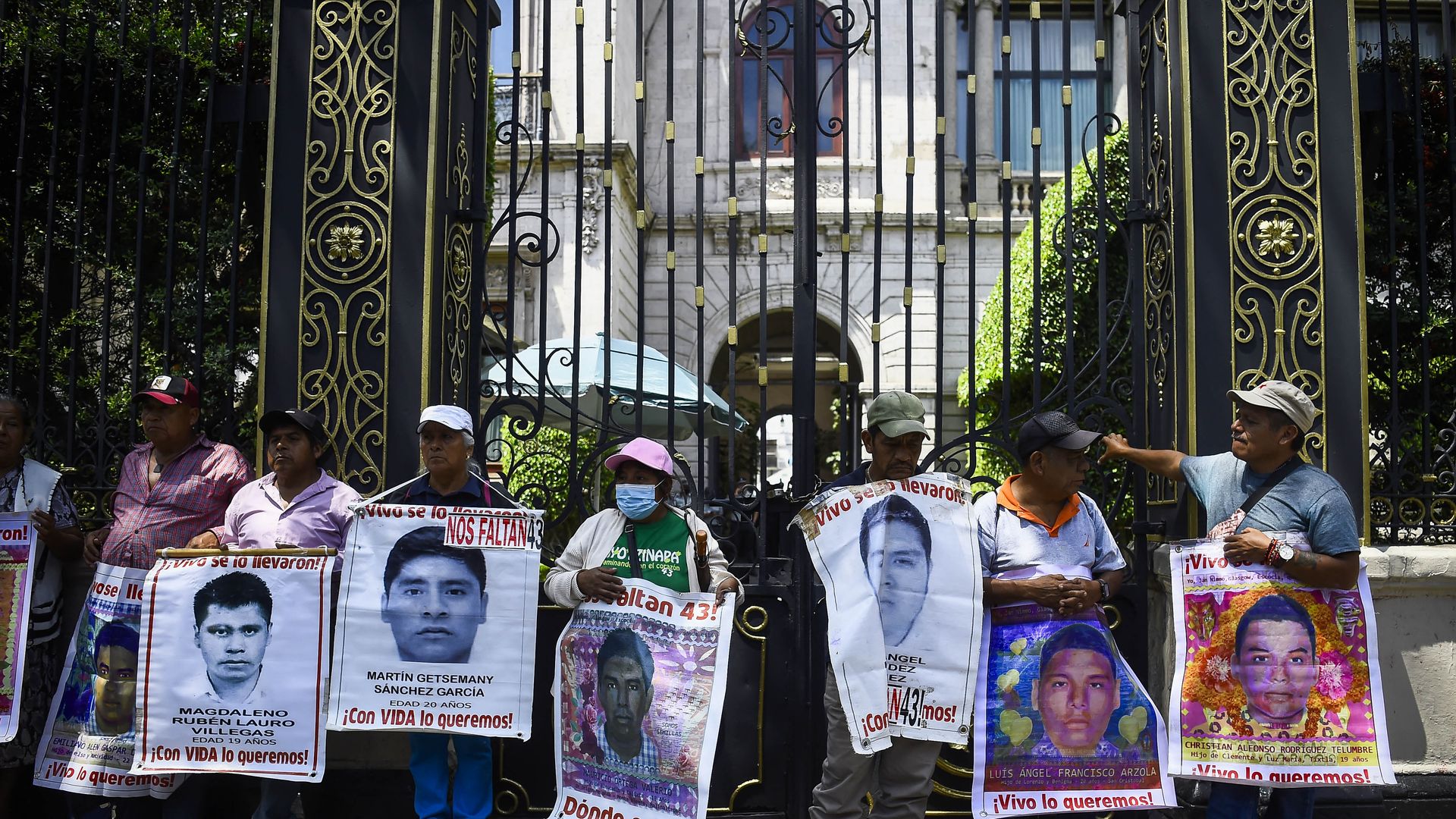 | | | Relatives of some of the students who were disappeared 10 years ago protest outside the Interior Ministry in Mexico City on Tuesday. Photo: Rodrigo Oropeza/AFP via Getty Images | | | | A decade after 43 students were abducted in Guerrero, Mexico, their families say the government has largely abandoned the investigation. Why it matters: The students from Ayotzinapa rural school are part of the largest mass disappearance in modern Mexican history, and they are among the more than 110,000 people who have been reported missing or disappeared in the last 50 years. - Yet the outgoing government of President Andrés Manuel López Obrador has downplayed the situation, arguing the number of people missing is "inflated" by alleged political opponents.
The other side: López Obrador said yesterday in a letter to the parents of the missing students that he's "happy that the case was handled." - "I leave with the peace of mind that the next government will continue" on with the investigation, he wrote.
Flashback: The pupils, who were studying to be teachers and were all from impoverished backgrounds, were last seen in police vehicles the night of Sept. 26, 2014, outside the state capital of Guerrero. They had arrived earlier that day to commandeer buses to travel to Mexico City for a yearly protest in remembrance of a 1968 massacre of students. - The motive for their disappearance is still unsolved, and the parents contend that it's in large part because López Obrador, who promised to prioritize the case when he came into power six years ago, has protected military officials who could have valuable information.
Zoom in: Outside investigators say it's likely the students were kidnapped because one of the buses they were in had drugs, which was unknown to the students. Inquiries have found links between a local cartel and officials who were in the Guerrero state government at the time. What they're saying: "As parents, we'll never stop looking for the truth about what happened to our kids … meanwhile, the president said he would support us and he just lied," said Metodia Carrillo, the mother of one of the missing students, on Tuesday during a protest outside the Mexican Senate building. - Carrillo's son, Luis Ángel Abarca Carrillo, was 17 years old when he disappeared.
- The families, advocates, and other students from the Ayotzinapa school are set to march down a main avenue in Mexico City later today.
Continue reading | | | | | | | | 3. Ecuador ranks last in safety | | By Marina E. Franco (Noticias Telemundo for Axios) | | | 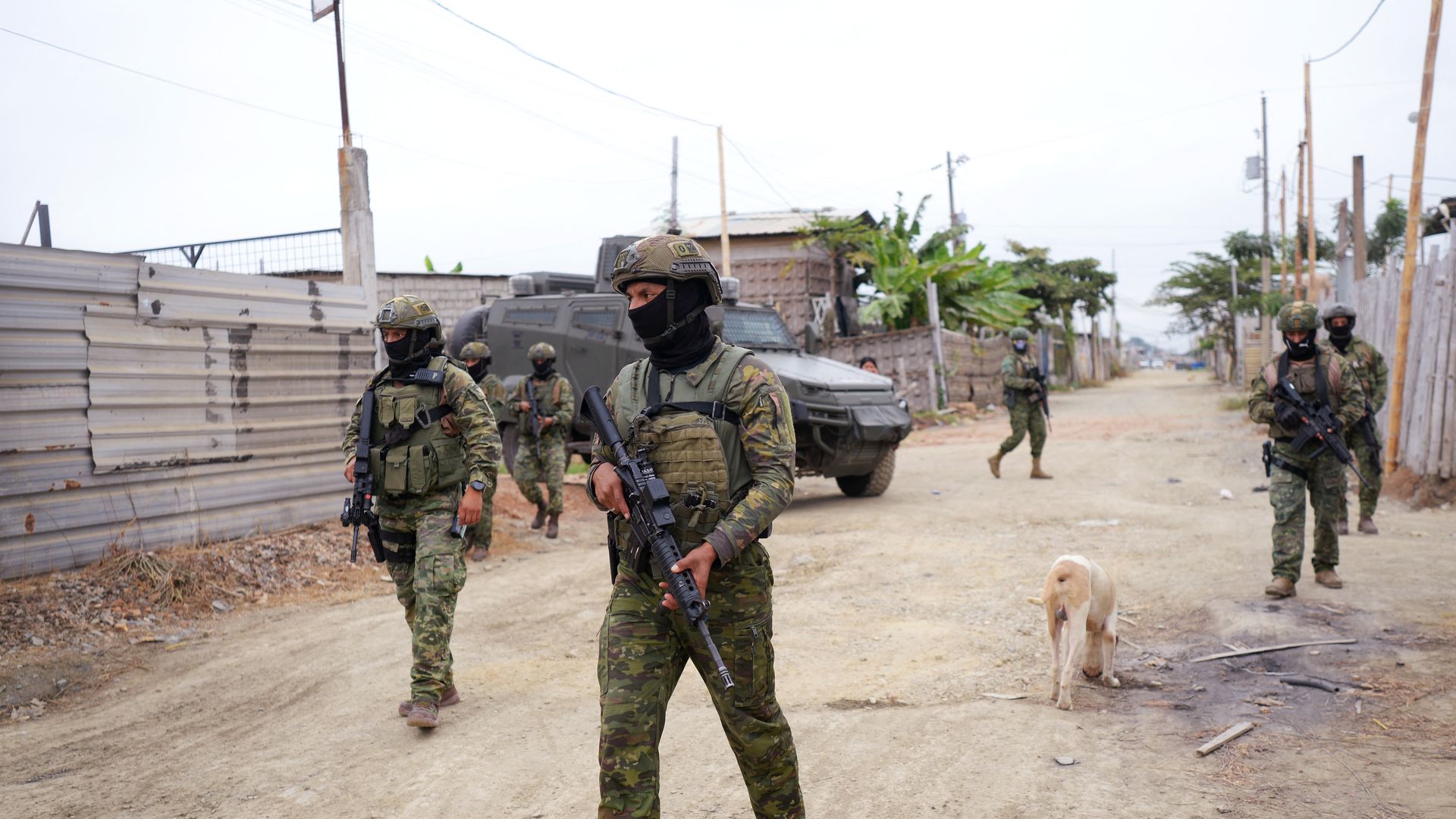 | | | Ecuadorian Army soldiers patrol in Duran, next to Guayaquil, Ecuador, on June 19. Photo: Gerardo Menoscal/AFP via Getty Images. | | | | Ecuadorians are the least likely in the world to feel safe in their country, according to new polling data from Gallup. Why it matters: Ecuador's long-time status as one of the safest nations in Latin America and the Caribbean is no more as the nation has been hit by the same systemic violence as nearby countries. Zoom in: Only 27% of Ecuadorians said they felt safe walking alone at night last year, tying with Liberia and South Africa, per the Gallup data published Tuesday. - As a result of the safety crisis, emigration from Ecuador has skyrocketed, even as the government of President Daniel Noboa has aggressively targeted crime groups and promised judicial reforms.
The intrigue: For the first time, El Salvador rose to the top of the list of places where people feel most safe. - The Gallup poll shows 88% of Salvadorans said they felt safe walking home at night last year, compared to the average of 49% for the last 17 years.
- That's seen as a result of a state of emergency targeting gangs that's been in place since the spring of 2022 and allows authorities to carry out mass arrests without probable cause or a warrant.
The big picture: Still, Latin America and the Caribbean are once again the regions where citizens say they feel the least safe in the world. - An average of 47% of respondents in Latin America and the Caribbean said they felt safe when walking home alone at night in 2023. The worldwide average was 70%.
- "The percentage has never topped 50% at any point in nearly two decades of polling," Julie Ray, the lead author of the Gallup report, tells Axios Latino.
Keep reading | | | | | | | | A message from Bank of America | | Latinas are a driving force for U.S. economy | | |  | | | | The U.S. Latina GDP Report, funded by Bank of America, is the first study of its kind to capture the expanding economic contributions of Latinas in America. A takeaway: Latinas contributed $1.3 trillion to the U.S. GDP in 2021. Read the report. | | | | | | 4. Stories we're watching | | |  | | | Illustration: Natalie Peeples/Axios | | | | 1. Puerto Rican authorities said yesterday they'd reached a deal to cancel the student debt of thousands of people on the island. - The agreement came through a lawsuit from the Puerto Rico Department of Justice against loan provider Navient (formerly called Sallie Mae) for alleged fraudulent practices.
- About 20,000 students will benefit, authorities said, with the estimated cancellation of about $7 million in debt.
2. Guatemala's Congress started the process this week of confirming hundreds of nominees to the Supreme Court and appeals courts, even as some of the suggested names are people accused of corruption. - Several of those names come from one of the nominating committees, whose members are close to Attorney General Consuelo Porras.
- Porras has been sanctioned by the U.S. for corruption and antidemocratic actions and is locked in a fight with President Bernardo Arévalo, who was elected on an anti-corruption platform.
| | | | | | | | 5. 🪅Pachanga: Leisha Majtan | | |  | | | Photo illustration: Axios Visuals. Photo: Courtesy of Leisha Majtan | | | | Congrats are in order for Leisha Majtan, executive producer for Spectrum News NY1 Special Projects! - Leisha and her team were nominated for five New York Emmy awards this year.
- Plus, Leisha recently became a new mom!
Keep up the great work, Leisha! 🎤 Please send us your pachanga nominations by filling out this form or replying to this email! | | | | | | | | A message from Bank of America | | U.S. Latina GDP surges ahead | | | 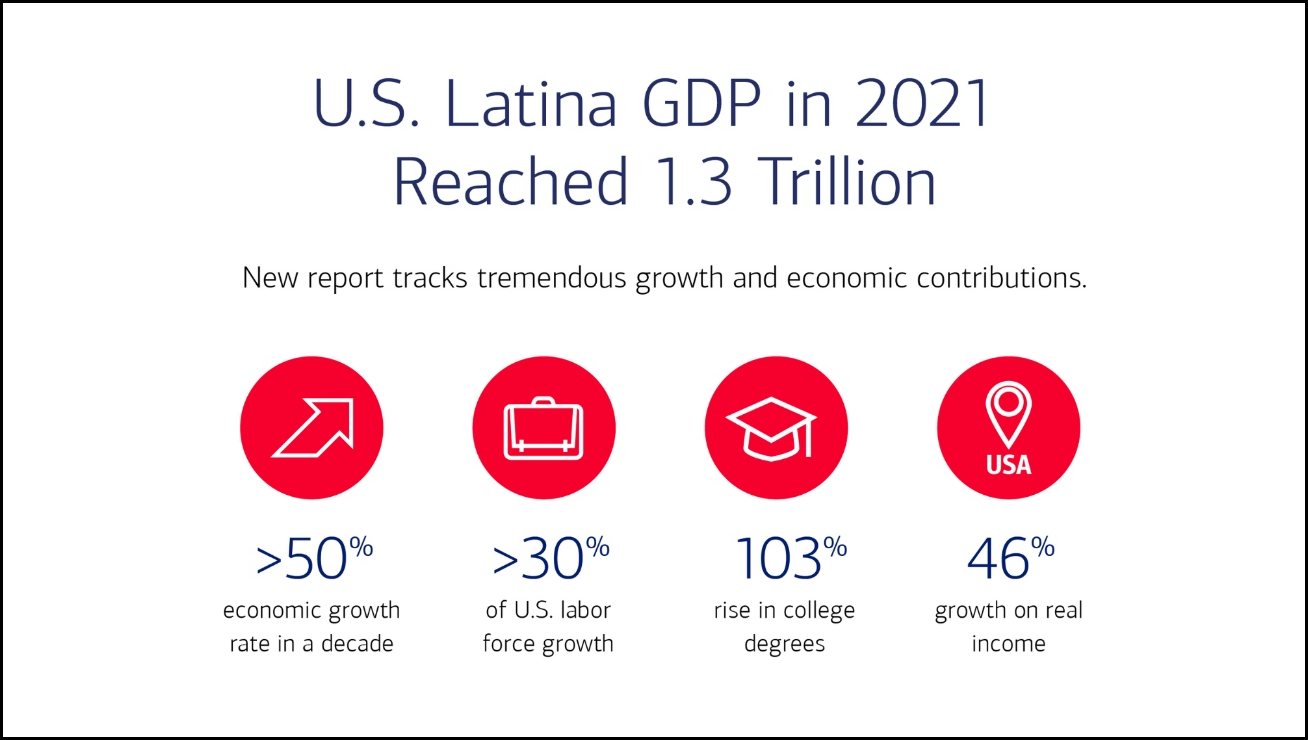 | | | | U.S. Latina GDP is growing 2.7 times faster than other groups. Get up to date: From 2010 to 2021, GDP for U.S. Latinas increased by 51.1% compared to 18.8% for non-Hispanic GDP. Explore this first-of-its-kind data, supported by Bank of America. | | | | 🛼 Russell is planning a skating party for his 11-year-old daughter, Ava, this weekend. 😥 Marina is very, very nervous about a vet visit with her dog later today. *Deep breaths.* 🍃 Astrid is planning a trip to Sequoia National Park next week and welcomes any recommendations! Many thanks to Patricia Guadalupe, Alison Snyder, and Axios Visuals for their contributions! |  | Your essential communications — to staff, clients and other stakeholders — can have the same style. Axios HQ, a powerful platform, will help you do it. | | | |


0 comentários:
Postar um comentário