

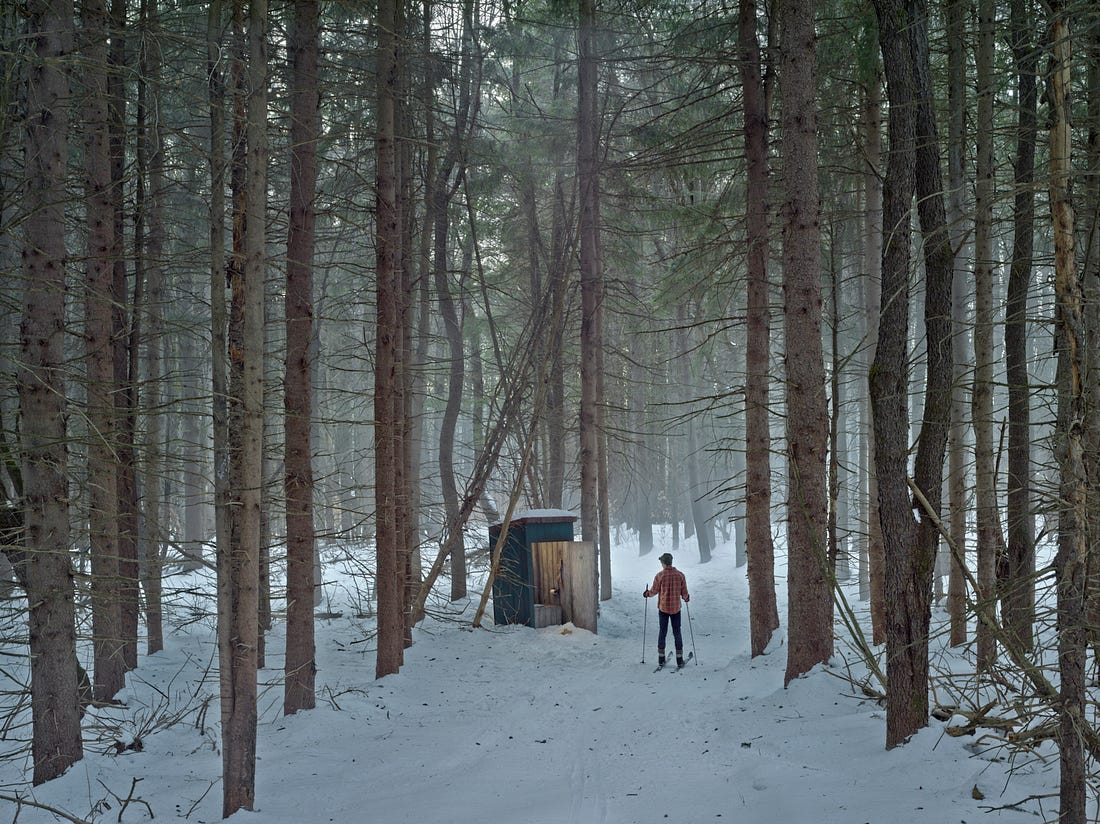
It’s always a bit tough when Gregory’s open water swimming ends. I sense a dip in his mood. His optimism wanes, slightly. This year, his last swim in Upper Goose Pond was Sept. 29, and the last one of the season (in other lakes) Oct. 5. He then entered the “in-between” season: That’s the low point. He goes to pools, and takes walks in the woods, but it is never really fulfilling to him. (He never says this overtly, but I know.) Once the cold weather truly sets in, there is hope again—we start looking forward to ski season. This year had an added challenge, though. Our favorite place, Canterbury Farm, announced it was closing for good. We still ski. We will always ski. Canterbury Farm was more than just a ski area to us, though. It was a place of creative awakening for Gregory. It inspired his series Cathedral of the Pines which came after a long period of him not making pictures. We also both had childhood ties to Becket, MA, where it’s located. We spent the early days of our relationship there, with each other, and sometimes with our kids. It was important to us. Gregory and I sat down with Dave and Linda Bacon (the owners) recently in their living room at Canterbury Farm to visit and reminisce. The following is a bit of our conversation. -Juliane Gregory: How many acres is Canterbury Farm all together? Dave: Just under 200. Gregory: When I was growing up, my brother Michael and I used to cross-country ski on our property in Becket, so I had a long history with skiing. Linda: So that’s why you liked the wilderness. Gregory: Yeah, that’s why I always liked skiing here, the forests, the streams, and ponds, and it’s Becket. It reminded me of my youth. Juliane: Where did you grow up, Dave? Dave: I grew up in Dalton [MA.] Then I went to college in Connecticut. When my necktie got a little too tight, I came back up here. I worked for the State in Conservation so I knew how to cut trails. I had a lot of experience in that. Linda: Thank goodness. Dave: I got into the landscape construction business, which was a smart thing to do because it worked well with the ski business. Gregory: So when did you officially open, what was your first year? Dave: 1985. Gregory: And what was your thinking about the trails? What was the philosophy behind it? Dave: The main thing for me was to visually go by things that I thought were beautiful, and to avoid the huge trees. I wanted to make sure that we kept those. Linda: He doesn’t want to cut trees for a view, either. Dave: No. Linda: …Even when I kinda wanted him to, because I know we have a good view of Mount Greylock up there. But that’s one of his philosophies. Dave: Yeah, don’t kill a tree just for something like a view. Trees are beautiful. So I kind of found my way through the woods making it skiable. It couldn’t be really too curvy, or narrow, or up and down, and being a skier, I had an understanding of that. I'd been skiing since I was four. Then as my landscape business got bigger, I had equipment. So then I could move dirt. Once I was able to move dirt with hydraulic power, that changed things dramatically. Gregory: Smoothing things out— Dave: Getting things graded, drained—drainage was key. I had to build bridges, obviously. I had never thought about it too much before then, and then suddenly I could see what you’d been talking about. I saw the light and the shadow. -Dave Gregory: So what do you think is the official season for cross-country skiing? Either now, or back then? Dave: Back then, you could count on December. And you could run pretty much through St. Patrick's Day, all the time. And we would usually have 75-80 days of operation, and some years maybe even a hundred. The last few years it’s been down to less than 30. Gregory: That's crazy. And the reason for that is— Dave: It’s warm. It has changed. We’ve really seen it. We've watched the change over the years, and it's not just the the dates and the weather, but you know, you can see there are different insects. Juliane: Like snow fleas? [Springtails.] Gregory: That’s always an indicator that it’s warming up. Dave: So as of right now, obviously, it's starts later, finishes earlier, and rains way more. And it’s often freezing rain, so that makes it difficult. Gregory: So what's the philosophy in terms of snow management, like in terms of keeping the snow at a high level? Dave: There three rules in trail building. Gregory: That's what I'm looking for. Dave: Yes, there are three. So you’ve got drainage— Gregory: Drainage. Dave: And then you’ve got drainage. Gregory: OK. Dave: And number three is don't forget the first two. Gregory: Ha. Dave: Well, you’ve got to make sure the water doesn't wipe out the snow. Gregory: What constitutes, for you, perfect conditions for cross-country skiing? Dave: When you’ve got a good base already. Then you get a nice dry snow, which we call champagne powder. Then you groom it, set a track the day before, then it tightens up overnight in the cold. Linda: Temperature is a factor, humidity is a factor. Dave: After a fresh powder, between 11:00 and 2:00, or maybe 11:00 and 1:00, snow will clump up on people's skis. And obviously that has to do with the sun.. and that’s when you have to put on the maxi glide on, or whatever. Linda: Furniture polish. Gregory: Really? Linda: Yeah. Wax is wax. Dave: Lemon Pledge. We used to use that. Juliane: You used the term ‘champagne snow.’ Are there other terms for like, stickier snow, for example? Dave: Well, there’s cord snow, [corduroy] champagne powder, and frozen granular. ‘Frozen granular’ by the way is how everybody makes it sound better than what it is. Linda: Then there's ‘loose granular,’ which means kind of turning into. mashed potatoes. Dave: Mashed potatoes is different. Juliane: That brings to mind a very specific texture. Gregory: What about ‘icy.’ Linda: We don’t like using that term. Or ‘rain.’ Dave: You can’t use the ‘r’ word around here. Gregory: Although sometimes when it’s raining a little bit, paradoxically, it can be really good to ski on. You just slide along. Dave: If you ski in New England, you’ve got to learn to ski on everything. Juliane: I remember you used to talk about the difference in the spring skiing, when the sun is much brighter, versus middle-of-winter skiing. The conditions are much different. Dave: Yeah, they change every three weeks. Gregory: There are the brutally cold days. and you’ve described the air as being different. Crystalline. Linda: Sometimes you can see that. I've been in the woods after a snowstorm and packing in the snowshoe trails, I'll see just little crystals all in the air. Gregory: I love that. I love when it's really cold and you start to warm up during a ski. Dave: Yeah, you got that good high-oxygenated air in the lungs. Then you can hear the wind in the leafless trees. Gregory: I was going to mention the wind. Dave: [Makes a haunting whistling sound.] Juliane: As you're entering Cathedral Pines, there are one or two trees that almost seem to talk to you. Dave: Yes. Gregory: As an open water swimmer, because that's my other activity, I'll always say, every single day is different—even though I do the same route at Upper Goose Pond. Like, there's some factor, either the water temperature, the wind, the sun, or just the landscape, that is different. So do you feel that here with the ski trails? Dave: Absolutely. Gregory: It's so interesting because we used to do the same ski route here every single time, basically, because I'm a creature of habit. But every day was slightly different, so there's this thing about continuity and change. You do the same routine. But each day has its own character. Dave: The shadows are different. I remember you kind of ‘enlightening’ me about light. When we were up there in the Pines [making the titular picture from Cathedral of the Pines in 2014.] We were talking quite a bit about light. Gregory: Yes. Dave: I had never thought about it too much before then, and then suddenly I could see what you'd been talking about. I saw the light and the shadow. Gregory: I’m very sensitive to that, obviously. Dave: That's a whole other world of nuance to notice. Gregory: So what will you miss most? Dave: I loved seeing all the people. Cross-country skiers are great people. Gregory: It’s a big loss for us. Dave: It kinda got out of our control. It just doesn’t snow. Gregory: There are some things you can’t control in life. Dave: Still, it was good. To read more about cross-country skiing, check out this post. For more about swimming take a look at this one. The Crewdson Trail Log is edited by Juliane Hiam, in close collaboration with Gregory. You're currently a free subscriber to Crewdson Trail Log. For the full experience, upgrade your subscription.
|
The Ghosts of Winters Past






Assinar:
Postar comentários (Atom)
0 comentários:
Postar um comentário